Fume Hood
Historical document, translated for reference. It reflects medical knowledge of the 1920s–30s and is not medical advice.
Summary
This article describes the design and function of a laboratory fume hood as a necessary piece of equipment for safely handling toxic or malodorous chemical substances. It details the construction of the hood, ventilation requirements, and safety features to protect laboratory personnel from harmful vapors.
Encyclopedia article (1928–1936)
FUME HOOD, serves in laboratories for performing chemical operations that are accompanied by the release of poisonous or foul-smelling gaseous products. By reducing the harmful conditions of laboratory work, the fume hood is a necessary piece of equipment for every chemical laboratory. It usually consists of an enclosed space, delimited by glass walls in wooden frames. The front wall is made to be raised, and it is most convenient if it is balanced by a counterweight so that it can be stopped at any height. The bottom surface of the fume hood is a standard laboratory workstation, with gas, water, and drain connections. In view of the fact that one often has to deal with very caustic and highly active reagents in a fume hood, it is advantageous to make its bottom out of tiles or cover it with sheet lead. In the upper part is located the exhaust
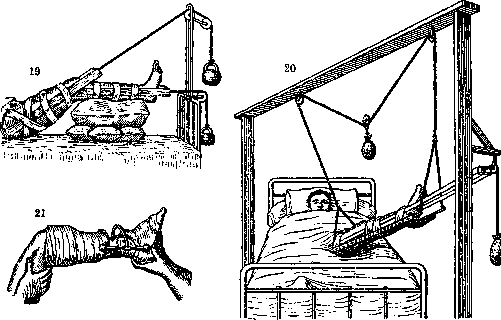
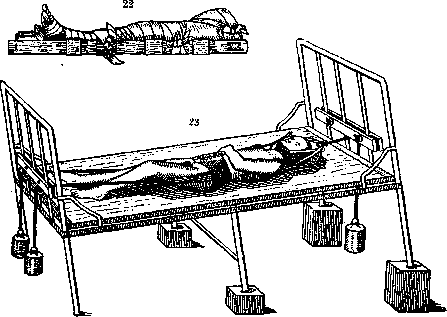
Figure 19. Traction according to Wegier for femoral fractures. Figure 20. Traction and suspension on a "Balkan frame." Figure 21. Distraction brackets of Naschepkin. Figure 22. Transport splint with traction of Liston-Esmarch. Fig. 23. Traction of the spine by the head and pelvis.
opening of the ventilation duct. The draft is provided either by a fan placed in the duct or simply by the movement of air, for which a gas burner is lit in the mouth of the duct. If there are several fume hoods in different rooms, it is disadvantageous to install one central fan, since it is difficult to adapt to changing load conditions, and with
the possibility of drawing harmful gases from one room to another.
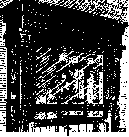
When installing electric fans, it is desirable to place only the blades or the turbine in the exhaust duct, while leaving the motor itself outside, since acidic and caustic vapors quickly destroy the contacts and the winding. In order to protect workers from harmful gases to the maximum extent, it is best to arrange the supply of gas, water, and electricity in such a way that the flow of gas or water can be turned on, regulated, and turned off from the outside, without opening the doors of the hood. For this purpose, the openings for the supply of water and gas and the sockets are located inside the fume hood, while the corresponding valves and switches are on the outside, on the front wall (see figure). For the sake of saving space, it is often very advantageous to use window space for the installation of a fume hood. It is sometimes possible to replace a fume hood to a certain extent with appropriately arranged exhaust openings located directly on the laboratory workbenches. However, maintaining the very strong draft necessary in these cases is only possible under particularly favorable conditions. To test the operation of a fume hood, it is best to use bromine vapors. With the hood working properly, these heavy brown vapors should be completely drawn into the exhaust opening when the door is half-lowered.
V. Engelhardt.
Related articles
Mentioned in
Cite this page
“Fume Hood.” Soviet Medical Encyclopedia. English translation of Bolshaya Meditsinskaya Entsiklopediya, 1st ed. (Moscow, 1928–1936), ed. N. A. Semashko. https://sovietmedicalencyclopedia.pages.dev/article/fume-hood/