Kjeldahl Method
Historical document, translated for reference. It reflects medical knowledge of the 1920s–30s and is not medical advice.
Summary
Description of the Kjeldahl method for the quantitative determination of nitrogen in organic substances, detailing the processes of digestion, distillation, and titration used in medical and chemical laboratory analysis during the 1930s.
Encyclopedia article (1928–1936)
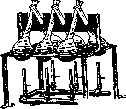
KJELDAHL METHOD (Kjeldahl) for the quantitative determination of nitrogen in organic substances. Principle of the method: 1. All the nitrogen of the organic substance is converted into ammonium sulfate by heating with concentrated sulfuric acid and a catalyst, whereby the organic substance itself is completely destroyed (so-called oxidation, combustion of the substance); in this case, carbon passes into CO2, hydrogen into water, while nitrogen is reduced to ammonia. 2. From the resulting solution, after alkalinization, ammonia is distilled off, which is absorbed by a measured, deliberately excessive volume of titrated acid (ammonia distillation). 3. The acid remaining unbound to ammonia is back-titrated with alkali, by subtraction the amount of titrated acid bound to ammonia is found, and consequently the amount of ammonia or nitrogen (titration). - Scope of application. The Kjeldahl method can be applied directly only to substances containing nitrogen in bonds with H or C. As for nitrates, nitrites, nitro-, nitroso-, azo-, cyano-, and certain other compounds, when heated with sulfuric acid they do not quantitatively convert into ammonia. Therefore, during combustion, reduction by the action of phenol-sulfuric acid, zinc dust, or stannous chloride must be applied to them. The Kjeldahl method is applicable for the determination of both large and very small amounts of N. Accordingly, macro-, micro-, and semi-micro methods are distinguished. The first of them is used if the sample weight of the substance contains more than 14 mg of N. If the amount of N is between 1.4-14 mg, one should switch to the semi-micro method. Finally, in cases where the amount of nitrogen is less than 1.4 mg, one must apply one of the micromethods, and even here there will be a difference in methodology depending on the amount of N: at comparatively large amounts, acidimetric titration and n/100 solutions can be used; at amounts approaching 0.14 mg, iodometry and n/200 solutions present an advantage. Macro-Kjeldahl. Combustion of the substance. A sample weight of 1-2 g of the substance or a corresponding volume of liquid (for urine 5 cm3) is placed in a Kjeldahl flask with a capacity of 100-200 cm3, pear-shaped or round in shape, with a long narrow neck (made of particularly durable glass). Then 0.5 g of CuSO4 and 3 g of powdered K2SO4 are poured in here as well, and 15 cm3 of concentrated sulfuric acid is added. In the case of substances that burn with difficulty, (according to the suggestion of Argutinsky) 25 cm3 of a mixture of sulfuric acid with phosphoric anhydride (200 g of phosphoric anhydride in 1 l of concentrated or fuming H2SO4) and 0.1 cm3 of metallic mercury are taken. After this, the flask is heated on a flame in an inclined position. A number of special stands have been proposed for the convenient heating of several Kjeldahl flasks simultaneously (Fig. 1). The contents of the flasks are boiled until, having darkened strongly at first, they become clear (a pale greenish hue without the slightest yellow tint may remain, which disappears after cooling). This process takes varying amounts of time depending on the substance: for urine it ends in 25-35 minutes, for feces it stretches for several hours. The operation should be carried out under a fume hood. Upon completion of the combustion, the flask is cooled, and if the work has to be interrupted, the flask with the acidic liquid is placed under a bell jar to avoid absorption of ammonia from the air, the edges of which are immersed in diluted sulfuric acid. The distillation of ammonia is carried out either using a standard distillation setup (Fig. 2) or using special
IP3
Figure 1.
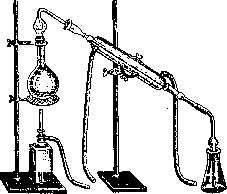
Figure 2.
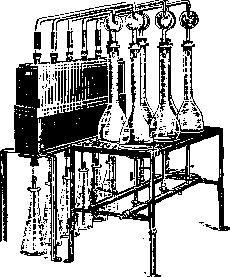
apparatus where several such setups are combined (Fig. 3). The distillation flask has a volume of 600-800 cm3. It is closed with a stopper equipped with a safety tube for trapping alkaline spray (Fig. 4). A preliminary experiment with 5 cm3 of concentrated sulfuric acid determines how much 33% sodium hydroxide is required to neutralize the amount of concentrated sulfuric acid taken for combustion. Usually about 90 cm3 of alkali solution goes to this. For alkalinization of the liquid being distilled, a certain excess (5-10 cm3) of alkali is taken. The contents of the Kjeldahl flask are carefully diluted with water, quantitatively transferred to the distillation flask (total liquid volume is about 300 cm3). Distillation can also be carried out directly from the Kjeldahl flask where the combustion was performed; in this case, the flask must be sufficiently large, specifically with a volume of about 500 cm3. When alkalinizing the liquid intended for distillation, not all the required amount of alkali is poured in at once, but only % of it, to avoid the loss of part of the ammonia from the strongly heated liquid; it is allowed to cool. Meanwhile, 50 cm3 of n/10 titrated acid is measured into the receiver using a pipette.
==£3U
Figure 3. The end of the nozzle that terminates the condenser is immersed into the acid. When the liquid in the distillation flask has cooled, a full teaspoon of powdered talc is poured into it, which is necessary for the uniform boiling of the alkaline liquid, the remaining amount of alkali is poured in all at once, and the flask is immediately connected to the previously carefully assembled distillation apparatus. The liquid in the flask is shaken, whereupon it changes color, and a blue precipitate of copper hydroxide Cu(OH)2 separates out in it, the appearance of which indicates that a sufficient amount of alkali has been added. If mercury was used during combustion, then in addition to alkali and talc, sulfurous alkali, K2S or Na2S, should also be added to the distillation flask, whereupon mercury precipitates in the form of mercuric sulfide. This is necessary for the destruction of strong compounds of ammonia with mercury. It is most convenient with the last portion of alkali to pour in 25 cm3 of a 5% solution of K2S, causing the liquid in the flask to turn black. - Now they begin to carefully heat the liquid and bring it to a strong boil; the liquid must boil evenly, without strong bumping. During proper distillation, the acid should only be sucked into the additional tube of the condenser. Usually all the ammonia can be distilled off within 40-45 minutes.
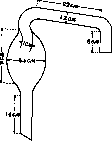
Fig.
Before finishing the distillation, it is necessary for the distillate to wash the interior of the condenser tube into which the liquid from the receiver was sucked; to do this, the supports on which the receiver stood are removed so that the end of the condenser is above the acid. After about 5 minutes, when the condenser has been washed, the distillate is tested for the completeness of ammonia driving off. To do this, the tube of the condenser and the tip are momentarily disconnected, and a red litmus paper is moistened with a drop of the liquid flowing down the condenser; in the event of even a faint blueing of the paper, the distillation is continued for another 15-20 minutes. Titration. Having added a few drops of an indicator (a 1:1,000 alcohol solution of methyl red or a tincture of 3 g of cochineal in 250 cm3 of 25% alcohol) to the resulting liquid, titration is performed with a N/10 solution of sodium hydroxide. A blank experiment must be set up to determine the amount of ammonia contained in the reagents. Usually, the ammonia contained in the reagents binds only 0.1-0.5 cm3 of N/10 acid. Calculation. Suppose that 49.5 cm3 of a N/10 NaOH solution was spent on titration in the blank experiment, and 25.0 cm3 of the same NaOH solution during the analysis. The released ammonia therefore bound an amount of acid corresponding to (49.5-25.0) cm3 of a N/10 NaOH solution. Since 1 cm3 of a N/10 NaOH solution corresponds to 0.001401 g of nitrogen, the amount of substance taken for analysis contained (49.5-25.0) × 0.001401 g of N. The obtained result is converted to percentages. Micro-Kjeldahl can be divided into the following modifications based on the features of distillation. 1) Ammonia is distilled with water by the macro-Kjeldahl type from a digestion flask. In this case, bumping during boiling presents a particular danger. 2) Ammonia is distilled with a stream of steam passing into the Kjeldahl flask from a special steam generator (Bang's method). Working by these methods requires skill, otherwise failures easily occur due to sucking and splashing of the contents of the Kjeldahl flask and receiver. 3) Ammonia is distilled using the aspiration of an air stream. These methods require a considerable amount of time to perform. 4) Ammonia is distilled by boiling the contents of the distillation flask while simultaneously aspirating a stream of air (Pincussen's method); this method is very similar to the one described below, only the connection of the receiver to the apparatus is more complex. 5) Ammonia is distilled using steam in an evacuated system. This method (Parnas) is intended for the determination of very small amounts of ammonia, but in view of the complexity of the apparatus it is hardly convenient for widespread use. Ammonia is distilled by boiling the contents of the distillation flask and passing a stream of air, this being achieved by pumping it in. This method presents certain advantages and consists of the following. Substrate digestion is carried out in Kjeldahl flasks with a capacity of 100 cm3 (sometimes in 50 cm3 flasks). 1 cm3 of concentrated H2SO4 and a few drops (up to 8) of a 10% CuSO4 solution are added to the substrate. However, if protein precipitation in the analyzed liquid was carried out using Bang's reagent, nothing else besides H2SO4 needs to be added, since phosphomolybdic acid acts as a catalyst in its own right. Recently Voit, on the grounds that copper can retain ammonia in solution, proposed using perhydrol for digestion, added in the amount of a few drops once the organic substances have almost burned away and carbon has been released. In addition, to reduce bumping during digestion, it is useful to drop a platinum wire about 1 cm long into the flask. Ammonia distillation is carried out from an apparatus that is very similar to Bang's apparatus (Figure 5), but in which a gasometer 1 is located instead of a steam generator. Air from this gasometer enters the distillation flask through a wash bottle with sulfuric acid in exactly the same way as steam from the steam generator in Bang's apparatus. In addition, the apparatus differs from the macro-Kjeldahl in that alkali can be introduced through funnel 2 while the flask is closed. Before work, the entire apparatus is steamed out. 10 cm3 of water is added to the cooled flask and it is connected to the apparatus. Then, if one wishes to conduct the determination iodometrically,
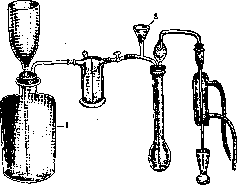
Figure 5.
take a solution of titrated sulfuric acid with added KIO3. This solution is prepared as follows: 10 cm3 of 1/10 normal solution of H2SO4 and 40 cm3 of neutral 1/10 normal solution of KIO3 are measured into a 100 cm3 volumetric flask and diluted with water to the mark. Relative to the sulfuric acid, the solution is 1/100 (centinormal). 2 cm3 of such a solution is measured into the receiver-beaker, and the end of the condenser is immersed in it. 4-5 cm3 of a saturated NaOH solution, decanted from the sediment of soda insoluble in it and consequently free from its admixture, are poured into a measuring cylinder. This amount is brought to 10 cm3 with water, and the resulting solution is carefully introduced from the funnel into the distillation flask by opening the clamp; immediately after that, the stopcock leading to the gasometer is opened, and air is let into the flask at such a rate that the bubbles can be easily counted. A burner is placed under the distillation flask, and the liquid is brought to a strong boil, while a strong stream of cold water is passed through the condenser. Due to the air passed from the gasometer, the liquid boils evenly, and the acid from the receiver is almost not sucked into the condenser; at the same time, ammonia vapors are washed out of the liquid. After 4 minutes, the main mass of ammonia has already been distilled. Lowering the small beaker, the end of the condenser is removed from the liquid of the receiver and the distillation is continued for another one to two minutes, during which drops of the distillate wash the inside of the tube. Ending the distillation, one should test the dripping distillate with litmus paper, then rinse the end of the condenser with a small amount of water from a wash bottle. Titration. To the distillate is added 2 cm3 of a 5% solution of KI not containing free J, or 0.1 g of KI in powder is directly poured in, and the liquid should acquire a brown color from the released iodine (if this does not happen—ammonia has neutralized all the acid, the experiment is spoiled and next time one must take more acid in the receiver or a stronger concentration of it or burn less substance). The reaction of iodine release, proceeding according to the equation 5KI + KIO3 + 6HCl = 6KCl + 3H2O + 6J, does not proceed instantaneously; in addition, the amount of released iodine depends somewhat on the concentration of the substances. Therefore, for the amount of distillate to always be the same, it is important to distill for a certain time, e.g., 5-6 minutes; as for the titration time, it is recommended to perform it 5 minutes after adding KI. After this period, 2-3 drops of a 1% starch solution are added (1 g of soluble starch is heated to dissolution with 10-15 cm3 of water, after which the solution is diluted up to 100 cm3 with a saturated KCl solution; this solution can be used only as long as it gives a pure blue color with a very dilute iodine solution; if a violet color is obtained, the solution is unfit) and titrated with 1/200 normal hyposulfite solution until the blue tint disappears, which does not return during the first minutes. The bluing occurring after 10-15 minutes should be ignored. The hyposulfite solution is prepared immediately before use from its 1/10 normal solution. Simultaneously, a blind experiment is performed under the same conditions that took place during the analysis. Calculation. Suppose that during titration in the blind experiment, 4.16 cm3 of 0.005121 normal hyposulfite was used for 2 cm3 of 1/100 normal acid, and in the main experiment for the same amount of acid, 1.95 cm3 of the same hyposulfite was used; consequently, the distilled ammonia bound the amount of acid corresponding to (4.16-1.95) cm3 of 0.005121 normal hyposulfite, or (4.16-1.95) · 0.005121 cm3 of normal hyposulfite solution. Since 1 cm3 of normal hyposulfite solution in this titration corresponds to 0.01401 g, or 14.01 mg N, the found amount of cm3 of normal hyposulfite solution corresponds to (4.16-1.95) · 0.005121 · 14.01 mg N. Usually, the amount of nitrogen is expressed in mg%. If one wants to determine ammonia not iodometrically, but acidimetrically, then in this case 2-3 cm3 of 1/100 normal HCl is measured into the receiver-beaker and for titration they take 1/100 normal NaOH solution, free from soda, and a solution of methyl red in 90% alcohol (1:10,000). As for the semi-micro method, it is especially applicable in determining the total amount of N in blood and urine; 0.1 cm3 of blood or 1 cm3 diluted 25 times is taken; the determination itself can be performed in an apparatus intended for micro-determination, but only in this case should one take more acid for combustion, more alkali for alkalinization, use 1/50 normal acid in the receiver, distill longer, titrate acidimetrically and with a solution no weaker than 1/50 normal.
Related articles
Mentioned in
Cite this page
“Kjeldahl Method.” Soviet Medical Encyclopedia. English translation of Bolshaya Meditsinskaya Entsiklopediya, 1st ed. (Moscow, 1928–1936), ed. N. A. Semashko. https://sovietmedicalencyclopedia.pages.dev/article/kjeldahl-method/