Kymography
Historical document, translated for reference. It reflects medical knowledge of the 1920s–30s and is not medical advice.
Summary
The kymograph is a physiological instrument used for the graphic recording of biological processes, such as blood pressure, utilizing a rotating drum and smoked paper. This article describes the mechanical components, various methods of rotation, and historical advancements in recording techniques, including photographic recording and endless strip devices.
Encyclopedia article (1928–1936)
KYMOGRAPHY, kymograph (from the Greek kyma - wave and grapho - I write), a method and instrument based on the use of moving surfaces for the purpose of graphic recording. Ludwig in 1847 first introduced graphics into physiological methodology for the purpose of recording blood pressure, which constituted an epoch in its development. Ludwig's kymograph consisted of a drum covered with smoked paper, rotating by means of a clockwork mechanism, combined with a mercury manometer with a float (Fig. 1). Modern kymographs represent a significant improvement on this basic
principle of rotation
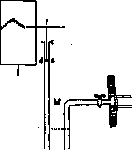
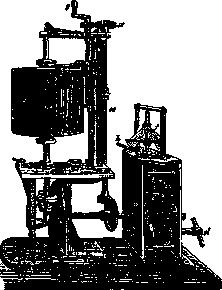
(Fig. 2). The drum must rotate at a uniform speed past the recording pen. Depending on the design of the kymograph, a wound spring, a falling weight, a water turbine, or an electric motor can be used to rotate the drum. To monitor the uniformity of the drum's rotation, a time curve is simultaneously recorded using an electromagnetic marker or a Jaquet chronograph. The rotation speed of the drum is regulated either by special vanes of different sizes, placed on one of the axes of the clockwork mechanism, or by changing the transmission distance to the center of the drum's rotation. For faster rotation (recording the contraction of striated muscles, etc.), kymographs rotated by a falling weight (Fallrotatorium, Fick's Myographion) or an electric motor are used. Figure 1. Ludwig's kymograph (diagram): M - mercury manometer; ds - float; l - recording pen. Figure 3 shows an image of the Ludwig-Baltzar kymograph, where the purpose of the individual parts is visible. On the right in the figure, the clockwork mechanism is visible, wound by key si; f - Foucault vane for regulating speed
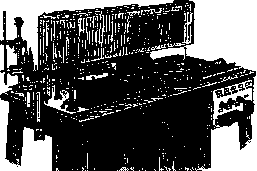
Figure 2. Improved kymograph with a long strip. and uniformity of motion; h - lever for starting the mechanism; r - transmission, moved to change the rotation speed. By means of the se and d device, the drum automatically lowers as it rotates, and thus a spiral recording is obtained, eliminating the need to stop the drum each time and move the writing pen. In the Marey kymograph, there is an automatically moving carriage with a stand for the writing pen for this purpose. Most kymographs can be moved from a vertical to a horizontal position. Surface
surface.
for recording on the drum is usually a stretched and glued glossy smoked paper (smoking is achieved by passing the paper-covered drum over the flame of a kerosene lamp or gas burner in special installations). The latter method allows for more uniform smoking of the paper (Figure 4). Recently, abroad, kymographs with photographic recording on a strip of light-sensitive paper have become widespread. This method is used successfully when recording very fast movements (e.g., the string in an electrocardiograph) or very weak ones, when the friction from the touch of the pen to the smoked paper can distort the appearance of the curve. Hering proposed a special device for increasing the recording surface to two or more meters, which consists of using an additional roller (counter-cylinder; Fig. 5).
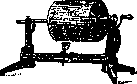
Figure 4. Device for
smoking kymographic drums using a gas burner.
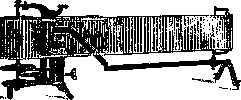
Figure 5. Kymograph (according to Hering) with a counter-cylinder, thanks to which the length of the strip is increased to 2 m.
There is also a very convenient device for an endless strip (Fig. 6), which was proposed by Ludwig. It consists of an additional stand P, which unrolls a roll of spare paper as the drum rotates. In this method, parchment paper is used, on which the recording is made with ink using special pens. Figure 6. Ludwig's device for the kymograph for lengthening the strip. Smoked strips are usually fixed in a shellac solution, with 10 parts of shellac dissolved by heating in 100 parts of 90° alcohol with the addition of a few drops of glycerin.
Related articles
Mentioned in
Cite this page
“Kymography.” Soviet Medical Encyclopedia. English translation of Bolshaya Meditsinskaya Entsiklopediya, 1st ed. (Moscow, 1928–1936), ed. N. A. Semashko. https://sovietmedicalencyclopedia.pages.dev/article/kymography/