THERMOELECTRICITY
Historical document, translated for reference. It reflects medical knowledge of the 1920s–30s and is not medical advice.
Summary
This article explains the principles of thermoelectricity, including thermoelements and their applications in temperature measurement and physiological research. It describes how thermoelectric currents are generated when junctions of different metals are heated to different temperatures.
Encyclopedia article (1928–1936)
THERMOELECTRICITY, THERMOELEMENT. A system of glass tubes filled with mercury. When heated, the mercury expands in volume, closing the opening through which gas passes, thereby reducing its supply to the burners. Gas thermostats are equipped with a metal thermostat consisting of two plates joined together: zinc and brass. Due to the different coefficients of expansion of these metals when heated, the plate bends and closes the opening through which the gas passes. When cooled, the plate straightens, allowing gas to pass. Kerosene thermometers are usually regulated by thermostat pads, which, expanding through a system of levers, cover the lamp glass opening with a metal cup, reducing oxygen access and decreasing the lamp flame. The main requirement for a thermostat is the constancy of its action, not allowing temperature fluctuations of more than one degree.
A. Nikolsky. THERMOELECTRICITY. THERMOELEMENT. Let us consider a circuit of two metals (Fig. 1): copper Cu and iron Fe, joined at points A and B. Let junction B be at the temperature of the surrounding atmosphere, and junction A be heated by a Bunzen burner K. A current appears in the circuit, the direction of which is shown by the arrows in the figure. This current is called thermoelectric. Copper is said to be positive with respect to iron, and iron is negative with respect to copper. For some pairs of metals, the current increases with heating, but in most cases, at a certain temperature, the direction of the current changes. For example, in the iron-copper pair, the current reaches a maximum at 274°C, then it decreases, becomes zero, and finally changes direction, with copper becoming negative with respect to iron. The electromotive forces arising in the above thermoelectric phenomena are small. We can increase them by connecting individual thermoelectric pairs in series (Fig. 2), and the electromotive force of such a complex battery, heated at A and maintained at room temperature at B, is equal to the sum of the electromotive forces of its individual parts. One of the largest electromotive forces belongs to the bismuth-antimony pair; it is equal to 0.000057 volts per 1°, and between 0° and 100° the potential difference is approximately proportional to the temperature difference of the two junctions.
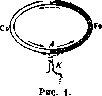

Figure 2.
The electromotive force of such a complex battery, heated at A and maintained at room temperature at B, is equal to the sum of the electromotive forces of its individual parts. One of the largest electromotive forces belongs to the bismuth-antimony pair; it is equal to 0.000057 volts per 1°, and between 0° and 100° the potential difference is approximately proportional to the temperature difference of the two junctions. The Clement battery, which served for a long time for practical purposes and consisted of 120 thermoelectric pairs, with a resistance of 3.2 ohms, gave a voltage of 8 volts. Heating was achieved by gas, the consumption of which was about 180 liters/hour. The coefficient of efficiency is about 1/100. Thermoelectric currents are obtained in homogeneous metals if their uniformity is disrupted by twisting the wire. For example, in a platinum wire twisted into a spiral and heated at point A, a current arises flowing along the arrows (Fig. 3). Thermoelectric batteries were used to obtain currents in technology. In recent times, thermoelements are widely used for temperature measurement. For high temperatures, a pair consisting of platinum and a platinum-rhodium alloy is used. The wire is introduced in an insulated manner using a quartz tube into the space where the temperature is measured. The current from

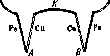
Figure 3.
Figure 4. is read on a galvanometer calibrated by immersing the thermoelement in metals with known melting temperatures. For physiological purposes, a thermoelectric needle is often used, consisting of thin wires of iron (Fe) and constantan (Cu) (Fig. 4). If points A and B are at different temperatures, the current generated in the circuit is proportional to this difference. To measure temperature, point B is maintained at a constant temperature, and the other point A is applied to the place being studied; with the help of a battery consisting of a series of separate needles, it is possible to determine the heating during a single muscle contraction. A similar device was recently applied by Hill to measure heat production in muscles. Thermoelectric devices are often used to measure energy in the spectrum and are of great importance in physiological optics. For these measurements, one group of junctions A is placed under light rays, while the other is in a dark space and has the temperature of the surrounding air. To calibrate the apparatus, junctions A are illuminated by rays having a certain energy, for example, rays of a black body or a Hefner lamp.
Related articles
Cite this page
“THERMOELECTRICITY.” Soviet Medical Encyclopedia. English translation of Bolshaya Meditsinskaya Entsiklopediya, 1st ed. (Moscow, 1928–1936), ed. N. A. Semashko. https://sovietmedicalencyclopedia.pages.dev/article/thermoelectricity/