Thermoesthesiometers
Historical document, translated for reference. It reflects medical knowledge of the 1920s–30s and is not medical advice.
Summary
Thermoesthesiometers are instruments used for the precise investigation of temperature sensation in clinical neurology and diagnostics. The article describes several historical models, including those by Roth, Goldscheider, and Eulenburg, detailing their mechanisms and application techniques for testing cold and heat sensitivity.
Encyclopedia article (1928–1936)
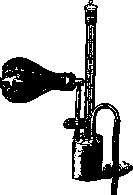
THERMOESTHESIOMETERS, instruments for the precise investigation of temperature sensation. In Russian clinics, the thermoesthesiometer by Prof. Roth (Fig. 1) is the most widely used. The instrument consists of a hollow metal cylinder into which a thermometer and two metal tubes are inserted. A pump is attached to one tube, and a rubber tube to the other. The latter is immersed in a vessel of water at the desired temperature. The water pumped into the instrument has its temperature indicated by the thermometer. The instrument is applied by its base to the skin, thus determining the sensitivity of the skin surface to the temperature of the instrument. Then the water is pumped out and replaced with water of a different temperature, the sensitivity to which is again determined by applying the instrument.- For a more precise study, it is best to use
Figure 1.
two Roth thermoesthesiometers filled with water having a difference of 6-7°. Having ascertained that the subject can distinguish these temperatures, cold water is added to the thermoesthesiometer in which the temperature was higher, thus reducing the temperature difference between the two. Through successive procedures, the smallest temperature difference perceived by the subject is established and compared with normal figures for temperature sensitivity from Nothnagel's table. A healthy person distinguishes a temperature difference of 1° everywhere. Goldscheider's thermoesthesiometer consists of a solid metal cylinder with a base of 1 cm2, equipped with an ebonite handle. To obtain an extreme temperature, the cylinder is immersed in cold water or heated over a fire. The instrument is applied to various parts of the body having both equal and different temperature sensitivities. For cold sensitivity, the areas, according to Goldscheider, are distributed according to a 12-point system, and for heat sensitivity, according to an 8-point system. The subject compares the sensations produced by the instrument in various areas and determines whether they are identical in the studied area to the sensitivity of spots of the same points, whether they are weaker compared to spots of highest sensitivity, and stronger compared to points of lowest sensitivity. - Eulenburg's thermoesthesiometer consists of two thermometers mounted on a rubber plate (Fig. 2). The thermometer attached to the
edge is stationary, while the second moves freely.
The stationary
thermometer is wound
with platinum wire
through which a current
from an electric power
source is passed. The
moving
thermometer is set
on the skin and shows
its temperature. Then the stationary
Figure 2
one is heated to a temperature one degree below the skin temperature. It is applied to the skin to ascertain whether it is felt as colder. Or, conversely, the stationary one is overheated to 1/2-1-11/2° higher than the skin temperature, and it is determined whether it is felt as warmer. Thus, the ability to distinguish the difference between the skin's own temperature and the temperature of an object is ascertained. Bekhterev pointed out the need to invent an instrument that would not touch the skin in order to avoid the sensation of touch, but such an instrument has not yet been proposed.
M. Neidish1.
Related articles
Mentioned in
Cite this page
“Thermoesthesiometers.” Soviet Medical Encyclopedia. English translation of Bolshaya Meditsinskaya Entsiklopediya, 1st ed. (Moscow, 1928–1936), ed. N. A. Semashko. https://sovietmedicalencyclopedia.pages.dev/article/thermoesthesiometers/