Bauer Qualimeter
Historical document, translated for reference. It reflects medical knowledge of the 1920s–30s and is not medical advice.
Summary
The Bauer Qualimeter is an instrument designed to determine the quality of rays in superficial and medium-depth radiotherapy, operating on the principle of an electroscope. It allows for assessing the consistency of tube operation at any moment.
Encyclopedia article (1928–1936)
Bauer Qualimeter (Bauer), for determining the quality of rays in superficial and medium-depth radiotherapy, is constructed on the principle of an electroscope. It consists of an ebonite cylinder through the center of which passes a fixed vertical metal axis. Inside the cylinder, horizontally to the axis, are attached two metal disks, one of which is fixed, while the other rotates around the axis and
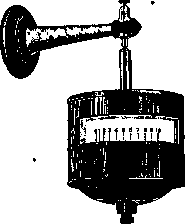
has a pointer. The cylinder axis is connected to the cathode of the tube, and, when current passes, the plates, being charged with electricity of the same sign, begin to repel each other, whereby the pointer, attached to one of the plates, deflects by a larger or smaller angle, the magnitude of which is judged by the numbers present on the instrument scale. Each division of the scale shows in tenths of a millimeter the thickness of the lead plate through which the given X-rays pass. This instrument is not entirely precise, but is very convenient in that it allows one at any moment to judge the consistency of the tube's operation.
Related articles
Cite this page
“Bauer Qualimeter.” Soviet Medical Encyclopedia. English translation of Bolshaya Meditsinskaya Entsiklopediya, 1st ed. (Moscow, 1928–1936), ed. N. A. Semashko. https://sovietmedicalencyclopedia.pages.dev/article/bauer-qualimeter/