Waldenburg Apparatus
Historical document, translated for reference. It reflects medical knowledge of the 1920s–30s and is not medical advice.
Summary
The Waldenburg apparatus is a gasometer used for breathing compressed or rarefied air. It consists of two metal cylinders, one inside the other, and allows for controlled pressure changes to treat patients.
Encyclopedia article (1928–1936)
WALDENBURG APPARATUS (Waldenburg), applied for breathing compressed or rarefied air. The Waldenburg apparatus is a gasometer consisting of two metal cylinders. A second (upper) cylinder (with a diameter of 27 cm), open at the bottom, is lowered into the lower cylinder, filled with water, with a height of 1 m (diameter 30 cm); the latter is suspended on three blocks and slides freely up and down. Cords are thrown over the blocks, attached at one end to the upper cylinder; a weight is suspended at the other end of the cords. Two tubes are attached to the lid of the upper cylinder; one is connected to a mask covering the nose and mouth, the other to a mercury manometer showing the pressure inside the cylinder. The upper cylinder has a scale with divisions indicating the content of air in the cylinder. At the bottom of the lower cylinder there is a tap for releasing water and a water gauge tube is fixed. A tap is fixed on the mask, when the tap is turned the mask is connected to the cylinder or to the outside air. Filling the apparatus with air occurs with the tap open by raising the upper cylinder, due to the increase in weight on the cords. With the tap closed and a weight placed on the upper cylinder, a higher pressure is obtained inside the cylinder, determined by the manometer. Putting on the mask and opening the tap, one inhales compressed air slowly and deeply, after turning the tap one exhales into the surrounding air and so on. To obtain rarefied air, the inner cylinder is lowered as deep as possible with the tap open, and then, closing the tap, the weight on the cords is increased and the upper cylinder is raised. The degree of rarefaction is determined by the manometer. Through the mask one inhales from the surrounding air and after turning the tap exhales into the rarefied air of the cylinder. For indications and contraindications for treatment with compressed and rarefied air, see Pneumotherapy.
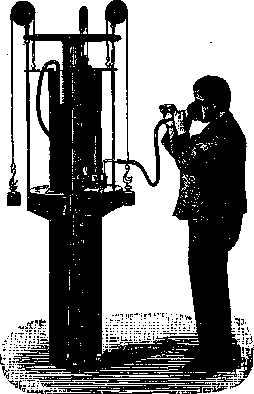
The Waldenburg apparatus is a gasometer consisting of two metal cylinders. A second (upper) cylinder, open at the bottom, is lowered into the lower cylinder, filled with water, with a height of 1 m (diameter 30 cm); the latter is suspended on three blocks and slides freely up and down. Cords are thrown over the blocks, attached at one end to the upper cylinder; a weight is suspended at the other end of the cords. Two tubes are attached to the lid of the upper cylinder; one is connected to a mask covering the nose and mouth, the other to a mercury manometer showing the pressure inside the cylinder. The upper cylinder has a scale with divisions indicating the content of air in the cylinder. At the bottom of the lower cylinder there is a tap for releasing water and a water gauge tube is fixed. A tap is fixed on the mask, when the tap is turned the mask is connected to the cylinder or to the outside air. Filling the apparatus with air occurs with the tap open by raising the upper cylinder, due to the increase in weight on the cords. With the tap closed and a weight placed on the upper cylinder, a higher pressure is obtained inside the cylinder, determined by the manometer. Putting on the mask and opening the tap, one inhales compressed air slowly and deeply, after turning the tap one exhales into the surrounding air and so on. To obtain rarefied air, the inner cylinder is lowered as deep as possible with the tap open, and then, closing the tap, the weight on the cords is increased and the upper cylinder is raised. The degree of rarefaction is determined by the manometer. Through the mask one inhales from the surrounding air and after turning the tap exhales into the rarefied air of the cylinder. For indications and contraindications for treatment with compressed and rarefied air, see Pneumotherapy.
The Waldenburg apparatus is a gasometer consisting of two metal cylinders. A second (upper) cylinder, open at the bottom, is lowered into the lower cylinder, filled with water, with a height of 1 m (diameter 30 cm); the latter is suspended on three blocks and slides freely up and down. Cords are thrown over the blocks, attached at one end to the upper cylinder; a weight is suspended at the other end of the cords. Two tubes are attached to the lid of the upper cylinder; one is connected to a mask covering the nose and mouth, the other to a mercury manometer showing the pressure inside the cylinder. The upper cylinder has a scale with divisions indicating the content of air in the cylinder. At the bottom of the lower cylinder there is a tap for releasing water and a water gauge tube is fixed. A tap is fixed on the mask, when the tap is turned the mask is connected to the cylinder or to the outside air. Filling the apparatus with air occurs with the tap open by raising the upper cylinder, due to the increase in weight on the cords. With the tap closed and a weight placed on the upper cylinder, a higher pressure is obtained inside the cylinder, determined by the manometer. Putting on the mask and opening the tap, one inhales compressed air slowly and deeply, after turning the tap one exhales into the surrounding air and so on. To obtain rarefied air, the inner cylinder is lowered as deep as possible with the tap open, and then, closing the tap, the weight on the cords is increased and the upper cylinder is raised. The degree of rarefaction is determined by the manometer. Through the mask one inhales from the surrounding air and after turning the tap exhales into the rarefied air of the cylinder. For indications and contraindications for treatment with compressed and rarefied air, see Pneumotherapy.
Related articles
Cite this page
“Waldenburg Apparatus.” Soviet Medical Encyclopedia. English translation of Bolshaya Meditsinskaya Entsiklopediya, 1st ed. (Moscow, 1928–1936), ed. N. A. Semashko. https://sovietmedicalencyclopedia.pages.dev/article/waldenburg-apparatus/