Bloodletting
Historical document, translated for reference. It reflects medical knowledge of the 1920s–30s and is not medical advice.
Summary
Bloodletting is the artificial rapid removal of significant amounts of blood from the circulatory system through venesection, venipuncture, arteriotomy, or artery puncture. This article discusses its historical use, therapeutic applications, physiological effects, and mechanisms of action.
Encyclopedia article (1928–1936)
BLOODLETTING, artificial rapid removal of significant amounts of blood from the circulatory system by means of venesection, venipuncture, arteriotomy, or artery puncture. For therapeutic purposes, B. is usually performed with the removal of 200-500 cm3 of blood. However, some authors apply repeated small bleedings with intervals of 3-7 days, while in acute cases others resort to very large single bleedings—up to 1 liter. History. Bloodletting is the oldest therapeutic measure, from which practical medicine has not abstained throughout its development. However, interest in this method, as well as the breadth of indications for its application, fluctuated within very wide limits. In this sense, the history of B. and its justification, as it were, reflected in itself most stages in the development of therapeutic thought, resp. of all medicine. In Greek and Arabic medicine, one can find indications of extremely broad indications for bloodletting, which was perhaps the main of the few therapeutic measures of physicians of that era. There are records of the use of bloodletting by Polydarius, son of Aesculapius, in 1184 B.C. Bloodletting was used no less widely in the Middle Ages and even at the beginning of the flourishing of modern medicine (end of the 18th and beginning of the 19th century). Sydenham and then Rokitansky also widely recommended bloodletting, as they believed that by means of bloodletting, those poisonous substances (materia peccans of ancient authors) are removed from the body, which are the cause of suffering, especially in acute diseases. In the second half of the 19th century, in many advanced clinics of Western Europe (Nothnagel, Gerhardt) and in Russia (Botkin), a natural reaction arose against the indiscriminate 'vampirism,' all the more so because the then prevailing localist understanding of the essence of diseases—organopathology of Virchow, as well as the subsequent bacteriological era—put into question the therapeutic meaning of B.: it seemed that there was and could be no scientific justification for this crude empirical, 'non-physiological' method. Only at the beginning of the 20th century, in connection with the development of pathophysiology and the application in the clinic of data from experiments, the effect of B. received some scientific justification, and the indications for its application were more precisely defined. This was also facilitated by the return of the clinic to the path of intensive study of the body as a whole and the exceptional attention paid in recent years to the transport role of blood and the circulatory system in intermediate metabolism. Mechanism of action of B. The effect exerted by B. cannot be considered only purely hydrodynamically as the removal of a certain amount of liquid from a closed circulatory system. Since blood includes products of the life activity of all organs and tissues, the removal of significant quantities of it (V10-V20 of the total mass of circulating blood) entails a subsequent reaction in the form of enhanced exchange phenomena between blood and lymph on the one hand and tissues on the other. In B. one should therefore distinguish the effect of B. on circulation, in particular on blood pressure (arterial, venous, and capillary), and the effect on intermediate metabolism. In the circulatory system, the acute artificial removal of significant quantities of circulating blood from the venous bed entails a fall in venous pressure by 10-20% of the original value, which leads to an increase in the difference between art. and venous pressure, resp. between the height of pressure in the left ventricle and the right atrium. Such an effect from B. is a moment that undoubtedly promotes circulation, which in turn favorably affects both the magnitude of the systolic volume and the force of cardiac contraction. Naturally, such a mechanical action of B. appears therapeutically most valuable in cases of cardiovascular insufficiency (see below clinical indications). The observed fall in venous pressure after B. is reflected shortly (after several minutes) also in a fall in the magnitude of arterial blood pressure. The decrease in blood pressure under ordinary conditions lasts for 2-8 hours, after which blood pressure returns to its original value. In pathological conditions, especially in hypertension, one can observe both a more prolonged decrease in art. pressure (in essential forms of hypertension) and, conversely, an extremely short-lived effect (1/2-2 hours) (in the final stages of arteriolosclerosis). In normal people, the fall in blood pressure is significantly less than in pathological cases. It amounts to 8-10 mm of mercury and thus fluctuates within 6-8% of the original value; in patients, however, a fall in art. pressure by 20-30% of the original is often noted. This applies especially to the magnitude of maximum pressure. Along with the change in blood pressure, B. entails a number of significant shifts in the chemical and morphological composition of blood. These changes arise, of course, not in the blood itself, but as a result of the disturbance of equilibrium in the extremely labile system caused by B.—the hemolymphatic apparatus—tissues—excretory organs—and of accelerated exchange between blood and tissues. The first and most constant consequence of B. should be recognized as the thinning of the blood—hydremia. It is caused by the influx into the blood from tissues of large amounts of water (up to 15% of the original amount). The incoming water helps restore the normal volume of blood. However, at the present time we know that the amount of circulating blood can, if necessary, increase also due to blood depots (see Circulation). Furthermore, the typical effect from B. already occurs when removing 50-100 cm3 of blood in humans, while the degree of hydremia is by no means proportional to the amount of blood released. All this testifies to the fact that the physiological essence of the hydremic reaction should be sought in other factors, at the present time still not clarified. The place of transition of water from tissue to blood is undoubtedly the capillaries. However, the mechanisms that which bring about the described rapid influx of water into the blood after B. remain not entirely clear to this day. Despite hydremia after B., the blood nevertheless quite persistently maintains the constancy of its osmotic pressure. This is probably explained by the regularly observed hyperchloremia after B., i.e., the increased content of NaCl in the blood (fig. 2). The enhanced entry from tissues of NaCl and many normal and pathological products of metabolism (urea, uric ,<№8.
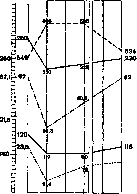
22,5
blood pressure -----------
dry residue in % Figure 1 and 2. Changes in the chemical composition of blood after bloodletting. 1-ordinary reaction. 2-abnormal reaction in nephrosclerosis (observation by Vovsey, Bagon and Itsikson). acid, indole, anions), as well as the introduction of dyes parenterally, indicates the profound effect of bloodletting on metabolism and gives some indication of the direction in which one must look for an explanation of the therapeutic effect of K. Thus, Endres observed a 20% increase in residual nitrogen (RN) in the blood after K.; Bauer described significant hyperazotemia and an increase in uric acid content in the urine. K. also has a definite effect on the physicochemical properties of blood. Blood viscosity, as well as its clotting time, significantly decreases (by 10-30% of the original). Klein and Rischawy noted a decrease in the alkaline reserve by 10-12 Vol. % CO2; Feilchenfeld observed the appearance of phenolsulfonephthalein in the urine after K. a day after a negative Rowntree test on excretion, and Nussbaum saw in a dog after K. a 25-fold increase in the excretion of indigo carmine with urine. All the above chemical changes in the blood after K. are transient in nature, and within 1-2 days the blood composition in normal people returns to the original. However, it should be noted that the shifts in the chemical composition of the blood are more constant and stable than the fluctuations in blood pressure observed after K. K. also affects the blood-forming organs. In the peripheral blood, this effect manifests as leukocytosis and the appearance of nucleated red blood cells. Some authors observed a decrease in the amount of Hb without a change in the number of red blood cells, which they tend to attribute to the entry of a large number of young red blood cells into the blood (stimulation of the bone marrow). Along with objective results, patients, especially hypertensives, as a rule, note a number of favorable subjective sensations, such as: disappearance of headaches and a feeling of pressure in the head and behind the sternum, paresthesias in the extremities, as well as a general feeling of vigor and freshness. In acute cases, shortness of breath and cyanosis (in pneumonia and decompensation) decrease, consciousness becomes clearer (in uremia, poisoning by toxic gases).- In pathological cases, atypical results of bloodletting are often noted. Thus, in uremias and in arteriolosclerosis of the kidneys, a shift in blood pressure is often not observed at all, or it is very short-lived. In these cases, there is also no characteristic hyperchloremia after K. (Vovsey, Bagon and Itsikson) (Fig. 1). It is interesting to note that clinically in these patients there is no clearly expressed improvement in condition after K. In a number of cases, on the contrary, a prolonged (torpid) reaction to K. is observed, manifested by a slow return to normal of both blood pressure and the chemical composition of the blood (lengthening of the hydremia phase). These deviations are probably due to the loss by the vessel walls of their normal tone and structural changes in them, due to which the vessels lose their ability to quickly adapt to new conditions, in particular after K. K. is one of the most valuable therapeutic means inherited by modern medicine from its founders. The indications for the use of K. acquire scientific justification thanks to the latest physiological data on the mechanism of its action. The value of bloodletting, as well as the breadth of its application, by no means should be diminished by the fact that many representatives of modern medicine, imbued with vitalism and mysticism, want to see in it an incomprehensible "means of renewing the organism", in other words, they want to return the concept of K. back to Galen's teaching about the removal of materia peccans from the organism (Aschner).:-Based on the effect of K. on blood pressure, hematopoiesis and metabolism, several groups of indications for K. can be established. 1. Increased venous pressure in cardiovascular insufficiency due to heart defects, pneumonia, emphysema. The symptoms indicating K. in this case are severe cyanosis, pulmonary edema, "positive" venous pulse and other symptoms of severe congestion. 2. Arterial hypertension of various origins; a particularly favorable effect is observed in cases with initial arteriolosclerosis, where changes in the vessels have not yet led to a complete loss of their ability to adapt. In such cases, systematic repeated K. of 200-400 cm3 of blood with intervals of 1-2 months, depending on subjective and objective clinical data, is indicated. Such treatment also has preventive value in terms of preventing the often observed strokes in such patients. On the question of indications for K. after apoplectic stroke, there is no unity of views. In the acute period after a stroke, the fluctuations in pressure observed after K., in the opinion of many authors, are hardly desirable, which is why many refrain from K. during this period (See also Apoplexy.) 3. Uremic and pre-uremic states, both eclamptic and azotemic. The pathogenesis of these conditions cannot be considered fully clarified, however, the generally recognized clinical experience and the data provided on the enhanced entry of nitrogenous metabolic products and NaCl from tissues after K. are sufficient to justify K. in uremia (see more under Uremia). 4. In eclampsia of pregnancy, K. also has a very favorable effect, and many insist on abundant K. in this condition (up to 1 l, Zweifel). 5. Polycythemias show significant improvement after K., since it is one of the few means of reducing blood viscosity, which is extremely high in this disease. 6. Poisoning by toxic gases (illuminating gas, carbon monoxide). In these cases, K., along with the introduction of physiological solutions, contributes to the faster removal of gaseous poisons from the body.-On the technique of K.:-see Venesection.
Related articles
Mentioned in
Cite this page
“Bloodletting.” Soviet Medical Encyclopedia. English translation of Bolshaya Meditsinskaya Entsiklopediya, 1st ed. (Moscow, 1928–1936), ed. N. A. Semashko. https://sovietmedicalencyclopedia.pages.dev/article/bloodletting/