Baths (premises serving to apply the effects of heated)
Historical document, translated for reference. It reflects medical knowledge of the 1920s–30s and is not medical advice.
Summary
This article from the 1928–1936 Great Medical Encyclopedia discusses the history, types, and hygienic significance of baths from antiquity to the Soviet era, detailing Roman and Russian bath traditions.
Encyclopedia article (1928–1936)
BATHS, premises serving to apply the effects of heated air (either dry or saturated with superheated steam) to the organism, with simultaneous washing of the body with water (with or without soap) at various temperatures, as well as the use of steam bathing and skin friction. Monuments of ancient cultural peoples indicate the use of ablutions, bathing, and baths either to free the body from contamination and restore strength or as a therapeutic measure (India, Egypt; Jews, Arabs, and other Eastern peoples). In Greece, as monuments of the Mycenaean culture and excavations on the island of Crete show, baths existed. In Homer's Iliad and Odyssey there are indications of the use of ablutions and baths; Herodotus, Plato, and Aristotle mention baths that spread in Greece after the Trojan War, and the Greeks, attributing the invention of baths to the Lacedaemonians, named their baths "laconicon"; Plato proposed to establish the existence of baths as public institutions by special legislation; Hippocrates and other physicians considered baths a powerful therapeutic agent. Some Greek baths were adapted for public use (Sparta) and consisted of a dressing room, a steam bath, and a room with a pool of cold water. Among the Romans, baths attained the greatest distribution, along with convenient and luxurious equipment, compared to other nations. In Rome itself there were public and private baths. Since the time of Pompey, almost every quarter and street had its public bath. Patricians and people of middle means had their own baths (balnearium) or bath compartments. The most extensive and luxuriously equipped were the baths (thermae) of Caracalla, Agrippa, Hadrian, and Diocletian. In these baths, compared by the historian Marcellinus to villages and towns, there were whole streets, squares, extensive gardens, porticoes and terraces, libraries, and a huge number of buildings and services. In the gardens and on the terraces, people listened to singers, musicians, orators, and poets; on the squares, public games took place, and works of art and luxury items were sold. The baths (thermae) of Diocletian had 3,000 baths, three large swimming pools, and were built, according to the testimony of Baronius, by 3,000-4,000 workers over the course of approximately 5 years. The flourishing of bath construction and their use continued until Emperor Constantine, during whose reign the Christian Church forbade its members baths as a sinful matter of body cult and as institutions violating morality, which was subsequently one of the factors in the decline of personal and public hygiene among Christian peoples. Only upon the return of the crusaders from the East, where they became acquainted with baths, did the latter again come into use in Europe. In the 15th and 16th centuries, private and public baths were already widespread; however, public baths at this time not infrequently bore the character of places of debauchery and served as foci for the spread of various diseases, including venereal ones. In 1569, at the insistence of church authorities, baths began to be universally closed again; only in the 19th century did baths, being borrowed from Russia, appear again in Western Europe. Regarding the character of baths in ancient Russia, there is an indication in the Primary Chronicle (Chronicle of Nestor), which attributes the following words to the Apostle Andrew the First-Called, who visited the Slavic lands: "...I saw wooden baths and they will heat them exceedingly, and they will strip off and be naked, and pour a lye over themselves, and take branches and begin to beat themselves, and they will beat themselves so that they barely crawl out alive, and pour cold water over themselves, and thus they do every day, tormented by nothing, but tormenting themselves..." As for public baths in ancient Russia, the Statute of Grand Duke Vladimir in 996 mentions that the Caves monks began to set up baths at "establishments for the infirm"; in 1091 Bishop Ephraim established baths at monasteries. During the time of the grand dukes and tsars, the bath was an integral part of court life and, besides ordinary weekly baths, the latter was considered necessary at weddings. Municipal commercial baths, farmed out to private individuals, are already mentioned in the 17th century in the Code of Tsar Alexei Mikhailovich. In the 18th century, medical baths ("baderskve") arose—for example, in St. Petersburg (Johann Lehmann, 1760)—where the following were used: "external methods for inducing sweat, bloodletting by cups, leeches, and veins"; such baths in the course of time turned into ordinary commercial baths. At the present time, the most widespread are two main types of baths (with transitional forms): I. The Roman bath—a type of bath that arose in the East, penetrated from there to the Romans, was adopted by the Turks, and subsequently accepted in Ireland (with improvements regarding, chiefly, ventilation); because of this, the Roman bath is also called the Romano-Irish and Turkish. A person washing in a Roman bath, while under the influence of a gradually increasing temperature of the air coming through special channels from the central heating furnace, undergoes sweating, followed finally by wiping away the sweat and a cool dousing of the body or shower. In accordance with this principle, the Roman bath is arranged so that in the dressing room (frigidarium among the Romans) the air has a temperature of 19–20°, in the warm sweating room (tepidarium) 35–40°; sweating is produced first in the warm sweating room for 25–40 minutes, then in the hot one (sudatorium) at a temperature of 45–50° for 15–20 minutes.—II. The Russian bath, in which the bather is all the time exposed to the action of hot air saturated with hot water vapor, washing at the same time with hot water or alkali with soap, rubbing the body with a sponge, washcloth, coarse cloth, etc., and sometimes subjecting themselves at the same time to massage or steaming with a hot birch broom. Varieties of the Russian bath are as follows: 1. Steaming in stoves is widespread in the peasant life of certain regions of the RSFSR; for this, an ordinary spacious Russian stove is used, well heated, after, for example, baking bread (the person wishing to steam climbs into the stove feet first, taking with him a pot of water and a birch broom soaked in hot water, with which, after splashing water and turning it into steam in the stove, he produces the steaming of the body). 2. The black bath, usually consisting of a single room with a stove and an anteroom (dressing room) without a stove; the room designated for washing has: a) a stove without a chimney with the smoke exiting into the bath, the windows of which are left open during stoking; b) a heater, consisting of a pile of river stones (or bricks) placed over the vault of the stove mouth, becoming red-hot during stoking and producing a large amount of hot steam when water is thrown on them; c) a polok—an elevation in the form of a platform having several... [The text breaks off]. Since the October Revolution, baths, for the most part municipalized and under the jurisdiction of communal departments, differ in larger size, technical installations (water supply, ventilation, sewage disposal) and have a dressing room, sometimes a hairdresser, a washroom, a steam room with a stove, various systems of showers, and sometimes a swimming pool.
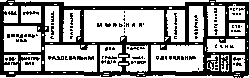
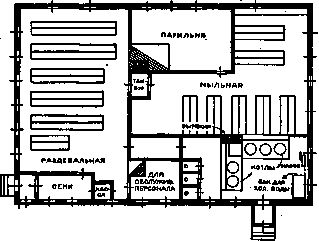
Figure 1. Plan of a public bath.
of the wooden steps, usually located near the heater and, consequently, in the zone of highest temperature and steam accumulation. 3. Urban domestic bathhouses with white heating, i.e., with smoke flues leading outside. 4. Public "commercial" Figure 2. Pass-through type bathhouse. for the simultaneous bathing of a significant number of people (see Figure 1). "Commercial" bathhouses are arranged as general and as family, private rooms, for individuals or small groups of bathers. 5. Special-purpose bathhouses: a) field dugout bathhouses and portable bathhouses; b) pass-through type bathhouses, first widely used by the Germans in the Imperialist War to combat epidemic typhus and then adopted by other armies, including the Russian one (see Figure 2). A "pass-through" bathhouse is divided into a dirty and a clean half; those passing through the dirty half surrender their underwear and clothing for disinfection and delousing, and after washing, upon exit in the clean half, receive back their underwear and clothing already disinfected. Often a laundry was attached to the pass-through type bathhouse. In the pre-revolutionary Russian army, there were no established field bath and laundry facilities. In the Imperialist War, the development of lice in field troops prompted public organizations (Red Cross, Zemstvo and City Unions) to form a large number of bath and laundry facilities for the active army, including mobile ones. - In the Red Army during the Civil War, the organization of bath and laundry work in 1919 was already entrusted to the military sanitary service, which formed a large number of bath and laundry field and rear facilities. During the Civil War, mobile railway bath and laundry installations (bath and laundry cars and trains) acquired great importance. On railway transport routes to serve masses of people moving along the railways (military echelons, prisoners of war, refugees, and other population groups), bath-laundry-disinfection installations of various capacities were created at isolation and pass-through stations (see Figure 3). The main sanitary requirements and hygienic norms imposed on bathhouses: 1. From the point of view of building material, stone bathhouses have an advantage over wooden ones, especially of the village type, in which the moss and tow located in the spaces between the logs, and the logs themselves rot from constant dampness. Stone bathhouses retain heat longer, although they require more fuel for heating. The walls of stone bathhouses should be plastered with cement and painted up to a height of 1.1 m with oil paint, and higher with glue paint; floors should be double: the lower floor of cement, the upper of wooden with openings for water drainage; the walls and floor of the bathing pool are suitably covered with tiles. 2. When distributing rooms in a Russian bathhouse, there must be observed
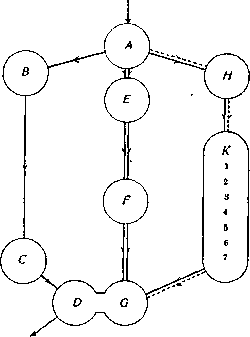
-» path for people j- » » clothing -------^..- » » underwear Figure 3. Scheme of the bath-laundry and disinfection installation: A- dressing room of the bathhouse; B- barbershop; C- bathhouse; E- receiver at the disinfection chamber; F- disinfection chamber; H- receiver of dirty linen at the laundry; rr- processing of linen (1- delousing, 2- soaking, 3- lye boiling, 4- washing, 5- drying, 6- mending, 7- ironing); G- warehouse of clean linen and clothing; D- undressing room. the principle of gradual transition of the bather from the higher temperature of the steam room to the lower temperature of the outside; therefore, the order of room arrangement in a Russian bathhouse should be as follows: entryway, dressing room, vestibule, washing room, steam room. 3. With a total height of all bathhouse premises of not less than 3.2 m, the floor area per bather must be at least 1.8 sq. m in the dressing room, at least 2.7 sq. m in the washing room, and at least 1.35 sq. m in the steam room. 4. In view of the fact that during all washing procedures in a bathhouse, bathers on the one hand have an increased need for oxygen, and on the other hand have increased excretion of carbon dioxide and various vapors, the washing room must be well provided with ventilation, preferably with an inflow of heated air. 5. During heating it is necessary: a) to set the temperature of the dressing room not lower than 20°, and in the washing room not lower than 30°; b) to avoid portable stoves and temporary stoves, as they give too sharp temperature fluctuations; c) to take measures to prevent CO poisoning, for which purpose stoves should be burned with dry wood, chimneys closed only after the charring of the wood is finished (absence of blue flame and coverage of most coals with ash), and the bathhouse ventilated after closing the chimneys. 6. Natural lighting should not fall below 712. 7. The bathhouse must be provided with good (soft and unpolluted) water in sufficient quantity, on average 200-300 liters per person for the proper performance of all bath procedures; in pools, there should be about 3 cubic meters of water per bather, at a temperature of not less than 20-21°, with a pool depth of 2.8-3.5 m for swimmers and 0.6-1.2 m for non-swimmers, with water changes at least once a day, provided the pool is used only after a thorough washing of the body in the bathhouse and subsequent ablution in a bath or under a shower. 8. The lye used when washing in a Russian bathhouse, predominantly in the provinces, must be not strong and transparent; birch brooms for steaming are best prepared from young branches with wide and small leaves of the birch species Betula alba pendula, but not the birch Betula nana; in the northern provinces, in the absence of birch, fresh brooms (dry ones will not do) made of larch (Pinus larix) are used. 9. A bathhouse should be kept in a high state of cleanliness, for which purpose: a) categorically prohibit the washing of dirty laundry in the bathhouse, b) do not allow any kind of rubbing of the body with various ointments and medicinal liquids in the general washing room, c) do not admit patients with contagious diseases and with all kinds of skin lesions to the general bathhouse, d) ensure the drainage of water from the washing room and steam room, drain bath waste water into the general sewer network where one exists, e) arrange a toilet in the bathhouse next to the dressing room, f) systematically wash all bathhouse premises and especially monitor the cleanliness of wooden benches, shelves, and tubs for water, g) avoid using the bathhouse immediately after the end of heating, but beforehand the bathhouse should be ventilated and "steamed" by throwing water on the heater in several stages. Based on experience, it is recognized that washing one shift in the steam room and washing room in a pass-through type steam bath takes up to 45 minutes, considering that such a bathhouse simultaneously contains three shifts of bathers: the 1st shift in the dressing room and barbershop, the 2nd in the washing room, and the 3rd in the undressing room. The throughput capacity of shower bathhouses is almost twice as large as that of steam ones, due to significant time savings when washing under a shower. In acute febrile conditions, in organic heart diseases, in acute diseases of the eyes and ears, in arteriosclerosis, etc., using a bathhouse is not harmless: great caution is required (especially at high bathhouse temperatures and prolonged stay in it). For healthy people, a bathhouse, being a strongly diaphoretic agent that enhances the action of the skin and muscles (Russian bathhouse) and at the same time increases metabolism, represents a powerful factor both in the field of personal and public hygiene, especially in the USSR, with the aim of raising general sanitary culture and to combat parasitic typhus, scabies, and other infectious diseases. Lit.: Znamensky V., On Russian baths from a hygienic standpoint, diss., SPb., 1861; Godlevsky V. V., Materials for the study of the Russian bath, diss., SPb., 1883; Polozov I. N., On the question of the effect of the Russian bath on body temperature, etc., in healthy people, diss., SPb., 1893; Songailo M. A., Types and norms of sanitary-technical structures for wartime needs, P., 1916; Levinson Ya. B., Station sanitary check-points of Moscow, Berlin, 1822; Soloviev Z. P., "Bathhouse" (Large Soviet Encyclopedia, vol. V, M., 1927); Weyl, Handbuch der Hygiene.
Related articles
Cite this page
“Baths (premises serving to apply the effects of heated).” Soviet Medical Encyclopedia. English translation of Bolshaya Meditsinskaya Entsiklopediya, 1st ed. (Moscow, 1928–1936), ed. N. A. Semashko. https://sovietmedicalencyclopedia.pages.dev/article/baths/