Swimming Pools
Historical document, translated for reference. It reflects medical knowledge of the 1920s–30s and is not medical advice.
Summary
This 1930s encyclopedia article discusses the construction, classification, and sanitary requirements of open and closed swimming pools. It details dimensions, water exchange systems, heating, filtration, and hygienic regulations for public use.
Encyclopedia article (1928–1936)
SWIMMING POOLS (more correctly - swimming establishments, swimming baths, German Schwimmbad) are established for bathing, learning to swim, and swimming competitions. Pools are used by schools, physical culture circles, military organizations conducting swimming training, and also by individuals for hygienic purposes. Pools are divided into open and closed. Open pools are arranged predominantly on rivers with a current or in the sea, firstly, to eliminate the danger of drowning, and secondly, to create equal conditions for all during swimming competitions and exclude the influence of the current on achievement results. Open pools are boxes fastened on pontoons. The average size of an open pool is 25x15 m; the bottom is made sloping lengthwise in such a way that the depth of the pool increases gradually from 1.5 to 3 m or more. On the deep side of the pool, a diving tower is installed. For daily water replacement in open pools set up on rivers, a part of the side walls is made removable or lifting. The simplest and cheapest method of constructing an open pool is the sinking of old, unserviceable barges, from which all sharp projections and iron parts are previously removed to avoid bodily injury, and the bottom is arranged in the manner described above. Open pools are also arranged as artificial structures in parks, at stadiums, physical culture houses, etc. In these cases, besides the swimming pool dug in the ground and lined with stone or specially built of reinforced concrete, special rooms are also arranged for undressing, washing, toilets, etc. Water usually flows in by gravity from canals and streams or is pumped from them by pumps driven by motors, or supplied from municipal water supply systems. Closed pools, under our climatic conditions, when open waters are available for bathing and swimming only for 3–4 months a year, are extremely necessary for hygienic and sports purposes and must enter into the network of preventive institutions. While in Germany almost every large city has several closed pools, in the USSR by 1928 there are only 6 of them (in Leningrad—4, in Moscow and Kharkov—1 each), and 2 of them (in Leningrad and Kharkov) were opened only in 1927. Communal construction must set itself the task of constructing closed pools, which with proper operation pay for themselves in a few years and then yield a significant profit. Closed pools usually represent a special building, in the center of which is the actual swimming pool, and around it are arranged a number of auxiliary rooms (dressing rooms, baths, showers, toilets, buffet, staff rooms, hairdresser, engine room, etc.), connected into a single whole by vestibules, stairs, and corridors. Closed pools are also arranged at ordinary bathhouses (for example, the pool at the former Sandunov Baths in Moscow, opened back in 1891). Large swimming buildings have three pools: men's, women's, and children's. The pool itself is made of stone, concrete, or reinforced concrete, and its interior is covered with smooth white or bluish-green tiles. The most suitable and widespread are rectangular pools measuring 50x25, 33x18, 25x15, and 20x10 m. One part of the pool is made shallower, 1 m–1.2 m; from it the bottom gradually deepens, reaching 3–4 m at the other end. Here, springboards or a tower are installed, with a height not exceeding twice the depth of the pool at the given place. The corners of the pool are made rounded to facilitate cleaning; on
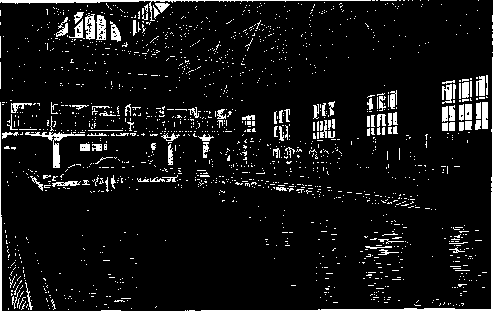
Swimming pool in Amsterdam.
B. M. E. t. IX, on the side walls, at a depth of 1–1.2 m below the water level, a ledge of 40 cm is arranged for swimmers to rest; above the water level along the walls, a metal rod is attached for holding onto it, which is also necessary for certain exercises when learning to swim. The remaining parts of the walls are made smooth, without any projections or depressions. At the bottom of the pool, it is recommended to lay out longitudinal strips of black tiles, which do not reach the transverse sides of the pool, intersecting at a distance of 1 m from the end of the pool with a transverse strip. Longitudinal strips during diving allow maintaining the correct direction, and transverse ones warn of approaching the wall. Ladders in the pool are made vertical and are placed mostly in special recesses in the long side of the pool. Around the pool, a passage at least 1.2 m wide is arranged, covered with mats; no handrails are installed. The floor around the pool must have an elevation of 0.5 m in width and 30 cm in height. The floor must be warm, for which heating is conducted beneath it. The sides and bottom of the pool from the outside (in the basement part) are made accessible for inspection and repair of damage. At a height of 2–3 m along the pool, two steel wire cables or rails are stretched, along which blocks move. Belts for learning to swim are attached to them on ropes, which greatly reduces learning time and allows training a whole group of individuals at once. At the height of the normal water level, a trough or special openings (overflows) are arranged, where the upper, most polluted layers of water overflow. Purity and regular water exchange are the most important problem in the construction of swimming pools. For this purpose, pressure and suction pumps (preferably two in case of breakdown) are installed in a special room, which are driven by a steam engine or an electric motor. The heat generated during their operation is also used for heating the water. After the water is purified, it is heated to the desired temperature and let into the pool. A complete change of water is carried out 2–3 times a week (after the passage of 1,000 visitors), at night. Pumps and pipes are arranged in such a way that they can pump out and fill the pool within 7 hours. Regardless of this, the water is constantly renewed during the stay of the bathers by a uniform inflow through decorative fountains (or cascades). Thanks to this, the upper layer constantly overflows into the trough or openings on the sides of the pool. 4–5% of the pool volume must flow in per hour, the water temperature should be 22–24°, the air temperature—2–4° higher than the water temperature. To maintain a uniform water temperature, a circulation pipeline is arranged, the water in which is set in motion by a special pump of the engine room. For preliminary washing (baths, showers), two water supply networks are laid: hot and cold. Hot water is obtained by passing steam through water with a special apparatus (or by heating water with coils and pipes in a hot water tank). The water in the pool and for washing must be clean, soft, and colorless. For water disinfection, chlorination is most often used, after which and passing through filters the water can be used again for the pool. Spectator stands are located around the pool and must be isolated from it. General dressing rooms or individual cabins with an area of 1.5 sq. m and rooms with warm and cold showers and foot-wash baths are arranged at the pool; supervision must be established to ensure that no visitor enters the pool without having thoroughly washed first. In some cases, along one of the sides of the pool, a small pool 3–6 m wide and about 1 m deep is also arranged for initial swimming instruction and for children. In the absence of a children's pool, special days and hours are established for children when the pool is half-filled; in the absence of a special pool for women, a special undressing room must be arranged for them or special hours established. At the pool, it is necessary to have a sufficient number of toilets (bathing increases urination), as well as spittoons; rescue equipment (lifebuoys, cork balls, poles, etc.) must be at hand. The calculation of the pool is made based on the fact that attendance will be equal to 2% of the served population; 3.5 sq. m of water surface must account for each swimmer, 1.2 sq. m for a non-swimmer, on average—2.4 sq. m. According to Recknagel, the pool area should be 1.5–2 sq. m per 1,000 inhabitants. Bathing time for each is 1/2 hour; the pool must be open daily for 10 hours. Thus, its useful area is used 20 times daily.
Related articles
Mentioned in
Cite this page
“Swimming Pools.” Soviet Medical Encyclopedia. English translation of Bolshaya Meditsinskaya Entsiklopediya, 1st ed. (Moscow, 1928–1936), ed. N. A. Semashko. https://sovietmedicalencyclopedia.pages.dev/article/swimming-pools/