Filters
Historical document, translated for reference. It reflects medical knowledge of the 1920s–30s and is not medical advice.
Summary
Filters are devices for purifying liquids and gases from foreign impurities, primarily suspended particles. This article describes various types of filters used in laboratories, industry, and households, including sand filters, charcoal filters, and biological filters, along with their mechanisms and applications.
Encyclopedia article (1928–1936)
Filters, devices for purifying liquids and gaseous substances from foreign impurities, mainly from suspended particles. Filters find wide application in scientific research and technical laboratories, in various branches of industry, in municipal services, in household management, etc. The process of filtration consists in passing a substance through fine-porous materials, for example through sand, cotton wool, flannel, cloth, loose paper, etc. During filtration, the suspended particles present in the liquid or gaseous substance are partly retained on the surface of the filter, and partly become stuck in its pores, whereby the liquid or gaseous substance that has passed through the filter is purified from sediment, dust, dirt. Besides purely mechanical action, the process of filtration also involves attraction (attraction, adhesion), as well as adsorption and chemical interaction between the filter material and the substance being filtered, due to which in certain cases not only the physical properties but also the chemical composition of the filtered substance can be substantially changed. For example, finely divided activated charcoal, when liquids and gaseous substances are passed through it, energetically adsorbs certain gases and many odorous and coloring substances; river water, when passed through a lime filter, is enriched with calcium salts, and when passed through iron filings-with iron salts. There are filters whose action is mainly due to biological processes depending on the vital activity of lower algae, bacteria, and protozoa. Such filters include sand English filters (see) for purifying drinking water and biological filters (see Biological method for purifying wastewater) for purifying wastewater. In biological filters, along with living organisms, the O2 of air plays a huge role, which is why these filters are also called oxidizers. Filters for purifying drinking water are divided into central, domestic, and portable. Central filters are installed in water supply systems; they purify water intended for the water supply network from turbidity, bacteria, and other impurities. There are many different systems of central filters, of which English and American filters (see) are most widespread. Besides typical English filters, there are also central filters of 'intermittent action', in which filtration alternates with intervals of rest, and 'unsubmerged filters' of the Miquel and Mouchet system, on which water arrives through sieves in the form of rain in such quantities that the surface of the sand in the filter is not submerged. Both of these systems have not found wide practical application due to the complexity of operation. Among fast-acting central filters, besides American ones, the similar 'preliminary filters' deserve attention. Among them belong the filters of Puich-Chabaud, Reiserter (Riess, Spa-ba1, Ke1-sert). In the USSR, the Reiserter-Peters filters have come into practice, installed at the Moscow filtration plant in Rublyovo. During floods they work with a coagulant (see Coagulation), in normal time-without a coagulant. As preliminary filters, they significantly facilitate the work of the main English filters. Domestic filters have the purpose of replacing central filters, if there are none, or improving the quality of tap water in cases when central filters work unsatisfactorily. Of simple designs of domestic filters, one can mention the Erisman sand filter. It consists (Fig. 1) of a metal bucket, into the bottom of which a water supply tube with a tap is embedded. On the end of the tube, which is inside the bucket, a small zinc cylinder filled with clean sand is screwed on tightly. So that the sand does not spill out, the bottom of the cylinder is made of a grating covered with flannel; the same grating with flannel covers the cylinder from above. In the first time after filling, a somewhat turbid filtrate is obtained, then it becomes better. The domestic filter of Korelsky has the appearance of a large clay jar with a lid. In the lower part of the jar, a porous sandstone is embedded, through which water is filtered into the lower compartment of the filter, equipped with a tap. From coarse turbidity, the Korelsky filter purifies water quite satisfactorily, however it soon becomes clogged, overgrown with bacteria, and is difficult to clean. Domestic pressure filters, which are attached to the tap, work much better. This includes the 'Neptune' filter of the Zimin system (Fig. 2). It consists of a fine-porous tube surrounded by a layer of sand, with water first passing through the sand, then through the porous tube. Pressure filters also include the Paster-Chamberlain candles (from kaolin) and Berkefeld candles (from infusorial earth), the device and application of which are shown in Fig. 3 and 4. These filters reliably purify water from turbidity and bacteria, but have low productivity and clog quickly, requiring complex cleaning. Candle filters have found application in some armies as military portable filters, besides they are used in bacteriological laboratories for separating bacteria from liquid media in which they are grown. Among portable filters, one can also mention the filters of Novak, Ménier, etc., made from pressed and fired charcoal tablets. These filters have the appearance of cylinders, balls, or hemispheres, inside of which there is a closed cavity with an outlet tube (Fig. 5). If such a filter is immersed in a body of water, water penetrates through the pores of the charcoal into the cavity of the filter, from where it flows out or is sucked out already purified'. Instead of charcoal, porous sandstone is often used. During the world war, the portable filter of Seitz (Fig. 6 and 7) proved itself well, in which water is pumped through a filtering plate made of a mixture of asbestos and cellulose by a small pump. There are many other systems of domestic and portable filters, but they have not found wide practical application
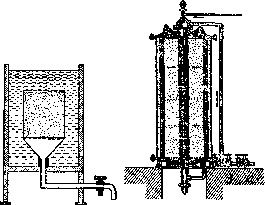
Fig. 1. School sand filter.
Fig. 2. 'Neptune' filter of the Zimin system.

due to general shortcomings inherent in all types of domestic and portable filters, namely the unreliability of their action and rapid clogging.-Finally, it should be pointed out to the methods of filtration with silvered sand (cathode vessels) (see Silver, application of silver for water sterilization) proposed in recent years. Ultimately, all domestic and portable filters, with the exception of the Paster-Chamberlain, Berkefeld, and Seitz filters, unsatisfactorily purify water from fine turbidity and bacteria. To expect that simple domestic and portable filters can purify suspicious water from pathogenic bacteria, in no case can be done. In this respect, all advantages are on the side of boiling water, as well as its chlorination and ozonation. Besides the types of filters described, there are also special filters for removing iron from water, zeolite filters for softening water, and others. Filters for purifying milk, kvass, broth, etc. from turbidity and dirt usually consist of pieces of cloth, through which the liquid being purified is strained. Filters for purifying air from dust have the appearance of fabric (cloth, flannel, etc.) partitions or cotton tampons, arranged in supply ventilation pipes and ventilation chambers. In some factories, such filters also serve for capturing dust sucked out by exhausters from WORKING MACHINES.
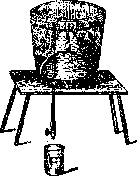
Fig. 5. Portable filter of the Novak system.
due to general shortcomings inherent in all types of domestic and portable filters, namely the unreliability of their action and rapid clogging.-Finally, it should be pointed out to the methods of filtration with silvered sand (cathode vessels) (see Silver, application of silver for water sterilization) proposed in recent years. Ultimately, all domestic and portable filters, with the exception of the Paster-Chamberlain, Berkefeld, and Seitz filters, unsatisfactorily purify water from fine turbidity and bacteria. To expect that simple domestic and portable filters can purify suspicious water from pathogenic bacteria, in no case can be done. In this respect, all advantages are on the side of boiling water, as well as its chlorination and ozonation. Besides the types of filters described, there are also special filters for removing iron from water, zeolite filters for softening water, and others. Filters for purifying milk, kvass, broth, etc. from turbidity and dirt usually consist of pieces of cloth, through which the liquid being purified is strained. Filters for purifying air from dust have the appearance of fabric (cloth, flannel, etc.) partitions or cotton tampons, arranged in supply ventilation pipes and ventilation chambers. In some factories, such filters also serve for capturing dust sucked out by exhausters from WORKING MACHINES.

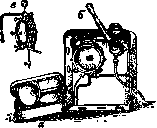
Fig. 6.
Fig.
7.
Fig. 6. Seitz filter. Fig. 7. Seitz filter: a-spare disks; b-pump handle; c-view of the filter from the side. candles, unsatisfactorily purify water from fine turbidity and bacteria. To expect that simple domestic and portable filters can purify suspicious water from pathogenic bacteria, in no case can be done. In this respect, all advantages are on the side of boiling water, as well as its chlorination and ozonation. Besides the types of filters described, there are also special filters for removing iron from water, zeolite filters for softening water, and others. Filters for purifying milk, kvass, broth, etc. from turbidity and dirt usually consist of pieces of cloth, through which the liquid being purified is strained. Filters for purifying air from dust have the appearance of fabric (cloth, flannel, etc.) partitions or cotton tampons, arranged in supply ventilation pipes and ventilation chambers. In some factories, such filters also serve for capturing dust sucked out by exhausters from WORKING MACHINES.
'
C. Ignatov. Filters in laboratory practice. In laboratory practice, the filtration of various liquids is carried out through filter paper, cotton, asbestos, glass wool, placed in a funnel. To separate liquids from smaller particles, so-called porcelain candles made from pressed kaolin or infusorial earth, hollow inside, with an opening on one side, are used. The liquids being filtered are passed through candles mounted in special apparatuses or flasks. Filtration can be carried out from the candle outward or backward with the help of a pressure apparatus or by means of a vacuum. The porosity of porcelain candles is so small that they can prevent the passage of microbes through them, thanks to which they have found wide application in bacteriological practice under the name "bacterial filters". For the disinfection of drinking water, the Berkefeld filter is used (see Berkefeld candle). The most common bacterial F. are the candles of the Pasteur-Chamberland system, made from pressed and fired kaolin at 1,200°. The candles have designations L1, L2, etc. up to L18. The numbers indicate the size of the pores, which decreases according to the sequential numbering. Pukall filters (Fig. 8) made of kaolin have the shape of a flat-bottomed flask with a long neck. They are hollow inside, their capacity ranges from 25 cm³ to 1 liter, and they are suitable for filtration from the outside inward. The Reichel candle - with very thick walls of kaolin - is mounted in special flasks of the same name; it serves for filtering large quantities of liquid, which is passed from the inside outward. For filtering small amounts of liquid, small candles of the Maassen and Silberschmidt system are used, mounted in special glass apparatuses that do not allow the filtered liquid to spread along the walls. In addition to the aforementioned candles, Kitazato candles are used (see Kitazato filter). Round plates made of pressed kaolin of various thicknesses and densities are placed into the Büchner funnel used as a filter. Filtration is carried out through the plates into flasks with the help of a vacuum. The Seitz apparatus with a filter made of an asbestos plate is mainly used for filtering serum, toxins, etc. A thin layer of talc, kaolin, infusorial earth, activated charcoal, or chalk successfully replaces filtering apparatuses in some cases. Membrane filters of Sigmundy and Bachmann are thin plates, 0.1-0.2 mm thick, resembling parchment, made of collodion or nitrocellulose. Thanks to their smallest pores, F. are used in ultrafiltration (see).
Z. Vaidakova.
Related articles
Mentioned in
Cite this page
“Filters.” Soviet Medical Encyclopedia. English translation of Bolshaya Meditsinskaya Entsiklopediya, 1st ed. (Moscow, 1928–1936), ed. N. A. Semashko. https://sovietmedicalencyclopedia.pages.dev/article/filters/