Ozonation
Historical document, translated for reference. It reflects medical knowledge of the 1920s–30s and is not medical advice.
Summary
Ozonation is a method of treating water or air by exposing them to ozone for disinfection and deodorization. In sanitary practice, it is primarily used for disinfecting drinking water by destroying pathogenic bacteria.
Encyclopedia article (1928–1936)
OZONATION, a method of treating water or air by exposing them to ozone for the purpose of disinfection and deodorization. In sanitary practice, the concept of O. is mainly associated with the task of neutralizing drinking water by destroying pathogenic bacteria in them. It is used much less frequently for deodorizing air and other purposes. In addition to sanitary purposes, ozone as an energetic oxidizer finds application in various branches of industry - in bleaching wax, starch, flax, hemp, paper pulp, straw, oil, in the preparation of oil varnishes and lacquers, for purifying beet juice from impurities, for oxidizing fusel oils, for sterilizing beer barrels; it is also used in the preparation of certain paints, such as indigo, aromatic substances, such as vanillin, heliotropin, etc. The process of O. of water consists of two basic operations: 1) obtaining ozonized air in devices called ozonators, and 2) mixing the ozonized air with the water to be disinfected in special reservoirs-sterilizers.
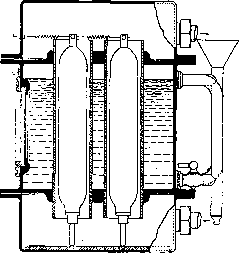
Ozonators are devices in which circulating, pre-dried air is subjected to the action of a silent electric discharge; the most common systems are Siemens-Halske, de Vries, Otto, and Gerard-Fosmaier. The ozonator of the Siemens-Halske system (Fig. 1) is a modification of the Siemens ozonator, consisting of two glass tubes, of which the outer one, 40 cm in length and 4.5 cm in diameter, is lined with stanniol on the outside, while the inner one is lined on the inside; in the Siemens-Halske ozonator, the inner glass tube is replaced by an aluminum cylinder 4 cm in diameter, closed at both ends; air, circulating in the narrow annular gap, is subjected to a silent discharge due to the action of high-voltage electric current, which is rapidly alternated between the stanniol covering and the aluminum cylinder; part of the oxygen in the air at this time turns into ozone. The tube-ozonators are placed in an iron box consisting of 3 compartments - 2 narrow end ones, communicating with each other through outer glass cylinders, and a wide middle one, in which water constantly circulates for cooling the strongly heated glass cylinders.
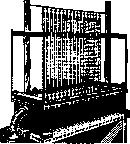
The ozonator of the de Vries system (Fig. 2) also belongs to the type of ozonators with a dielectric: here the air is ozonized in a crescent-shaped space, bounded below by a metal gutter, above by a glass board covering it, to which a series of small metal half-disks-electrodes is attached on top.
The Otto ozonator (Fig. 3) consists of 2 glass plates, covered on the outside with metal; these latter are connected with opposite poles of high-voltage current, with one of them being grounded.
The ozonator of the Gerard-Fosmaier system (Fig. 5) consists of an outer glass cylinder, lined on the outside with stanniol, and an inner tube, silvered on the inside; the stanniol and silver surfaces serve as poles for high-voltage current; air circulates in the annular space between both tubes, entering and leaving through openings in a porcelain mouthpiece, into which both tubes are hermetically sealed. The entire system is immersed in a zinc cylindrical reservoir, placed on a porcelain insulator and intended for circulating cooling liquid; it
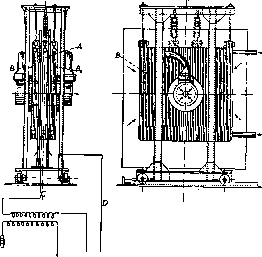
The Otto ozonator; on the right - side view; arrows show the movement of air between two glass plates, where it is ozonized. A - high-voltage electrode, located between two low-voltage electrodes (B and Bh); C - wire from transformer to A; D - frame of ozonator, connected by wire to ground.
also plays the role of a voltage regulator; of electricity. Ozonation of water was first applied in 1893 in the Dutch city of Ondshoorn, where an ozonation plant of the de Vries system was installed. Several years later, an ozonation plant of the Siemens system was established in Wiesbaden; in Lille, a plant of the Marmier-Abraham system; in 1910, the largest filter-ozonation station in the world was built in Petersburg with Siemens-Halske ozonators, which neutralized 62,000 cubic meters per day and served the districts across the river for 14 years. Ozonation stations also exist in a number of cities in France, Italy, Romania. Ozonation of drinking water at waterworks requires a rather complex installation both for obtaining ozone and for the preliminary treatment of water, which is absolutely essential for river waters, since the presence of turbidity and colloidal substances in the water significantly reduces the beneficial effect of ozonation. Experiments with unfiltered Neva water conducted in 1906 in Petersburg with Otto ozonators gave unsatisfactory results in terms of the neutralizing effect; experiments with the same Neva water, but pre-filtered through English filters (see), conducted in the autumn and winter of 1910 with Otto, Siemens, and de Vries ozonators, gave significantly better results. In 1911, in Petersburg, the effect of the Gerard-Fosmaier ozonation plant was tested on filtered Neva water, and complete neutralization of the water in relation to its bacterial flora and a significant improvement in its physicochemical properties were achieved. Similar results were obtained in experiments with water from the Marne River conducted in Paris, as well as experiments in Marseille in 1910, etc. Due to the need for preliminary clarification and decolorization of water before ozonation, the ozonation plant is always combined with filters, usually American ones (see American filters). A prototype of such a plant can be the Leningrad filter-ozonation station (since 1923 converted to chlorination). River water entering the station through a main line undergoes coagulation with aluminum sulfate (see Coagulation) in special settling tanks, then the settled water passes through American filters and finally enters sterilization towers simultaneously with ozonized air. For the purpose of ozonation, atmospheric air, brought into the station through a special pipe and freed from dust by filtration through a fabric filter, is first dried in a special refrigeration unit, in which cooling is achieved by the evaporation of CO2. The refrigeration unit consists of 1) a compressor compressing CO2 under a pressure of 50-70 atmospheres; 2) a condenser where the compressed CO2 circulates in a coil, washed by a current of cold water; 3) a refrigerator, i.e., a hermetic chamber with heat-insulating walls, in the middle of which are located in a special box expansion pipes where the evaporation of CO2 takes place, absorbing significant amounts of heat. The CO2 pipes return to the compressor, continuously repeating their circular motion; the air, leaving the chamber at a temperature of 1-8° and thus significantly dried, enters the air main and from there into the aforementioned ozonators, and after ozonation into the sterilization towers, where it is carried by the force of the water itself entering through 4 so-called emulsifiers (water-jet pumps). The Otto system emulsifier consists of a short, conically tapering downward pipe, inserted at its lower end into a box into which the ozonized air is fed; water emerging at high speed from the narrowed opening of the pipe carries the ozonized air with it and enters a pipe located inside the tower and reaching to its very bottom; the lower end of this pipe is bent upward slightly to give the water a rotary motion (for closer contact between water and ozone). In sterilizers of other systems, various other devices are present to enhance such contact: thus, Siemens-Halske towers for this purpose are filled with gravel, de Vries towers are partitioned with celluloid grating plates, in Gerard-Fosmaier towers the water rolls from one shelf to another, with the arrangement of the shelves being such that each particle of water makes a long, winding path in the tower. After a 2-3 minute stay in the tower, the ozonized water overflows in a cascade in a special, glazed, stepped reservoir (for the rapid volatilization of ozone), enters a collecting pipe, a reserve tank, and finally into the city water supply network. To evaluate the beneficial effect of this entire complex water purification plant, systematic laboratory, i.e., physicochemical-bacteriological, control is necessary. In water that has passed all the mentioned stages of purification, a marked improvement in physicochemical properties is observed (removal of suspended substances, reduction in color reaching 85% or more, reduction in oxidizability by 72%, etc.). The improvement in the physicochemical properties of water, as research has shown, should be attributed mainly to the preliminary treatment of water. The number of bacteria and in particular of coli bacilli sharply decreases both in filtered water compared with untreated water, and in ozonized water compared with filtered water. Many years of control studies have shown that when the entire system functions correctly, only individual spore-forming species and some cocci remain in the water, i.e., representatives of bacterial species that do not play a role in so-called water infections, while pathogenic species from the coli-typhus group, cholera vibrios, etc., invariably perish. The picture changes when the normal operation of individual parts of the plant is disrupted for some reason: such moments as overloading the filters, insufficient washing of them, imperfect drying of the air to be ozonized, leading to a decrease in ozone concentration in the air and water, reduction of the contact time of water with ozone in the tower, etc., inevitably lead to a deterioration of the beneficial effect; therefore, the elimination of design defects (correct calculation of the working area of filters, capacity of the reserve tank, accurate accounting of ozone concentration in each individual tower, etc.) and careful technical supervision are a necessary prerequisite for the successful operation of the station. When properly organized, ozonation of drinking water is the most impeccable method of disinfection from a sanitary point of view, since, ensuring the destruction of the usual agents of water infections, it at the same time introduces no foreign substances into the water; the negative aspects of this method are the complexity and high cost of the installation. Ozonation of air for the purpose of improving its quality in residential apartments and public institutions, for which significant hopes were initially placed, has little justified itself from a sanitary point of view: in practical terms it cannot replace either ventilation or air disinfection and only occasionally finds application for deodorization purposes (see).
L. Gorovits-Vlasova.
Lorenz Oken (Oken, originally Ockenfuss, changed his last name to Oken; 1779-1851), German natural philosopher and natural scientist, privat-docent in Göttingen, later professor in Jena, who applied in his natural philosophy the mystical ideas of Schelling ('all in all and all in each part') to nature, animals, plants, and man. His lectures were very successful. When in his journal 'Isis' O. began to publish besides natural-historical and philosophical articles political ones, the Weimar government demanded either the closure of the journal or O.'s departure from his chair. Oken preferred the latter, moving the publication of the journal to Rudolstadt. Later Oken received a professorship in Munich and still later in Zurich. - The ideas of Oken are sufficiently abstract and fantastic. The animal classes for example according to his opinion are in reality nothing other than reproductions of the sense organs, and must be formed according to this principle. Invertebrates - touch, skin; fish - taste, tongue; reptiles - smell, nose; birds - hearing, ear; mammals - sight, eye etc. Since according to Oken's opinion natural philosophy is the science of the eternal transformation of god into the world, then Oken's doctrine is not alien to historical evolutionary ideas, although this is 'rather the development of concepts than actual historical development'. All organic according to him originated from primary marine slime consisting of bubbles called infusoria. From these infusoria developed plants, animals and man. The organism however is 'nothing other than the combination of all activities of the world in the simple body of the individual'. It is impossible not to note some influence of the ideas of Oken on Haeckel. Together with Wolfgang Goethe Oken shares the priority of the foundation of the so-called metamerous theory of the skull of vertebrates, which played a large role in the development (especially of the German school) of comparative anatomy. Of the works of Oken the most important are: 'Grundriss der Naturphilosophie, der Theorie der Sinne u. der daraus gegriin-deten Klassification der Thiere' (Gottingen, 1802); 'Lehrbuch der Naturphilosophie' (Jena, 1808-11); 'Lehrbuch der Naturgeschichte' (Vol. I-III, Lpz.-Jena, 1813-27).
Related articles
Mentioned in
Cite this page
“Ozonation.” Soviet Medical Encyclopedia. English translation of Bolshaya Meditsinskaya Entsiklopediya, 1st ed. (Moscow, 1928–1936), ed. N. A. Semashko. https://sovietmedicalencyclopedia.pages.dev/article/ozonation/