LAUNDRY
Historical document, translated for reference. It reflects medical knowledge of the 1920s–30s and is not medical advice.
Summary
A comprehensive 1930s Soviet medical encyclopedia article describing the processes, equipment, and sanitary requirements for institutional laundry facilities, including preparation, washing, and finishing of textiles.
Encyclopedia article (1928–1936)
LAUNDRY, a room where washing and processing of dirty linen is carried out for its cleansing and finishing of cleaned linen for further use. All processes of linen processing are divided into 3 main groups: 1) preparation of linen, facilitating the removal of contaminants from it; 2) removal of contaminants; 3) finishing of already cleaned linen. The nature and degree of contamination and the quality of the fabric from which the linen is made require different processing, which is why the first group of operations deserves special attention from a production point of view. Since during the preparation of linen for washing the worker comes into direct contact with dirty linen, which may be infected or infested, this group of operations is very important from a sanitary point of view. The first group - preparation of linen - includes the following operations: receiving dirty linen, its breakdown and sorting, marking of linen, soaking and boiling (scalding). Receiving of linen is done by weight (weighing) or by piece (counting). Breakdown and sorting of linen is done a) by color into colored and white, b) by quality (strong, torn, fine, coarse), c) by degree of contamination and d) into that subject to and not subject to boiling. If the linen is from different individuals or institutions, it requires marking. Sorted linen is packed into bundles with indication of linen categories (labels).-Soaking is a mandatory preparatory operation. Linen contaminated with sweat, blood, pus and feces (especially hospital linen) contains in the pores and threads of its fabric dried protein substances. Proteins in cold water swell, soften and partially dissolve, while in hot water they coagulate and are firmly retained in the fabric (stains). Coagulation of proteins occurs at a temperature of about 60-70°. Besides the dissolution and softening of protein substances during soaking, there occurs swelling of the fabric fibers and softening of all contaminants, which facilitates easier and faster cleansing of the linen. Duration of soaking (in water at room temperature) is about 12 hours (from 8 to 20 hours depending on the degree of contamination of the linen); it is rational for the purpose of reducing working time to soak in the evening, on the eve of the washing day. Spraying linen with kerosene and soaking with the addition of solutions that give the water an alkaline reaction further accelerates and facilitates washing: crystalline soda (which however gives the linen a yellow tint), borax, sodium borate or a 26% solution of NH3. Alkalis act saponifyingly on the fatty parts of contaminants, which, when saponified, dissolve more easily in water.-Boiling is the scalding of linen in boiling water (see Boilers)-is applied to heavily contaminated, coarse linen; it has a disinfecting effect and kills insects. To enhance boiling, solutions of soda and borax are added. Duration of boiling, including loading and unloading, is up to 2.5-3 hours (on average with manual washing 1 hour, mechanical-0.5 h.). Colored linen fades from boiling. After boiling, before washing, the linen is rinsed in clean water to remove dirty water and suspended particles of contaminants from the surface and from its pores. Removal of contaminants consists of two moments-washing and rinsing and is achieved simultaneously by mechanical rubbing and chemical binding of mechanically separated contaminants. In manual washing, rubbing is done by rubbing the linen against each other in water or with a stiff brush (which has a destructive effect on the fabric fibers); better is to rub against sheets of corrugated zinc in a wooden frame. In mechanical washing, as the linen rolls in the washing machine drum, it slightly rubs against the inner surface of the drum, is lifted out of the soapy water and falls back into it, being sprinkled with this water from above; destruction of fibers is significantly less. Chemical action depends mainly on soap, which dissolves in hot water and, decomposing, forms an insoluble acid fatty salt and a basic fatty salt dissolved in water; the softened and separated contaminants of the linen are enveloped by the latter salt and remain in the soapy water in the form of flakes. Soap consumption in mechanical washing is less than in manual washing. Duration of washing in two-drum type machines in 3 change waters with bleaching 1.5 hours, including loading and unloading; with manual washing 1 laundress washes, rinses and blues in 1 hour about 3.5 kg of linen. In mechanical washing about 10% of linen is rewashed by hand (individual types of linen).-Rinsing is done in clean warm water, and then in cold water to wash away the flakes - & ;::: :.;'. ч: .-:':£:: j'l i7 JL фии1 U i Ли II Floor Figure 1. Mechanical self-service public cabinet-type laundry for 10,000 people: 1-storage room; 2-soaking; 3-porch for hand carts; 4-cabin; 5-engine; 6-mechanic; 7-boiler room; 8-fuel shed; 9-elevator; 10-cashier; 11-office; 12-scales; 13-warm driveway; 14-cleaners; 15-waiting area; 16-watchman; 17-drying room; 18-packaging; 19-hollanders. washing from the soapy water containing the insoluble acid fatty salt, the presence of which is harmful to further processing of the linen. Duration of rinsing-10--12 min., bleaching, acidification, rinsing and bluing-0.5 hours with mechanical rinsing, including loading and unloading. Finishing of cleaned linen consists of bleaching, bluing, wringing, drying, rolling and ironing (and for some linen also starching), breakdown, repair, packaging, storage and issuance of linen. Bleaching is used to destroy the unpleasant yellow tint in the linen. Bleaching reagents are added to the water at the end of washing or during rinsing. After bleaching is completed, the linen is neutralized and thoroughly rinsed. Bluing is used to destroy the slight yellowness that remains even after bleaching. Wringing is done either manually - by twisting wet linen into ropes, or mechanically - by passing the linen between rollers (or centrifuging). Duration of centrifuging 25 minutes, including loading and unloading. Normal wringing of linen should be considered when no more than 30% of the weight of dry linen remains in the linen. Drying of wrung linen is carried out: a) in the air or in ;| special covered premises (attics, canopies) with good ventilation and b) in special drying cabinets with warm air or in apparatus. Drying in drying cabinets is carried out at a temperature of from 50 to 60°, because a higher temperature affects the strength of the linen. Duration of drying from 0.5 hour.-1 hour to 2 hours.«Direct» linen (sheets, pillowcases, towels, handkerchiefs and the like) goes from the centrifuge to hollanders (about 40% of linen), where it is simultaneously dried and ironed. Rolling and ironing of linen are used to give the linen softness and smoothness. Rolling is done on heavy mechanical rollers; ironing of linen is done with irons manually or with ironing machines; direct linen is dried, rolled and ironed simultaneously on hollanders. Ironing linen with an iron also has sanitary significance (destruction of insects and nits). Clean linen that has undergone the specified procedures is broken down, sorted; linen requiring minor repair is mended, checked, packaged and issued. Laundries are divided: a) by device- into stationary and mobile laundries; b) by equipment- into mechanized laundries and with manual washing; c) by the categories of population served- into laundries for self-service of the population of their own house, quarter and settlement [self-service laundries (Fig. 1 and 2)], for general service of the population [communal laundries-(Fig. 3), industrial], for service of individual institutions and special groups of the population (e.g. health-sanitary institutions, children's homes, etc.), as well as for processing rags, wipes, etc. (production laundries). Manual laundries by device and equipment are expensive, accessible for construction from local materials, but their operation costs more, labor is tiring and takes
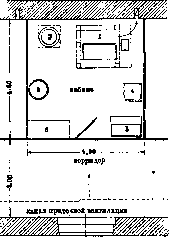
Figure 2. Detail of cabin: 1-washing machine; 2-centrifuge; 3-boiler; 4-cart; 5-washing tub; 6-table.
up much time. Mechanized laundries save time, labor, health, do not damage linen, are cheaper in operation, washing of linen occurs at a higher temperature, but they are more complex in device, factory-made equipment requires experienced skilled workers. All laundries must satisfy the following sanitary requirements: a) da- of the served laundry area or institution; g) correspond to the amount of linen to be washed; h) be in strict accordance with the production process of washing; i) be of a «pass-through system», i.e. arranged so that linen moves from one operation to another in strict sequence and so that contact between dirty and clean linen is excluded (division into clean i ° = 1} 32 1 1 116,

and
Floor 3Q O- -TirlTT t i 4> [ рэиГ 1 ! ) Щ't зз B 36 Hie le he 24 г-, |-| г-, -ц 16 1« |i6 Fig. 3. Mechanical municipal laundry: 1-issue; 2-office; 3-receipt-sorting; 4-5 disinfection department; 6-ventilation chamber; 7-soaking; 8-upper clothing of workers; 9-boilers; 10-washing hall; 11-soap; 12-soda; 13-hand washing tub; 14-rinsing machine; 15-washing machines; 16-table; 17-centrifuge; 18-machine room; 19-steam engine; 20-electric motor; 21-transmission shaft; 22-hot water tank; 23-boiler room; 24-elevator; 25-clean linen; 26-ironing stove; 27-hand ironing; 28-watchman; 29-storage room; 30-linen keeper's apartment; 31-starch room; 32-hollander; 33-ironing room; 34-roller; 35-drying cabinet; 36-drying rack. a) to provide the possibility of obtaining completely clean, non-infected, free from insects linen; b) to give workers the opportunity to wash linen in the most favorable conditions and without harm to health; c) to be safe in terms of infection spread; d) to allow easy, convenient and rapid cleaning; e) not to contaminate water sources (open and groundwater), soil and the surrounding area with discharged water; f) to be located in a place and at a distance that allows convenient use by the population and dirty departments).-The calculation of the amount of dirty linen to be washed is based on the following data: a) change of underwear on average 4 times a month, bedding-2 times a month; b) amount of linen per 1 change on average 2-5 kg per person, per month 6-8 kg, in dormitories 3-4 kg, in homes for the elderly and disabled 4-5 kg, in children's homes and school dormitories 5-6th kg, in hotels 2-5 kg, per month per 1 bed g 12-30 kg, in canteens 2-5 kg, per 100 meals 15-20 kg, in places of detention 3-4 kg, in med.-san. institutions the amount of dirty linen to be washed varies depending on the purpose of the institution: from 16 to 48 kg per bed per month [maternity-48 kg, surgical-48 kg, pediatric (for children 1-3 years)-48 kg, pediatric department in maternity wards-32 kg, infectious-32 kg, psychiatric-32 kg, general in somatic departments-16 kg]; c) 30-50% of all linen depending on contamination requires boiling (scalding); d) 5-10% of washed linen requires repair. Depending on the occupations of the population, domestic, economic, climatic conditions, these average data can vary significantly and require preliminary experimental verification. Linen arriving at the laundry can be divided in a sanitary sense into a) obviously infected or lousy; b) obviously non-infected or disinfected. Linen of the first category is usually subjected to preliminary soaking in disinfectant solutions or delousing on site (hospital, shelter, etc.) with subsequent mandatory boiling (scalding) in the laundry; chamber disinfection is required only for plague, anthrax, glanders. Linen of the second category goes directly to washing and only heavily worn and soiled linen is subjected to boiling. According to the processes of linen treatment, the laundry premises are divided into two main parts: dirty and clean; the dirty part in turn can be divided into infectious and non-infectious departments. Infected, lousy linen goes to the infectious department, where it is sorted, soaked and boiled, after which the linen goes to the general washing room, boilers are located in the wall separating the soaking from the washing room. Non-infected linen goes to the non-infectious department, where after sorting and classification it is soaked and transferred to the general washing room. Thus, in both cases, linen enters the washing room disinfected. Linen enters the clean part of the laundry only in clean form: after washing, rinsing and wringing. Dirty and clean departments must be isolated from each other and have separate exits; in the dirty part there must be sanitary lockers.-For receiving and issuing linen, there must be a special entrance and exit, and the premises themselves must be separated from other production premises. Depending on the productivity of the laundry, the number and size of individual premises vary. A mechanized, fully equipped municipal or industrial laundry for public use with high productivity (2,000 kg of linen per working day and more) has the following premises: A. Main: 1) entrance for bringing dirty linen; 2) reception of dirty linen with waiting area; 3) room for storing dirty linen; 4) sorting of dirty linen; 5) washing room, consisting of rooms for soaking tanks, boilers, washing machines, rinsing, centrifuges; 6) drying room; 7) ironing room, consisting of rooms for hollanders, rollers, hand ironing; 8) sorting of clean linen and repair; 9) room for storing clean linen; 10) room for issuing clean linen; 11) exit (with clean linen). B. Auxiliary: 1) office with cash register; 2) entrance for workers; 3) sanitary lock with individual lockers for workers and showers; 4) rooms for workers' rest and meals with toilet; 5) toilets; 6) rooms for the local committee; 7) boiler room; 8) machine room; 9) mechanical workshop; 10) storage room for materials; 11) rooms for supply and exhaust ventilation; 12) rooms for tanks with cold and hot water; 13) shed for transport (garage) or 14) stables; 15) rooms for grooms, drivers; 16) watchman's room. The determination of the areas of individual laundry premises is carried out taking into account the area occupied by the equipment and its throughput, and the arrangement of machines must correspond to the best mechanization of the washing process, the progressive movement of linen and the requirements of technical safety. The reception of dirty linen and sorting are calculated for at least 4.7 m2 of room area per 100 kg of linen during the working day. For soaking
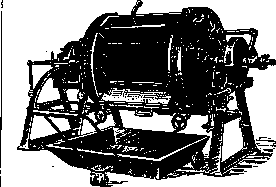
Fig. 4. Washing machine and cart for linen.
tanks, a special area is allocated. The boiling-washing-rinsing department requires 6 m2 of area per 100 kg of linen processed in an 8-hour working day, and centrifuges-2.5 m2 (total 7.5-8.5 le8). For hand washing, 1 laundress requires at least 4.5 m2. The size of the washing area per unit weight of linen is inversely proportional to the amount of washed linen. In self-service laundries, washing rooms are arranged in the form of separate cabins 4.5x4.6 m each, separated from each other by mesh partitions. In laundries with hand washing, the size and equipment are determined based on the productivity of the laundress. With mechanization of washing processes, the throughput of the laundry significantly increases (up to 50 families per 1 cabin). Drying and ironing are also calculated depending on the equipment. The sorting of clean linen and repair require at least 6.0-7.5 m2 of area per 100 kg of linen washed during the working day. The height of the laundry premises where the working process is carried out should be at least 3.5-4 m, in others at least 3 m. In in-house laundries, the height of all premises can be 2.8 m. The required amount of equipment in the laundry is determined depending on the type of laundry, its size, throughput and the nature of the equipment. Separate equipment: 1) tanks for soaking-fixed and mobile; 100 kg of linen per day requires 0.75 m3 of useful capacity of tanks. 2) Boilers (see). For 100 kg of linen per day, 0.85 m3 of useful capacity of the boiler is required. 3) Washing machines-cam type, preferably double-drum type (fig. 4). Linen should occupy no more than 2/3 of the volume of the inner drum. For hand washing
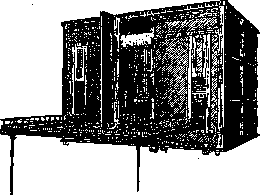
Fig. 5. Continuously operating chain drying cabinet.
tubs with two compartments are used: one for washing, the other for placing washed linen on its removable mesh and for rinsing and bluing. 4) Rinsing machines are installed for each specific group of washing machines they serve, and their capacity is determined by the productivity of this group. For 100 kg of linen, 1.5 m3 of useful capacity of the machine is required. For manual rinsing, for every 8 manual washing tubs-1 rinsing tank. 5) Dewatering machines-rollers or centrifuges. When centrifuging, linen is strongly pressed against the wall of the basket, so the edges of the holes in the walls are of great importance for its preservation. 6) Drying equipment-drying cabinets (fig. 5 and 6), tinned copper drums (for tulle fabrics) and equipment for special drying of various shapes (for stockings). 7) Rollers-rollers and 1 I I I ГП I П I I M I И I I III
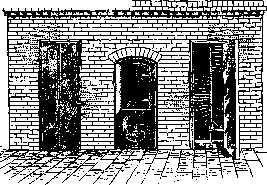
Fig. 6. Ironing stove with drying cabinet.
table-type rollers. Medium-sized rollers, one for every 6 laundresses, medium-sized table-type box rollers, one for every 10 laundresses; with mechanical drive - 1 roller for every 100 kg of linen processed on the rollers within an hour. 8) IRONING DEVICES (irons and ironing machines) differ in the greatest variety and number of types. Among irons, the most convenient are those heated by electric current. When heating irons with coal, damage to linen from falling coal particles and ash and flying sparks is possible. With gas irons, air pollution from gas leakage and its combustion products is observed. For mass production, ironing machines heated by gasoline, gas or steam are used. For the simultaneous ironing and drying of linen, multi-channel steam ironing machines (damage to linen from stretching) and drum Dutch machines (Fig. 7) are used. Due to the significant amount of water vapor when ironing only centrifuged, undried linen, intensive ventilation of ironing rooms or suction of humid air directly from the Dutch machines is required. When ironing with irons, 1.25 m of table length is required per ironer. BUCKETS for soap and soda solutions are calculated in capacity based on the required total amount of each solution prepared for the working day, prepared 2-3 times during the day. Consumption per 100 kg of linen: 2.5 kg of dry soap, 1.25 kg of dry soda. For every 3-4 washing machines, 1 bucket for soap and soda is needed, for every 3-4 boilers-1 bucket for soda. For transporting linen, wooden mobile cages, low-sided carts, and woven baskets on carts are used. When constructing walls, floors and ceilings of the laundry, it must be possible to maintain them clean and protect them from dampness and contamination. Their finish should allow for quick and easy cleaning, not have parts that contribute to contamination of the room and accumulation of dirt and dust. The ceiling and walls should be smooth, walls to a height of at least 0.75 m (and in the sorting room completely) should allow washing, floors without potholes, cracks and crevices, on one level, without steps between individual rooms. In the dirty department and rooms with wet processes, floors should be waterproof with a slope and holes for water drainage; in the holes, gratings and floor traps are installed. The lighting of the laundry should be direct natural light, uniform, without dark corners, with large unshaded windows. The lower edge of the window should not be lower than 1 m from the floor. Windowsills are sloped downward with drainage of condensation water. Machines and devices should be well illuminated and should not darken work areas. The light coefficient should be at least 1/8. The heating in laundry rooms should be calculated so that the air temperature in hot workrooms is 22°C (not less than 20°C) and in others 20°C (not less than 18°C) taking into account the heat balance. Since the processes of boiling, washing, and ironing give off significant heat to the air in the rooms, the calculation of the heating system in these rooms (most suitable is a low-pressure or medium-pressure steam system of 1-1.5 atmospheres) is based on an internal temperature of 10°C, which is sufficient to maintain the required temperature on working days and minimal during non-working hours. Heating devices should have smooth surfaces. Ventilation in workrooms is supply-exhaust, aimed at reducing air humidity and f; in other rooms, standard hygienic requirements, i.e., maintaining air cleanliness. In rooms where soaking, boiling, washing, rinsing, wringing, drying and ironing are carried out, the volume of ventilation depends on the amount of water vapor and heat released into the air of the rooms (see Ventilation). In other rooms, the exchange rate: receiving linen-3, sorting and marking dirty linen-3, storage of dirty linen-4, storage of clean linen-1. Water consumption for processing 100 kg of linen: hot (65°C) with manual processing about 850 l, with mechanical processing-1,400 l; cold (5°C) with manual processing-1,700 l, with mechanical processing-2,800 l. The amount of water may vary depending on the degree of soiling of the linen, the design and selection of machines, and the experience of workers in the laundry. With hard water, softening installations are used, which provide significant soap savings. For wastewater from laundries, special grease traps are installed, and for large laundries, settling-cooling wells are also installed, which retain lighter suspended (fatty) substances. The admixture of soapy waters to domestic wastewater is usually allowed in an amount not exceeding 25%. If in larger quantities, precipitation of soapy waters with lime hydrate solution is used. When choosing a location for a laundry, one should consider 1) convenience of communication with the population using it (if special reception points are not set up in residential areas); 2) unhindered and uninterrupted receipt of water in sufficient quantity and proper quality (preferably less hardness, absence of iron salts); 3) the possibility of discharging laundry wastewater without harmful effects (pollution) on water sources, the surrounding area (pollution and waterlogging of the soil), on the sewerage system; 4) the possibility of installing treatment facilities for laundry wastewater if necessary. For the most rational use of the heat supply and for better service of the working population, it is advisable to combine large laundries with baths, creating a kind of complexes (bath-laundry complexes). For convenience of service, a network of different types of laundries should be planned. The tremendous growth of socialist construction, the emergence of new construction sites and worker settlements, the development of collective farms and state farms require extensive construction of laundries, and along with large mechanized laundries, simplified laundries are organized in the first period. These laundries are intended to provide an opportunity for washing linen by the most accessible method under the given conditions and with the most economical expenditure of fuel, funds, etc. The organization of the simplest laundries makes it possible to improve the sanitary-hygienic conditions of residential premises and prevent their damage from dampness. Simplified laundries are set up in new construction sites (by order of the Supreme Council of National Economy of the RSFSR of 17/XI 1931), in worker settlements, at worker and student dormitories, at residential houses (blocks) and etc. Along with this, they should find widespread use in collective farms, state farms and MTS. The simplest laundries can be with personal labor (self-organized), and with hired labor force. In these laundries, washing and drying of linen is carried out, and where possible, ironing; as an exception, only washing may be allowed. In collective farms, simplified laundries are organized in huts, barns, storage rooms and other premises that are in the funds of rural councils, district executive committees, state farms, collective farms, MTS and can be used for these purposes. Assuming 1,000 people and 6 kg of linen per month per person, with 24 working days in the laundry, 7 tubs are required. Area of the room: in the washing room 4 m² per tub, in the drying room 1.5-2 m² and in the ironing room 3 m² per laundress. The design, operation and maintenance of laundries are regulated by special orders: resolution of the Council of People's Commissars of the RSFSR of 14/V 1932 'On measures to improve the sanitary condition of cities and new construction sites' ('On the Health Front', official department, 1932, № 16-17; also in 'Bulletin of the NKKh', 1932, № 4); 'Sanitary rules for the design, operation and maintenance of laundries', NKZdr., Construction Sector of Gosplan and NKT of the RSFSR of 4/VI 1930 ('On the Health Front', official department, № 20, 1930); 'On the maximum development of laundries in houses included in the housing cooperative system' NKZdr. and Central Council of Housing Unions of 14/I 1932 ('On the Health Front', official department, 1932, № 4); 'On the service of workers with baths and laundries' NKZdr. and NKKh of 8/I 1932 ('On the Health Front', official department, 1932, № 3); 'On measures to regulate the household service of the working population with baths and laundries' NKKh of 4/IV 1932 ('Bulletin of NKKh', official department, 1932, № 11); 'Minimum sanitary-technical service for the population of worker settlements' NKKh and NKZdr. of 9/IV 1932 ('On the Health Front', official department, 1932, № 12); 'On ensuring constant sanitary supervision of bath-laundry enterprises' NKZdr. of 14/I 1932 ('On the Health Front', official department, № 4, 1932); 'On the conduct by communal economy and health authorities of an inspection of the workload of bath-laundry installations and the development of measures for their expansion and maximum utilization' ('On the Health Front', Official Department, 1932, № 3).
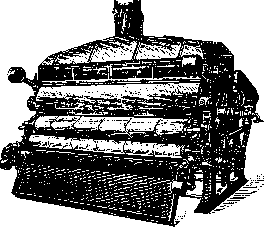
Figure 7. Dutch machine with exhauster.
during the day. Consumption per 100 kg of linen: 2.5 kg of dry soap, 1.25 kg of dry soda. For every 3-4 washing machines, 1 bucket for soap and soda is needed, for every 3-4 boilers-1 bucket for soda. For transporting linen, wooden mobile cages, low-sided carts, and woven baskets on carts are used. When constructing walls, floors and ceilings of the laundry, it must be possible to maintain them clean and protect them from dampness and contamination. Their finish should allow for quick and easy cleaning, not have parts that contribute to contamination of the room and accumulation of dirt and dust. The ceiling and walls should be smooth, walls to a height of at least 0.75 m (and in the sorting room completely) should allow washing, floors without potholes, cracks and crevices, on one level, without steps between individual rooms. In the dirty department and rooms with wet processes, floors should be waterproof with a slope and holes for water drainage; in the holes, gratings and floor traps are installed. The lighting of the laundry should be direct natural light, uniform, without dark corners, with large unshaded windows. The lower edge of the window should not be lower than 1 m from the floor. Windowsills are sloped downward with drainage of condensation water. Machines and devices should be well illuminated and should not darken work areas. The light coefficient should be at least 1/8. The heating in laundry rooms should be calculated so that the air temperature in hot workrooms is 22°C (not less than 20°C) and in others 20°C (not less than 18°C) taking into account the heat balance. Since the processes of boiling, washing, and ironing give off significant heat to the air in the rooms, the calculation of the heating system in these rooms (most suitable is a low-pressure or medium-pressure steam system of 1-1.5 atmospheres) is based on an internal temperature of 10°C, which is sufficient to maintain the required temperature on working days and minimal during non-working hours. Heating devices should have smooth surfaces. Ventilation in workrooms is supply-exhaust, aimed at reducing air humidity and f; in other rooms, standard hygienic requirements, i.e., maintaining air cleanliness. In rooms where soaking, boiling, washing, rinsing, wringing, drying and ironing are carried out, the volume of ventilation depends on the amount of water vapor and heat released into the air of the rooms (see Ventilation). In other rooms, the exchange rate: receiving linen-3, sorting and marking dirty linen-3, storage of dirty linen-4, storage of clean linen-1. Water consumption for processing 100 kg of linen: hot (65°C) with manual processing about 850 l, with mechanical processing-1,400 l; cold (5°C) with manual processing-1,700 l, with mechanical processing-2,800 l. The amount of water may vary depending on the degree of soiling of the linen, the design and selection of machines, and the experience of workers in the laundry. With hard water, softening installations are used, which provide significant soap savings. For wastewater from laundries, special grease traps are installed, and for large laundries, settling-cooling wells are also installed, which retain lighter suspended (fatty) substances. The admixture of soapy waters to domestic wastewater is usually allowed in an amount not exceeding 25%. If in larger quantities, precipitation of soapy waters with lime hydrate solution is used. When choosing a location for a laundry, one should consider 1) convenience of communication with the population using it (if special reception points are not set up in residential areas); 2) unhindered and uninterrupted receipt of water in sufficient quantity and proper quality (preferably less hardness, absence of iron salts); 3) the possibility of discharging laundry wastewater without harmful effects (pollution) on water sources, the surrounding area (pollution and waterlogging of the soil), on the sewerage system; 4) the possibility of installing treatment facilities for laundry wastewater if necessary. For the most rational use of the heat supply and for better service of the working population, it is advisable to combine large laundries with baths, creating a kind of complexes (bath-laundry complexes). For convenience of service, a network of different types of laundries should be planned. The tremendous growth of socialist construction, the emergence of new construction sites and worker settlements, the development of collective farms and state farms require extensive construction of laundries, and along with large mechanized laundries, simplified laundries are organized in the first period. These laundries are intended to provide an opportunity for washing linen by the most accessible method under the given conditions and with the most economical expenditure of fuel, funds, etc. The organization of the simplest laundries makes it possible to improve the sanitary-hygienic conditions of residential premises and prevent their damage from dampness. Simplified laundries are set up in new construction sites (by order of the Supreme Council of National Economy of the RSFSR of 17/XI 1931), in worker settlements, at worker and student dormitories, at residential houses (blocks) and etc. Along with this, they should find widespread use in collective farms, state farms and MTS. The simplest laundries can be with personal labor (self-organized), and with hired labor force. In these laundries, washing and drying of linen is carried out, and where possible, ironing; as an exception, only washing may be allowed. In collective farms, simplified laundries are organized in huts, barns, storage rooms and other premises that are in the funds of rural councils, district executive committees, state farms, collective farms, MTS and can be used for these purposes. Assuming 1,000 people and 6 kg of linen per month per person, with 24 working days in the laundry, 7 tubs are required. Area of the room: in the washing room 4 m² per tub, in the drying room 1.5-2 m² and in the ironing room 3 m² per laundress. The design, operation and maintenance of laundries are regulated by special orders: resolution of the Council of People's Commissars of the RSFSR of 14/V 1932 'On measures to improve the sanitary condition of cities and new construction sites' ('On the Health Front', official department, 1932, № 16-17; also in 'Bulletin of the NKKh', 1932, № 4); 'Sanitary rules for the design, operation and maintenance of laundries', NKZdr., Construction Sector of Gosplan and NKT of the RSFSR of 4/VI 1930 ('On the Health Front', official department, № 20, 1930); 'On the maximum development of laundries in houses included in the housing cooperative system' NKZdr. and Central Council of Housing Unions of 14/I 1932 ('On the Health Front', official department, 1932, № 4); 'On the service of workers with baths and laundries' NKZdr. and NKKh of 8/I 1932 ('On the Health Front', official department, 1932, № 3); 'On measures to regulate the household service of the working population with baths and laundries' NKKh of 4/IV 1932 ('Bulletin of NKKh', official department, 1932, № 11); 'Minimum sanitary-technical service for the population of worker settlements' NKKh and NKZdr. of 9/IV 1932 ('On the Health Front', official department, 1932, № 12); 'On ensuring constant sanitary supervision of bath-laundry enterprises' NKZdr. of 14/I 1932 ('On the Health Front', official department, № 4, 1932); 'On the conduct by communal economy and health authorities of an inspection of the workload of bath-laundry installations and the development of measures for their expansion and maximum utilization' ('On the Health Front', Official Department, 1932, № 3).
E. Bragin. Professional hazards of laundry work. Mechanization of almost all basic processes of washing and ironing laundry fundamentally changes the general character of laundry work, which from a primitively organized production with predominance of manual labor transforms into one of the types of industrial production with quite significant division of labor and with a considerable number of workers. The successes of the cultural revolution and the broad involvement of women in production determine the broad development of this branch of production in the USSR. The main harmful aspects of labor for workers in mechanized laundries are: a) high temperature and high humidity of the air, b) constant contact with moisture, c) danger of infection, d) forced standing position of the body, e) strain of individual muscle groups and pressure on individual parts of the body. The effect on the working organism of unfavorable meteorological conditions—high temperature and high humidity—takes place in almost all departments of a mechanized laundry and covers almost all detailed professions, except for receivers and sorters of laundry. In the washing hall, where the main 'hot' and 'wet' work is concentrated, temperature according to data from the People's Laundry in Moscow (mechanized) fluctuates between 23.2° and 26.8° with relative humidity of 82-96.8% and outside air temperature of +4-6°. In summer the temperature in this hall reaches 28.4°. This leads to disruption of thermoregulation of the workers, since sweating in these conditions disappears almost completely, while heat transfer by conduction, due to the immobility of the air, is also reduced. The fairly intense physical strain when working at certain groups of workers also creates conditions for increased heat production. As a result, there are phenomena of heat accumulation and overheating of the body: after 3 hours from the start of work, temperature under the arm increases in this category of workers (washers, rinsers, wringers) by 1-1.8°, reaching 37.8°. The high temperature of the premises, on the one hand, and sharp temperature fluctuations, to which many workers are exposed, on the other, can be a cause of spread of cold diseases among laundresses. This type of disease according to outpatient materials from the mechanized People's Laundry ranks second (49 per 100 workers). Contact with hot water, less often with cold water, also occurs in most professions of mechanized laundry work. Under the influence of this factor, physiological functions of the skin are disrupted; the latter becomes macerated. Chemical reagents (alkali, 'Javelle water'), used to accelerate the washing process and to whiten laundry, aggravate the effect of hot water on the skin, whose resistance to harmful substances is thereby reduced. In connection with this, skin diseases are almost occupational diseases of laundry workers, ranking first according to outpatient data from the People's Laundry in Moscow (53 per 100 workers). Among skin diseases, abscesses, phlegmons, and eczemas are most widespread. A characteristic disease among laundresses is nail changes, named by Oppenheim onycholysis partialis (fig. 8) (see Nail).


Figure 9.
Among the sanitary factors related to the labor process itself and inherent to almost all basic professions, one of the most important places is occupied by the constant forced standing position during work and the various disorders and diseases associated with it. This factor acquires specific significance in laundries because here work is done almost exclusively by women. These include disorders of the female reproductive sphere (ante- and retro-flexio uteri, metritis, etc.), discovered by A. Letavet and Z. Smeiansky in 1924 in a considerable number of workers in mechanized laundries. It is necessary, however, to point out that most workers in mechanized laundries began work at an early age in small manual laundries, where the main hazards are expressed particularly sharply, therefore it appears extremely difficult to attribute this type of disease solely to the hazards of mechanized laundries. The phenomena of hand deformation observed among ironers, caused by uniformly repeated and requiring great strain manipulations during ironing, also deserve attention. A special role in the origin and development of this deformation is played by the following factors of professional activity: pressure of the iron handle on the palm surface, bending of the hand at the wrist joint and deviation of the fingers (nail phalanges) in the ulnar direction. According to data from the examination of Moscow laundries, some form of deformation was found in the majority of ironers (about 70%): thickening of the phalangeal joints with limitation of their mobility, apparently due to prolonged injury of the joint surfaces when pressing on the iron handle (fig. 9), deviation of the nail phalanges in the ulnar direction (fig. 10).

Figure 10.
In small laundries, where all labor processes are performed manually, where all laundry processing is done by two detailed professions (washers and ironers), occupational hazards due to general unfavorable sanitary factors (insufficiency of cubic capacity, lighting, combination of laundry with living quarters, etc.) are expressed extremely sharply. Since both washing and ironing are done in the same room, the occupational hazards related to the production environment are common to both. The most important factors are unfavorable meteorological conditions: temperature up to 40° and higher, high humidity and physical strain during work. Such a combination of unfavorable meteorological conditions and physical strain causes much more severe disruption of thermoregulation than occurs, as mentioned above, in mechanized laundries. If we add to this that ironing, due to the absence of any mechanical devices, requires greater physical strain than in mechanized laundries, then it becomes completely obvious the sharp difference in working conditions that exists between manual and mechanized laundries. It also follows that among measures to improve working conditions in laundries, the first place should be given to the maximum degree of mechanization of production processes. The correct organization of labor is extremely important. The fight against high temperature and high humidity should be directed toward the rational design of production equipment (washing drums, etc.) and a rational supply and exhaust ventilation system.
3. Smeiansky.
Related articles
Mentioned in
Cite this page
“LAUNDRY.” Soviet Medical Encyclopedia. English translation of Bolshaya Meditsinskaya Entsiklopediya, 1st ed. (Moscow, 1928–1936), ed. N. A. Semashko. https://sovietmedicalencyclopedia.pages.dev/article/laundry/