Sewage
Historical document, translated for reference. It reflects medical knowledge of the 1920s–30s and is not medical advice.
Summary
This article from the 1928–1936 Great Medical Encyclopedia examines the composition, classification, and characteristics of sewage water, distinguishing between domestic-fecal and industrial wastewaters. It details water consumption rates, temperature variations, and chemical properties across various Soviet and international cities.
Encyclopedia article (1928–1936)
SEWAGE, or "wastewater", in sanitary engineering refers to water contaminated by various wastes and removed through sewerage systems (see). In hydrology, the term "sewage" is sometimes applied to designate surface runoff waters, i.e., atmospheric waters polluted by contact with the surface of a catchment basin. The character of pollution determines the two main categories of sewage, their sanitary evaluation, and their relation to treatment processes: 1. "Fecal-domestic" sewage, the main pollution of which is created by excrement from toilets and kitchens (fecal matter, urine, kitchen waste, dishwashing, water from washbasins, bathtubs); often, when sewering settlements and cities, this group includes water from bathhouses, laundries, and medical institutions with their specific pollutions; the purification of this sewage is carried out mainly by the so-called biological treatment method. 2. "Industrial" sewage is polluted by various wastes from factory and manufacturing industries; this second category of wastewater also has special, purely chemical methods of treatment. Fecal-domestic sewage and industrial wastewater, as two types of sewage, are found in a "pure" form in the case of separately located residential properties, settlements, and individual factories and plants. But more often one has to deal with a mixture of these waters in various proportions. Municipal sewage from cities and large factories with adjacent settlements yields a very complex mixture depending on water consumption norms, the water supply system, and living conditions. In this regard, water consumption per resident in cities with a combined sewerage system (Chicago—910 l, Philadelphia—850 l, New York—459 l, Glasgow—248 l, London—159 l, Birmingham—111 l, Essen—600 l, Paris—163 l) and a separate system [Moscow—73 l, Kharkov—65 l (presumably calculated from the composition of the sewage), Nizhny Novgorod—44.5 l] is particularly noteworthy. For small settlements and individual properties, the daily water consumption per resident can drop to 35 l and lower. The distribution of water consumption throughout the day varies greatly and shows a sharp minimum during nighttime hours. This unevenness of hourly sewage flow is of tremendous importance in the calculation of both pipes and channels removing sewage and purification facilities. It is expressed by the technical term coefficient of unevenness of inflow. Since pollution (feces, urine, household waste) calculated per resident corresponds to a certain physiological norm, the concentration of sewage depends on the water consumption per resident (dilution). Nitrogen (ammonia) consumption and discharge in sewage are especially stable in this respect—from 7 to 8 g per person (Stroganov, Buswell). The bulk of organic matter and chlorides in sewage (9–10 g of Cl per person) is of the same origin, insofar as they are not of "industrial" origin. However, the composition and properties of sewage also depend strongly on other circumstances. Thus, the mineral salt composition of sewage is often determined by the character of the tap water, with the quantity of carbonates, sulphates, iron, and dissolved O2 being especially important. In particular, it is at the expense of this O2 that certain primary changes in the composition of sewage take place within the sewerage network. Therefore, the influence of river water supply (dissolved oxygen is present in the water) and artesian water supply (no oxygen) will be very different. The admixture of bathhouse and industrial waters sometimes sharply changes the character of fecal-domestic sewage. The penetration of groundwater, brackish water, and, in coastal cities, seawater into the sewerage network—all this extremely diversifies both the composition and concentration of sewage. Among the properties of sewage, its temperature deserves special attention, since the conditions of sewage treatment depend significantly on it. The main temperature background is created by the temperature of tap water—wide fluctuations with river water supply (from 1° to 25°) and generally low and fairly constant temperature with artesian waters. Sources of heat for sewage are kitchens, bathhouses, bathtubs, and industrial waters. The admixture of groundwater and surface water during the cold season lowers the temperature of sewage. In Moscow, during the winter months, the temperature of sewage in the pre-war period was about +10°. As an example, we cite the composition of sewage from Russian cities and individual settlements, as well as European and American cities—to show the difference between them and what caution is required when transferring foreign construction practices to our soil (see Tables 1 and 2). The data provided are the results of the analysis of average daily samples over a more or less prolonged period of time. Due to very large fluctuations in water consumption throughout the day and the variability in the nature of introduced pollutants, the analysis of a single random sample generally gives a very inaccurate idea of the actual composition of sewage. To judge the degree of pollution and to calculate purification facilities, it is very important to have an analysis of sewage precisely during the hours of maximum inflow and maximum use of the sewerage system. There are very significant fluctuations in the character and quantity of sewage by days of the week (holidays, bath days), by season, and by weather—depending on a number of living conditions, the progress of the development of the pipe sewerage network, and so on. The possibility of comparing different sewages is facilitated by converting the analysis per resident per day. By such conversion of the data in Tables 1 and 2, we obtain Tables 3 and 4.
In the given tables, noteworthy is the great constancy in the amount of ammoniacal nitrogen both for cities with almost exclusively fecal and domestic sewage (Russian cities) and for more or less industrial cities with combined sewer systems: in the former, an average of 7.5 g per inhabitant per day; in the latter, 7.9 g, with very minor fluctuations. In all other respects, the difference between the two groups is very clearly expressed, but the fecal and domestic waters of the first group differ relatively little from each other. This makes possible an approximate calculation (in various practical cases) of the composition of the liquid and, conversely, of the population size in American cities. In characterizing sewage, and especially for the design of preliminary treatment plants, the quantity (by volume) of suspended, settleable substances is very significant. For fecal and domestic sewage, the volume of sludge per liter ranges from 2.5 to 15 cubic centimeters (98% water), which depends mainly on the concentration of the liquid. In the composition of "suspended solids" by weight determination, fine, non-settleable suspension is taken into account, and colloidal substances fall into the dissolved part (total residue). According to Metcalf and Eddy, for typical American sewage, substances are distributed according to their state in sewage as follows (mg per liter): suspended solids 300, dissolved solids 500, settleable 150, suspension (non-settleable) 150, colloids 50, crystalloids 450. Sewage in a combined sewer system is an ideal means for the rapid removal of fecal and domestic pollution. By themselves, these waters represent a significant danger in a sanitary respect due to strong bacterial contamination. Of particular importance in the bacteriological study of sewage is the group Bact. coli. When seeded on ordinary gelatin, meat-peptone, or agar, the total number of bacteria in sewage is determined in millions (from 1 to 10) per 1 cubic centimeter. In one recent American study for Cincinnati and Louisville, the number of bacteria in sewage per inhabitant per day is determined in billions: 11,000–12,000 with growth on gelatin, 8,000–12,000 on agar; for Bact. coli 200–300. Data for Moscow: sewage yields about 10 million per 1 cubic centimeter when seeded on gelatin; for Bact. coli, about 100,000. Recalculated per inhabitant per day (in billions), it is about 1,000, and for Bact. coli, about 10. Among pathogenic microbes, besides the causative agents of gastrointestinal infections, B. anthracis (with slaughterhouse waters), Staphyloc. pyog. aureus, B. tuberculosis, B. pyocyaneus, and others have been found in sewage. Infection is possible not only by direct contact with sewage, but also indirectly. Particularly dangerous in this regard are the contamination of drinking water supplies by sewage (wells, springs, rivers). Great caution is therefore necessary when consuming vegetables from sewage farms, especially in raw form. One must not forget the transmission of infection by flies and infection through oysters. Regarding malaria, sewage is safe because Anopheles larvae do not develop in them. Finally, sewage can be a spreader of various helminthic diseases. But the sanitary "harmfulness" of sewage is not exhausted by this alone. Sewage, being a focus of vigorous decomposition of organic substances, including anaerobic processes, spreads a stench, spoiling the air. In this regard, H2S is particularly dangerous, mainly for workers in contact with sewage. On the other hand, sewage entering public bodies of water and rapidly consuming the O2 dissolved in the water can create a completely intolerable distortion of its natural properties in the reservoir and ruin the water in it to such an extent that any possibility of using it not only for drinking water supply and watering livestock, but also for swimming, for domestic needs, and even for sports purposes will be excluded. All these are the fundamental prerequisites for prohibiting the direct discharge of sewage into public water bodies and for the requirements of purification (see Biological method of sewage purification), and in certain cases for the requirements of sewage disinfection (see below).
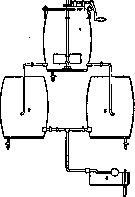
Figure 1. Scheme of the disinfection installation: 1—barrel with a stirrer for the stock solution (5%); 2 and 3—barrels with the working solution (1%); 4—regulating tank with a float valve.
method of sewage disinfection must include the difficulty of dosage, the variable composition of the reagent, and the precipitate formed in the tanks, which requires frequent cleaning. Recently (since 1913), the use of gaseous chlorine has begun to expand noticeably. Chlorine is obtained in liquid form in steel cylinders (weight from 10 kg of liquid chlorine). In special apparatus—chlorinators—chlorine water is obtained by dissolving chlorine gas in water. Since a liter of water saturated with chlorine at 20° contains 6.84 g of chlorine, a very precise dosage of active chlorine according to the amount of water passing through the chlorinator is possible. In Europe, the Ornstein system chlorinator is very widespread (see Figures 3 and 4). Chlorine from the cylinder (6–8 atm.) through a pressure-reducing valve (0.5 atm.) enters the absorption column, where it is dissolved in water supplied from the water mains. The chlorine water obtained in the chlorinator breaks down according to the equation: Cl2 + H2O = 2HCl + O or Cl2 + H2O $\rightleftharpoons$ HClO + H+ + Cl-. The dose of the required amount of chlorine water in each given case is established by experiment (KI and starch) and verified bacteriologically. A special technical task is the thorough mixing of the reagent with the treated water and the realization of the necessary contact time. Convenient and accurate dosage, absence of precipitates, simplicity and automaticity of manipulations constitute the indisputable advantage of this method of sewage disinfection. The very introduction of liquid chlorine into the wastewater
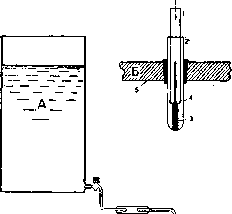
Figure 2. Apparatus for dosing the solution of bleaching powder: A—tank with 1% solution; B—details of the float: 1—glass tip with rubber ring; 2—test tube; 3—glass soldered cone; 4—rubber ring; 5—plug-float; V—dosing tank with regulating float. liquid is possible at various stages of the purification process. The most effective will be the chlorination of already treated liquid (freed from organic matter)
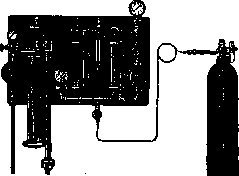
Figure 3. Ornstein system chlorinator for 5 kg of chlorine per hour.
substances), i.e., after biological oxidizers (a secondary settling tank is required for 1–2 hours of contact). But sometimes chlorination of "raw" sewage is done before entering the settling tank (this eliminates the stench). In Emscher tanks, chlorination is carried out in the middle of the channels. Chlorination of infected hospital sewage (including from hospital laundries) should be carried out before it enters the municipal sewer network (ensuring 1–2 hours of contact). The bacterial effect of sewage disinfection with chlorine gas can be very high (up to 99% reduction in the total number of bacteria). In a general sanitary evaluation of various methods of sewage disinfection, it must be taken into account that the above-mentioned technical methods by no means always guarantee complete sterility of the treated waters. This applies in particular to waters containing suspended substances. Therefore, the possibility of secondary reproduction of bacteria after the inhibiting effect of the residual active chlorine ceases is not excluded. Installations for sewage disinfection abroad (especially in Germany and America) have recently, with the
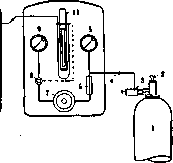
Figure 4. Diagram of the Ornstein system chlorinator: 1 - cylinder with liquid chlorine; 2 - shut-off valve; 3 - connection valve; 4 - gas pipeline; 5 - high-pressure manometer; 6 - gas filter; 7 - pressure-reducing valve; 8 - regulating valve; 9 - low-pressure manometer; 10 - gas outlet (during disassembly of the device); 11 - capillary gas meter; 12 - check valve; 13 - absorption vessel; 14 - tap water manometer; 15 - regulating valve; 16 - pressure-reducing valve; 17 - water supply pipe; 18 - chlorine water outlet.
introduction of disinfection with gaseous chlorine and with the decrease in its price (in Germany 0.5 marks per kg), are noticeably spreading. Recently, Ornstein apparatuses have been acquired for the sewage treatment plants of Moscow, Kharkov, and Tula. The cost of sewage disinfection is determined by the price and dose of the reagent. The price for 1 kg of bleaching powder (33% active chlorine) is about 30 kopecks, for chlorine gas - about 1 ruble. The initial equipment for bleaching powder depends on the size of the reservoirs (wood, concrete). For chlorine gas, the Ornstein apparatus, producing 2.5 kg of chlorine per hour, costs (1927) about 2,000–3,000 rubles. 2.5 kg of chlorine is sufficient for 10–50 cubic meters of liquid per hour (depending on the dose), i.e., for a daily sewage discharge of 240–1,200 cubic meters, which at a water consumption of 80 liters per resident is sufficient for a population of 3,000–15,000 residents.
Related articles
Mentioned in
Cite this page
“Sewage.” Soviet Medical Encyclopedia. English translation of Bolshaya Meditsinskaya Entsiklopediya, 1st ed. (Moscow, 1928–1936), ed. N. A. Semashko. https://sovietmedicalencyclopedia.pages.dev/article/sewage/