Denitrification
Historical document, translated for reference. It reflects medical knowledge of the 1920s–30s and is not medical advice.
Summary
Denitrification is the biological process of reducing nitrates to nitrites, ammonia, or free nitrogen. Many bacteria possess this ability, with direct denitrification playing a crucial role in nitrogen cycling and anaerobic conditions.
Encyclopedia article (1928–1936)
Denitrification, biological process of the reduction of nitrates (nitrate salts) to nitrites (nitrite salts), NH3, or free N. In microbiology, D. refers to the decomposition of nitrates with the release of free N. Many bacteria have the ability to perform D., but many of them carry D. only to nitrites, and then in the presence of amides or amines, there is a purely chemical process of free N release ('indirect' D.). In nature, 'direct' D., which is entirely associated with the life activity of bacteria, for which this process is partly trophic (assimilation of N for protein synthesis), and mainly (which is especially important) energetic - the use of O2 in the oxidation of organic C or S (Beyerinck). These D. reactions proceed according to the following equations: 6C + 4KNO3 = 2K2CO3 + 3CO2 + 2N2 (van Iterson); 5S + 6KNO3 + 2CaCO3 = 3K2SO4 + 2CaSO4 + 2CO2 + 2N2 (Beyerinck). In both cases, denitrification creates the possibility of life and oxidative processes under conditions of anaerobiosis. The first of these processes is widely distributed wherever nitrates, organic matter, and insufficient air supply are present (soil, polluted bodies of water, sewage treatment facilities). The decomposition of cellulose with simultaneous D. has great practical importance. Undoubted denitrifiers are B. denitrificans, B. fluorescens, B. radio-bacter, B. pyocyaneus. - The causative agent of the second process (with S oxidation), Thiobacillus denitrificans, discovered by Beyerinck, - is a typical prototroph (not requiring organic matter), also widely distributed wherever free sulfur can be expected (soil, sulfur springs, bottom sediments in rivers, seas, sewage facilities). S oxidation can lead to the formation of sulfates (gypsum and Deville's salt) in concrete and cause more or less severe deformation of structures. ^ S?-,> 4*. Figure 1. Figure 2. Figure 3.
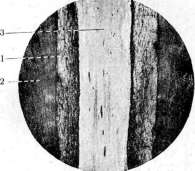
Figure 4.
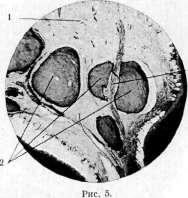
Figure 1. Branches of dentinal tubules in the peripheral layer of dentin (at the border with enamel). Figure 2. Regular striation of dentin, depending on the presence of dentinal tubules in its main substance. The globular nature of the calcification of the peripheral layer of dentin - zone of interglobular dentin {/}. Figure 3. Deposition of secondary dentin (2) on the walls of the pulp cavity of the upper central incisor; deformation of the pulp cavity; 1 - pulp of the tooth. Figure 4. Deposition of secondary dentin (1) on the walls of the root canal and the resulting narrowing of the canal lumen; 2 - normal dentin; 3 - pulp of the root canal. Fig. 5. Denticles (2) in the pulp (1) of the tooth; 3 - nerve trunk, compressed between two denticles. (From the author's preparations.) See article Dentin.
By returning nitrogen to the atmosphere, the processes of D. have great significance in the general cycle of this element. In agriculture, the process of D. must be taken into account when applying artificial fertilizers (nitrates) to the soil. In hygiene and sanitary engineering, denitrification plays a significant role in the operation of sewage treatment facilities (see Aeration, Biological method of sewage treatment). Thanks to D., oxidative processes can proceed without access to air: in the deep layers of filter fields, D. of nitrates formed in the surface layer occurs. The same thing happens in poorly aerated biooxidizers (in percolators and especially in contact filters). This feature of D. was practically used in Belfast (Ireland), where the abundance of nitrates in the purified water caused the undesirable lush development of algae in the bay water, into which the purified water was discharged (Kinnicutt).-It should be noted the use of D. in sanitary water analysis when determining the biochemical oxygen demand of the liquid for O2 by the Lederer method, when NaNO3 is used as a source of oxygen for biochemical oxidation of organic matter. D. of purified wastewater can introduce significant complications into the operation of settling tanks when using activated sludge (see). The ease and speed with which D. proceeds can easily distort the results of nitrate determination in water analysis if the sample is not preserved and the analysis is not done immediately after sampling.
Related articles
Mentioned in
Cite this page
“Denitrification.” Soviet Medical Encyclopedia. English translation of Bolshaya Meditsinskaya Entsiklopediya, 1st ed. (Moscow, 1928–1936), ed. N. A. Semashko. https://sovietmedicalencyclopedia.pages.dev/article/denitrification/