Irrigation Fields
Historical document, translated for reference. It reflects medical knowledge of the 1920s–30s and is not medical advice.
Summary
Irrigation fields are land areas used for wastewater treatment through natural soil self-purification biological processes. They combine sanitary wastewater treatment with agricultural utilization of water and fertilizing substances.
Encyclopedia article (1928–1936)
IRRIGATION FIELDS, FILTRATION FIELDS (of intermittent filtration), land areas adapted for the purification of wastewater through natural biological processes of soil self-purification. Therefore, these biological purification methods are usually called natural or soil methods. In essence of the purification process and in the construction of facilities, there is no particular difference between filtration fields and irrigation fields. The distinction between them lies mainly in the fact that filtration fields have exclusively sanitary purposes, while on irrigation fields, the purely sanitary task of wastewater purification is combined with agricultural use of the water itself and the fertilizing substances contained in it. In most cases, this second task is achieved only under conditions of very small loads. On filtration fields, the load (irrigation dose) is 10-20 times higher than on irrigation fields. This quantitative difference is also reflected in the design of individual parts of the structures and their economic evaluation. The design and operational methods of so-called cesspool fields (see) essentially distinguish these latter, even when they have agricultural use, both from irrigation fields and from filtration fields. The concentration of impurities in a removal system is determined as 1-5 liters per inhabitant, while in wastewater it is 50-250 liters. Filtration fields and irrigation fields, as one of the methods of biological purification, are applicable to wastewater (see Wastewater) containing organic pollution of both domestic and industrial origin. Since filtration fields and irrigation fields, when properly operated, yield purified water of high degree of mineralization, their construction often provides the best solution to the problem of sanitary protection of bodies of water. But these structures also have certain disadvantages (see below), which limits their widespread applicability. The possibility of agricultural use of wastewater liquid as fertilizer or as irrigation water allows for partial (filtration fields) or complete (irrigation fields) combination of this economic task with purely sanitary tasks. In this case, the choice between irrigation fields and filtration fields is determined by technical conditions and economic calculation. In many cases, a combination of both types of fields is quite appropriate. As structures most closely related to the use of natural processes of soil self-purification, irrigation fields and filtration fields require certain natural conditions for their implementation (relief, soil-hydrological conditions, amount of atmospheric precipitation, location in relation to bodies of water, etc.). For approximate calculations, the following loads on various soils can be adopted (Table 1). Table 1. Soil Per 1 hectare per day in m³ Annual layer in meters Filtration fields Irrigation fields Loam 100-300 50-100 25-50 15-25 50 35 25 15 3.6-10.0 1.8-3.6 0.9-1.8 0.5-0.9 1.8 1.2 0.9 0.5 Clay and peat are generally unsuitable for irrigation fields, as they evaporate rather than filter the liquid and carry negligible loads. The possibility of irrigating wastewater with chernozem and loess-like loams is questionable. In the hydrological and sanitary characterization, the nature of the subsoil, the level of the groundwater table, and their connection with aquifers feeding groundwater wells, springs, and with artesian horizons are very important. Highly permeable subsoil (gravel, shell rock, coarse sands) facilitates water drainage and allows for the abandonment of closed underground drainage. On the contrary, clays, layers of ortstein or peat create great difficulties. Fractured rocks as subsoil are very dangerous as they create a threat of contamination of groundwater and artesian waters at considerable distances from the fields. It is clear that in the case of irrigation fields, all these soil features have less importance due to the smaller load and significant evaporation, but then purely agricultural requirements appear.- Of the elements of climate, temperature, amount of precipitation and evaporation (all of course in their annual course) particularly affect the operation of irrigation fields and filtration fields. Depending on the soil and locality, the amount of atmospheric precipitation is important not
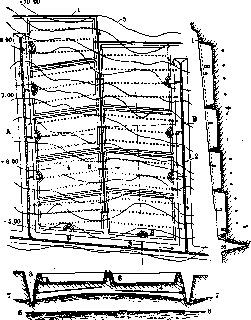
Figure 1. Plan of a field area with contour lines and all necessary structures: 1-distribution ditches; 2-drainage ditches; 3-spring outlets; 4-drainage; 5-contour lines before field construction; 6-surface level of groundwater before irrigation; 7-surface level of groundwater after irrigation; 8-irrigation outlets.
only for irrigation fields, but also for filtration fields due to the significant volume of water,
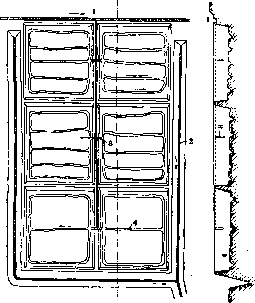
Figure 2. Irrigation fields-scheme of use: 1-distribution ditches; 2-drainage ditches; 3-irrigation outlets; 4-irrigation furrows.
periodically increasing the load. Areas of excessive moisture and subsoil moisture make the construction of irrigation fields generally irrational; conversely, areas of insufficient moisture dictate their use; temperature, not to mention its influence on the course of biochemical processes in the soil and its importance for vegetation on irrigation fields, also affects the filtration rate, since
Figure 3. Scheme of irrigation "under ice": 1-ice; 2-irrigation furrows; 3-drainage ditch.
it strongly influences the coefficient of viscosity. In places with severe winters, slowed filtration and rapid cooling of the liquid inevitably lead to freezing of the liquid on the surface of the fields, which requires a corresponding height of the ridges enclosing the plots (up to 1 m) and a horizontal surface of the plots themselves. Figure 4. Outlet from drainage into a drainage ditch: 1-clay drainage pipe; 2-layer of clay; 3-wooden pipe; 4-discharge chute; 5-filling of peat; 6-clay pipe. The rapidly proceeding process of "degradation" of soils (disintegration), irrigated with wastewater, along with the accumulation of organic substances in the surface layers, leads to a decrease in the filtering capacity of the soil. This circumstance must be taken into account when designing and planning the development of treatment facilities. General 4
IfWWWWWF»
Figure 5. Spring outlet: 1-earth ring; 2-clay pipe; 3-wooden hoop; 4-wooden chute; 5-fascines. The general layout of irrigation fields, as well as filtration fields (shape of plots), is determined by the location of irrigation canals and mainly drainage ditches, and the direction of the latter must be closely linked to the hydrological conditions of the area. The irrigation system consists of a network of distribution, canals bringing water to the plots (brick, concrete, wood, turf) (Figure 1). Their dimensions, cross-section, slopes Fig. 6. outlet from a distribution canal are subject to hydraulic calculation. The outlet from distribution canals is made with the help of gates of various designs. For winter, to prevent clogging with snow and cooling of the liquid, the canals are covered with wooden shutters. Water distribution over the surface is carried out with the help of furrows made with a plow, hiller or shovel (ridges) (Figures 2-4). For the purpose of lowering the groundwater level, which can rise significantly under the influence of irrigation, a drainage system is installed, consisting of open drainage ditches and underground closed drainage (mostly of clay pipes). On filtration fields, open drainage ditches are most effective. Underground drainage usually removes a very small percentage of the water supplied to the plot. Its cost amounts to 50% to 70% of the total cost of construction. The load
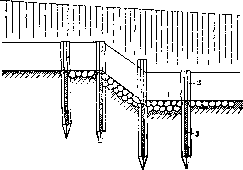
Figure 7. Drop on a drainage ditch: 1-pile; 2-stone riprap; 3-piling.
above 100 m3 per 1 hectare per day leaves so much sediment on the surface that it makes advisable its preliminary separation (see Basins, settling basins in sewerage). Operational difficulties and purely sanitary considerations (prevention of odors from decaying sediment, multiplication of flies) make this measure quite appropriate even with smaller loads and even with irrigation fields.
Figure 8. Earth distribution canal.
When calculating the size of the area allocated for irrigation fields or filtration fields, it is necessary to add about 20% to the useful irrigation area for drainage and distribution canals, ridges, roads. Determination of the area of irrigation fields is significantly more difficult, as the load on them depends mainly on the nature of the cultivated plants, on the farm plan and on climatic conditions (see below). Operating conditions must also be taken into account. Depending on the requirements,
Figure 9. Wooden distribution canal. Figure 10 Brick distribution canal.
imposed on the use of irrigation fields, the following should be distinguished: 1) Irrigation fields as independent treatment facilities, when the entire process of wastewater treatment throughout the year takes place on the territory of the irrigation fields. Since even under the most favorable climatic conditions there are still periods when water for agricultural crops is not needed, during these periods wastewater treatment takes place on special reserve plots, the area of which usually ranges in pre-irrigation fields, pre






from 20% to 30% of the entire area. Examples of such structures can serve as irrigation fields in many German cities, and in the USSR - in Odessa and Kiev. 2) Special irrigation fields are used mainly for agricultural purposes, i.e., those that fundamentally use wastewater as fertilizer; in this case, the main task - wastewater treatment - lies on any other Fig- ii- Drainage canal-GOM OCHISTITel'nom SO- nava: ^F^ny; 2-piles. facility, and irrigation fields receive water only in the amounts necessary for agricultural purposes; irrigation fields of this type can undoubtedly be arranged when there is free land area at any treatment plant, whether natural or artificial methods of treatment. In recent times, such irrigation fields have been arranged around the Lyubertsy irrigation fields in Moscow. To avoid confusion in concepts, irrigation fields of the first type should be called "sanitary" irrigation fields, and of the second type - "agricultural" irrigation fields. Depending on climatic and economic conditions, all types of agricultural plants can be cultivated on irrigation fields, but, considering the predominant arrangement of irrigation fields near cities and settlements, it is advisable to recommend for the economy of irrigation fields a vegetable direction and especially vegetable-milk with the cultivation of fodder grasses, root crops, and silage plants. The advantages of the latter economy are the following: a) more even distribution of wastewater in different periods of the year (garden plots

Figure 1;
ODrena
ODrena Vegetable irrigation in furrows.
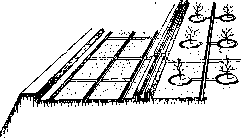
Figure 13. Irrigation of meadows and fruit trees.
a) the predominantly continuous irrigation of fields in winter and meadows in summer); b) the high 'water-holding capacity' of meadow and silage crops; c) complete sanitary safety in using milk from irrigation fields (pasteurization) as opposed to vegetables; d) more even and rational distribution of labor force; e) more complete utilization of waste from vegetable farming. The distribution of wastewater on irrigation fields is an extremely complex task. The total annual load for the central part of the USSR with average soil permeability (light loams and sandy loams) is given in table 2. When drawing up an irrigation plan, it must be taken into account that meadow crops are excluded from irrigation in January, February, March, November and December, while vegetable gardens are excluded in April, May, September, and October. Table 2. Load per 1 hectare of irrigation fields. Crops Annual (in m³) Daily (in m³) Annual layer (in m) Meadows........ Vegetable gardens and root crops ..... Reserves from...... to...... 18,000 10,000 20,000 40,000 27 55 110 1.8 1.0 2.0 4.0 To evaluate the economic effect of agricultural crops on irrigation fields, table 3 provides data on average and maximum yields (in centners per hectare) according to data from Moscow (10 years) and Berlin (50 years). Table 3. Moscow Berlin i ! Crops avg. max. avg. l max- ! im. Late cabbage . Early cabbage . Table beet . Fodder beet . Table carrot 340 260 460 185 225 185 1,160 610 295 1,050 445 295 210 300 100 540 210 240 170 210 500 150 3i5 400 | 270 ! Cauliflower . | Tomatoes, eggplants, and pumpkin react extremely favorably to irrigation with wastewater (fig. 12). Potato and root crops from the crucifer family react unfavorably to irrigation, the latter easily spoiling during storage. The cultivation of medicinal plants is quite appropriate on irrigation fields, since most valuable medicinal plants require abundant fertilization. Among tree species (fig. 13), the basket willow responds most favorably (yield up to 30-40 m3 of wood per hectare per year). Winter irrigation (freezing) plays a significant role in accumulating nutrients in the soil, especially in areas of excessive and normal moisture, since during the vegetation period irrigation is usually quite infrequent and in any case insufficient for nutrient accumulation. Mandatory winter irrigation also coincides with the interests of even distribution of wastewater for purification purposes. This condition—winter freezing—requires appropriate construction of protective ridges and for spring time a reserve irrigation area that guarantees protection of water bodies from contamination. Irrigation with wastewater is inevitably a source of intense overgrowth of cultivated plants with weeds. Constant and intensified weed control significantly increases the cost of cultivating agricultural plants and substantially limits the range of plants on irrigation fields, often forcing abandonment of plants with weak development in the initial growth period (e.g., carrots, turnips, onions, etc.).-To evaluate the fertilizing value of wastewater, the following calculation of the main fertilizer ingredients, compiled according to data from Bachaus and Langbein for Berlin (table 4), can be made: with content in wastewater (in mg per 1 liter) N-100, P2O5-18, K2O-51, CaO-100; in purified liquid (in mg per 1 liter) N-19, P2O5-1, K2O-17, CaO-130. Table 4. Content and use of fertilizer ingredients P*Oя k2o CaO Given in m³ per hectare. . , Used by the yield Removed by weeds, drainage water and air...... Of which: by water ........ by weeds (probably) by atmosphere .... I 000 ! 141 180 141 1,000 100 1,325* 1,300* 25 Leaching of CaO from the soil occurs. The ratio between nutrient elements in plants is usually for P : K : N-1 : 2 : 1, while in Berlin's wastewater it is 1 : 2.8 : 5.5. Therefore, P is the determining element according to the law of minimum, which determines the useless waste of K and N, which are given in excess. In this case, N is lost mainly by denitrification (see). The task of operating irrigation fields besides maintaining the irrigation and drainage system consists of constant care for the surface of the filtering area itself, which involves cultivating the soil of irrigation fields with agricultural implements: plowing, harrowing, and furrowing. Cutting irrigation furrows for even distribution of wastewater is the most essential operation in preparing the soil for irrigation. It should be done with special implements in two furrows; for summer irrigation, furrows are cut at a distance of 2 to 5 m and up to 30 cm deep, while for winter irrigation—at a distance of 1 m and up to 40 cm deep to allow for the introduction of wastewater under the ice. In general, 2 to 4 soil cultivations are required during the warm season. Finally, weed control should be included in soil cultivation, which besides plowing or harrowing consists of timely mowing of the slopes of ridges and drainage and distribution canals. The winter season is an especially unfavorable period for operating irrigation fields, for example, in the central part of the USSR irrigation fields usually operate for only 4 months through freezing, and their productivity during this period does not exceed 50% (this circumstance must be taken into account in the design and construction of irrigation fields). The only way to somewhat increase the winter permeability capacity of filtration fields is the above-mentioned cutting of frequent and deep irrigation furrows for introducing wastewater under the ice. Turning to the economic evaluation of filtration fields and irrigation fields, it should be noted that the economic effect of filtration fields as structures of purely sanitary-technical value is easier to determine than that of irrigation fields, since in the latter case, when determining the overall economic effect, it is necessary to consider not only the interests of the municipal budget but also the interests of solving the vegetable-milk problem for industrial centers in connection with the scarcity of fertilizers and the issue of relieving transportation from long-distance transport of perishable products (table 5). -Table 5. Economic evaluation of devices. Cities Water consumption Load per 1 inhabitant per 1 hectare Cost of devices Cost of operation per 1 hectare ! per 1 inhabitant per 1,000 m³ per 1 inhabitant per year Paris ...... Berlin ..... Moscow: filtration fields irrigation fields Odessa: irrigation fields 350 250 80 50 110 33 120 25 2,400 rub. 981 » 10,000 » 1,903 » 1,380 » 7 rub. 45 6 » 45 6 » 75 6 » 10 7 rub. 45 K. 7 » 50 » i 13 » 00 » 13 » 00 » 94.5 kopecks. 63.5 » 38.2 » 38.2 » 12 » 20 » \ 22.2 Data on income from irrigation fields is extremely scarce. According to data from the state farm on Odessa irrigation fields in 1930, net profit from vegetable crops amounted to 1,430 rubles per hectare. When evaluating the economic aspects of filtration fields and irrigation fields, it is necessary to consider not only the cost of the fields themselves and service structures (roads, bridges, farmsteads, water supply, etc.), but also the cost of water delivery, i.e., the cost of water conduits and pumping stations. With any significant distance from the city, the costs of constructing water conduits become a heavy burden on initial capital investment (and later as interest on capital, depreciation), while pumping the liquid (height and distance)—on annual expenses. In the economic evaluation of irrigation fields, along with income from the harvest, in addition to purely agronomic expenses, expenses for maintaining, accommodating, and feeding the labor force (in Odessa 3,000 workers for 600 hectares), for organizing transport when removing the harvest, for constructing vegetable storage facilities, etc., must be taken into account. Sanitary evaluation of irrigation fields and filtration fields. Under normal operating conditions (the loads given above are based on obtaining well-purified liquid), the soil method gives excellent results both in terms of mineralization of organic pollutants and bacteriologically (tables 6 and 7). Table 6. Components Paris (1905) Berlin (1905) waste- puri- waste- puri- \ water fied water fied water Organic substances in mg/l . 43.3 37.4 3.9 Ammonia nitrogen in mg/l. . 22.0 0.5 10.2 0.4 Nitrate nitrogen in mg/l . . 0.3 4.5 - 4.5 Chlorides in mg/l . . . - 20.0 14.7 Bacteria in 1 cm³ . . . 3,690 MLN. 8 29,840 Load per 1 hectare (in m³) 38 M$ Oxidizability and composition Moscow (Lyubertsy) (1929) wastewater Oxidizability in mg/l . . Ammonia nitrogen in mg/l. . . Nitrate nitrogen in mg/l . . Chlorides in mg/l .... Bacteria in 1 cm³: «Agar» 37°....... «Endo» 37°....... Load per 1 hectare per day 61.0 86.3 203.0 3,260 1,700,000 purified water from drainage canal No. 4 purified water from drainage canal No. 77' 10.1 9.4 14.1 171.5 3,830 675 86-out of 10.6 16.1 11.5 173.6 4,690 1,140,185 l3 Conditions of winter operation (temperature, ice formation) usually result in deterioration in performance, which, given the heavy load, is particularly noticeable on filtration fields. For low-permeability soils, increased precipitation above the norm also has a negative effect. But in general, it is undoubtedly the case that filtration fields, and especially irrigation fields, produce purified water of such high quality that they rank first in terms of sanitary evaluation of treatment facilities and provide the greatest guarantees for the safety of the filtrate.
However, it should not be forgotten that both irrigation fields (I. f.) and filtration fields (P. f.) under winter operating conditions in a harsh climate actually do not function, but serve as accumulators for wastewater, which in the spring enters the water body in almost untreated form. No less important, especially with large irrigation and filtration fields, are the difficulties in proper liquid distribution, which easily leads to distortion of the operation of individual sections and to the possibility of accidents (erosion of ridges, drainage of spring releases). For irrigation fields, this is compounded by the requirement to ensure high crop yield and quality, and these economic considerations easily push purely sanitary requirements into the background and lead to abuses in both open (increased discharge to reserves) and hidden form (discharge of untreated liquid with masking of the location or at night). In the sanitary assessment of the impact of irrigation and filtration fields on the surrounding environment, it is difficult to find positive factors, as in any other treatment facility. The impact on open water bodies (rivers), as already noted, depends entirely on the nature of operation. The introduced pollution, mainly bacterial, for the summer period and in the case of irrigation fields and with careful operation of filtration fields, is minimal, and its significance is determined by the relative capacity of the water body and displacement conditions. On the quality of local groundwater, due to the sharp change in their regime, irrigation and filtration fields can have such a sharply negative impact that they can eliminate the possibility of water use from wells fed by the contaminated horizon. Therefore, settlements on the territory of irrigation and filtration fields should be served by an impeccable water supply for drinking and domestic needs (Table 7, especially for washing vegetables). Air pollution on the territory of irrigation and filtration fields depends entirely on the amount of organic matter (including sludge) per unit area. But even on irrigation fields, where there are minimal loads, periods of pronounced odor are not excluded. Deep in autumn, in winter, and especially in spring when eliminating winter sludge accumulations, irrigation fields differ little from filtration fields in terms of odor, and filtration fields under proper operation (adherence to calculated load norms, regular processing) are noticeable in terms of odor only in the immediate vicinity during the summer. At the same time, the sludge retained on the surface and relatively slowly decomposing with the formation of foul-smelling products becomes very important. Particularly great sanitary danger can be created by irrigation and filtration fields under certain conditions in relation to the spread of helminthiases and other gastrointestinal infections. One of the paths of infection has already been noted above - treated and groundwater. But even greater importance in this regard are agricultural products (vegetables, milk) that are transported out and even exported to distant distances, and the infection of personnel serving the fields and crops. Contamination of vegetables can occur directly from wastewater with careless irrigation and from splashing by raindrops, and by insects and humans during care and harvesting, and when washing vegetables in apparently clean 'treated' water. Contamination of milk is also easily possible with careless livestock maintenance. Calmet notes that milk from irrigation fields has a specific taste and that it spoils very easily. Some believe that irrigation and filtration fields favor the development of malaria. It cannot be denied that the surface where water stagnates and drainage ditches are places of mass mosquito development, and lush vegetation (grass, shrubs) provide shelter for myriads of insects, but these mosquitoes are not Anopheles, which apparently cannot even tolerate slightly polluted water. The presence of individual foci favorable for its development on irrigation and filtration fields is no more likely than in their vicinity. Direct observations on the bacterial contamination of vegetables from irrigation fields (Kotsyn) show no difference compared to vegetables grown in suburban gardens (where fertilization from garbage collected from cesspool barrels was widely used). The irrigation fields of Paris and Berlin do not encounter objections from this side in the sale of their products, both vegetable and milk, to the urban population. It is unquestionable that thorough cleaning and washing of vegetables before shipment are sufficiently effective preventive measures. However, Calmet draws attention to the greater danger of vegetables in case of an epidemic in the city. Where there is no basis to count on strict adherence to rules for thorough washing and cleaning of vegetables on irrigation fields, it is necessary to exclude from the list of permissible crops those that can be consumed uncooked (cucumbers, lettuce, onions, radishes, carrots, turnips, tomatoes, etc.). As early as 1907, Calmet noted a sharp reduction in the use of irrigation fields in England. Since then, they have almost disappeared in England and the USA. In Germany and France, they have remained only where large sums were spent on their construction, but even there they are no longer expanding (Paris, Berlin), giving way to bio-stations. In this process, the main role belongs to economics, as well as the lack and high cost of suburban land, especially near large population centers. However, the fundamental change in economic conditions in the USSR after the October Revolution again raises the question of the wider application of irrigation fields in our country's practice, since with the abolition of private land ownership, the aforementioned difficulties have disappeared. In addition, the development of suburban state farms gives a new impetus to the use of this method. Regardless of this, irrigation fields retain all their significance for individual holdings, small settlements, hospitals, sanatoriums, small cities, and some factories and plants.
Related articles
Mentioned in
Cite this page
“Irrigation Fields.” Soviet Medical Encyclopedia. English translation of Bolshaya Meditsinskaya Entsiklopediya, 1st ed. (Moscow, 1928–1936), ed. N. A. Semashko. https://sovietmedicalencyclopedia.pages.dev/article/irrigation-fields/