Biological Method of Sewage Treatment
Historical document, translated for reference. It reflects medical knowledge of the 1920s–30s and is not medical advice.
Summary
This article describes the biological methods used for treating sewage containing organic substances. It details the microbial and biochemical processes, including mineralization and decomposition, facilitated by the diverse microflora and microfauna known as the biological population.
Encyclopedia article (1928–1936)
BIOLOGICAL METHOD OF SEWAGE TREATMENT, containing organic substances (in a broad sense), encompasses all those methods in which microbial, biochemical processes (of decomposition and mineralization of organic matter) are used, in which diverse microflora and microfauna, the so-called "biological population," take active or passive part.
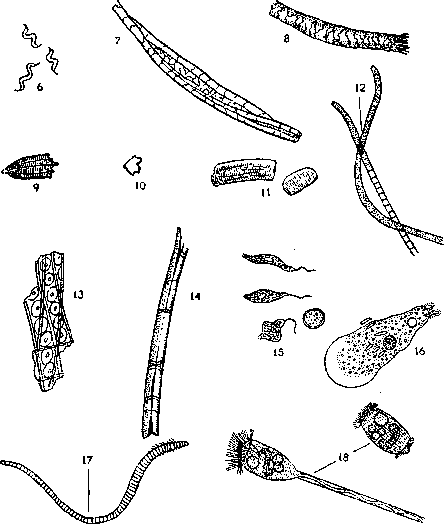
1-Zoogloea ramigera x 110. 2-Streptococcus x 280. 3-Sarcina paludosa x 210. 4-Bacillus subtilis x 280. 5-Chromatium Okenii x 280. 6-Spirillum undula x 280. 7-cotton fiber x 210. 8-wool fiber x 210. 9-butterfly scale x 140. 10-grain of laundry blue x 140. 11-muscle fibers x 140. 12-Beggiatoa alba x 210. 13-coniferous wood fiber x 210. 14-flax fiber x 210. 15-Euglena viridis x 140. 16-Amoeba limax x 700. 17-Tubifex rivulorum x 2. 18-Vorticella microstoma x 210.
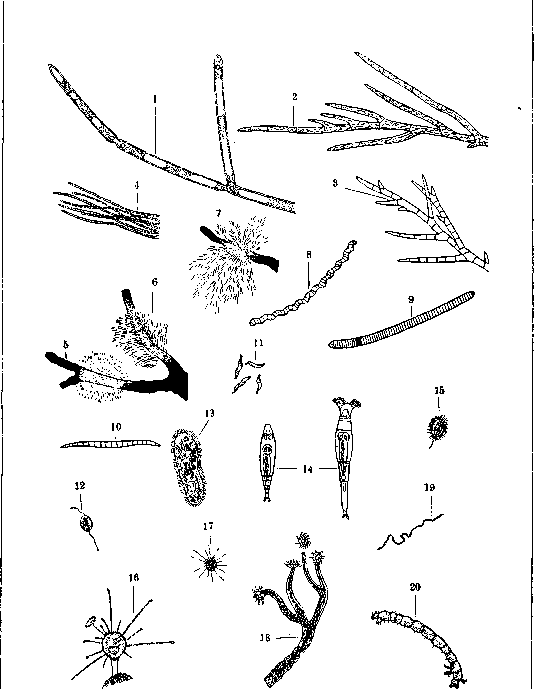
1-Leptomitus lacteus x 280. 2-Fusarium aquaeductuum x 210. 3-Stigeoclonium tenue x 280. 4-Sphaerotilus natans x 210. 5-Leptomitus lacteus x 1 1/2. 6-Sphaerotilus natans x 1 1/2. 7-Fusarium aquaeductuum x 1 1/2. 8-Spirulina (Arthrospira) Jenneri x 210. 9-Oscillatoria Froelichii x 210. 10-Oscillatoria chlorina x 420. 11-Thiospirillum sanguineum x 210. 12-Bodo ovatus x 210. 13-Paramaecium caudatum x 140. 14-Rotifer vulgaris x 140. 15-Cyclidium glaucoma x 210. 16-Podophrya fixa x 140. 17-Actinophrys sol x 105. 18-Anthophysa vegetans x 210. 19-Spirochaete plicatilis x 210. 20-Chironomus larva x 4.
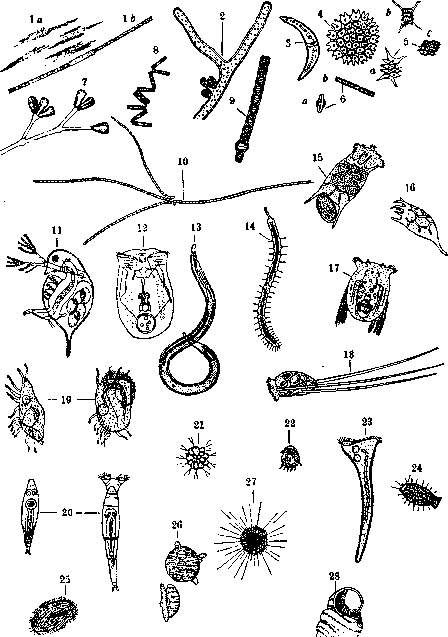
1-Aphanizomenon flos aquae, a x 35, b x 280. 2-Vaucheria sessilis x 70. 3-Closterium Leibleinii x 70. 4-Pediastrum Boryanum x 140. 5-a) Scenedesmus acutus x 140, b) Scenedesmus quadricauda x 210, c) Scenedesmus obtusus x 210. 6-a) Navicula amphisbaena x 105, b) Synedra ulna x 105. 7-Gomphonema olivaceum x 210. 8-Diatoma vulgare x 105. 9-Melosira varians x 140. 10-Cladothrix dichotoma x 210. 11-Daphnia pulex x 17. 12-Asplanchna priodonta x 40. 13-Dorylaimus stagnalis x 2. 14-Stylaria lacustris x 7. 15-Anuraea aculeata x 140. 16-Anuraea cochlearis x 140. 17-Polyarthra platyptera x 140. 18-Triarthra longiseta x 105. 19-Euplotes charon x 210. 20-Rotifer vulgaris x 140. 21-Synura uvella x 175. 22-Aspidisca lynceus x 250. 23-Stentor polymorphus x 55. 24-Coleps hirtus x 210. 25-Chilodon cucullulus x 140. 26-Arcella vulgaris x 140. 27-Actinosphaerium Eichhornii x 105. 28-Paludina vivipara x 3/4.
...of treatment facilities. In this respect, the biological method of sewage treatment is contrasted with methods of mechanical and chemical sewage treatment. The biological method of sewage treatment has received the widest application in all cases where the task of treatment consists of obtaining a "non-putrescible" liquid; the concept of the biological method of sewage treatment encompasses the following treatment devices: irrigation fields (see), filtration fields, septic and Imhoff tanks (see Basins); "biological oxidizers" of various types, aeration (see) of sewage with activated sludge (see), and treatment ponds. But as a technical term, the biological method of sewage treatment is usually applied only to so-called "biological filters," or "bio-oxidizers," with the facilities necessary for their operation for "preliminary sewage treatment." Very often such an aggregate of devices bears the name "biological station" (a homonym for a scientific institution conducting observations on the flora and fauna of a certain region). Whatever the complex of facilities for biological sewage treatment may be, they all, as stated, solve one and the same task—the obtaining of "non-putrescible" treated water. This state is characterized in analysis by the fact that the test water with an admixture of methylene blue, when stored in a hermetically (airless) sealed bottle at 20°, must not decolorize this dye within 7 days. The standards of the People's Commissariat of Health of the RSFSR (1923) generally require "non-putrescible" water, but the practice of sanitary supervision has retained the requirement of "non-putrescibility" for 7 days. In the language of modern methodology for sewage analysis, the phenomenon of "putrescibility" is determined by "relative stability" at 80%. This means that the biochemical oxygen demand of the treated liquid is 80% provided for by the supply of O2 contained within it. The demand for O2 is a measure of the contamination of the liquid by oxidizable (organic) substances. The supply of O2 is the sum of O2 dissolved in the liquid and O2 bound with nitrates and nitrites, which easily give up their O2 in the process of denitrification (see). Therefore, the "non-putrescibility" of the liquid can be achieved by a combination of two processes: 1) by lowering the demand for O2 (mineralization of organic substances) and 2) by increasing the supply of O2 in the treated liquid. Since no more than 7-15 mg of O2 per liter can be dissolved in pure water, and usually even less in treated waters, an increase in the supply of O2 is feasible only by means of the nitrification of nitrogenous compounds contained in the sewage. This dual role is performed to one degree or another by facilities for biological sewage treatment. The choice of the most suitable system of treatment facilities for a given case, the conditions of their operation, and consequently, the design, cost, and their sanitary-technical evaluation—all this presents a very complex task, but its solution depends to a significant degree on certain basic features of those biochemical processes whose technical application is being discussed. In this respect, any treatment facility operating as an oxidizer can be viewed as a kind of mechanism delivering O2 for complex biochemical processes which lead to the mineralization of the organic substances of the sewage liquid. In general, one can compare these treatment facilities to a furnace where "wet" combustion of organic matter occurs, whereby in place of high temperature stands the living catalyst of the process—the microbial population of these facilities. It would seem there can be no doubt that the quantity of organic matter subject to oxidation must be in a certain correspondence with the design and dimensions of the oxidation devices (with the dimensions and system of the furnace). The "load" of sewage per day per unit of area or volume of treatment facilities, indeed, constitutes one of the main tasks of calculation during design. But for the most part, by load is understood a certain volume of liquid subject to treatment, whereby known norms established empirically are used; for example, for Moscow conditions: filtration fields accept from 25 to 100 cubic meters per day per hectare (depending on the soil), bio-oxidizers—from 0.30 cubic meters per 1 cubic meter per day of filtering material, aeration tanks—3-5 cubic meters of liquid, aerofilters—2-4 cubic meters per 1 cubic meter of facility volume. In essence, however, the factor determining the magnitude of the load is the mass of organic matter, which can be different in nature (see Sewage waters) and in concentration. In this respect, the determination of the "biochemical oxygen demand" of a given sewage liquid is of exceptional value, which allows the total contamination of the liquid to be expressed by a number of mg of O2, regardless of its composition. This determination shows what quantity of O2 must be given to the liquid for its practically complete oxidation. The demand for O2, expressed in mg of O2 per liter, fluctuates within the range from 100 mg (with high water consumption per 1 person) to 700 mg and higher with low water consumption. For industrial sewage, the demand for O2 rises to 1,000-10,000 mg (waters from slaughterhouses, tanneries). For the sewage waters of a number of American cities, the oxygen demand per 1 inhabitant is about 75 g, for Moscow—about 40 g. Taking this latter value, we obtain, at different daily water consumption per 1 person, consequently, the "contamination" of 1 liter: at 100 liters (8 buckets)—400 mg, at 75 liters (6 buckets)—535 mg, at 50 liters (4 buckets)—800 mg, at 25 liters (2 buckets)—1,600 mg. Since the oxidative capacity of any facility has definite limits, the load of liquid of one concentration or another must be coordinated with them. The oxidative capacity of a facility is determined by two factors: the degree of microbial activity inherent in a given volume of the facility, and the conditions of O2 supply. Moreover, the first biological factor, insofar as one is dealing with aerobic organisms, depends on the conditions of air supply. In the case of sewage treatment on filtration fields, aeration is limited to a thin surface layer of soil, the respiration of which intensifies at the moments of liquid filtration, but, in general, is very weak. Therefore, the development of the microbial population of the soil is concentrated in this small layer (10-25 cm), and the conditions of irrigation (irrigation dose and inter-irrigation period) must be such that the active layer is freed as quickly as possible from the water filling the interstices where air penetrates. In the process of treatment itself, two phases are distinguished (Adeney, Phelps): 1) the oxidation of carbonaceous substances, proceeding initially and at a decreasing rate, and 2) nitrification, proceeding at a constant rate, but beginning only when the main mass of organic matter has already been oxidized. Both phases occur in this upper thin layer of soil and both must be provided with O2, but, in addition, O2 is also consumed by suspended substances introduced onto the surface of the soil. Oxidative processes continue, however, even below the aerated layer, but already at the expense of the secondary use of O2 bound in the aerobic zone, mainly at the expense of the O2 of nitrates (denitrification), whereby 2.85 mg of O2 is released from every 1 mg of nitrogen. Ultimately, the conditions of soil aeration determine the quantity of O2 that can be transferred per unit of time by a certain volume (surface) of it for the oxidation of organic matter. But the transmitter of O2, the living catalyst of this process, is the microbial population of the soil, the development and activity of which are determined not only by the influx of O2. In this respect, one especially has to reckon with temperature. A load perfectly suitable for summer will prove unacceptable for winter. The active reaction (see), to the value of which microbial processes are so sensitive, the presence of disinfecting substances in the sewage liquid, the absence of certain elements necessary for the development of organisms (e.g., N, P, and K in some industrial waters), and finally, the specific biological features of microorganisms—all this in one way or another affects the intensity of the process. And the more intense the oxidative process, the stronger the influence of all these factors, and the more sharply the oxidizer reacts to their change. For example, overloading filtration fields even with water (atmospheric precipitation) hinders soil aeration and creates an environment favorable for anaerobic processes associated with the accumulation of organic matter in the soil. If one considers bio-oxidizers from this point of view, even percolators (see below), it is clear that the conditions of air supply in them are many times better than in soil, even in sand. By virtue of this alone, the biological activity of the body of the oxidizers is higher, and the depth of microbial colonization is greater. Therefore, the high intensity of the oxidative process on a percolator is not surprising. But even here, wherever aeration is hindered (deep internal layers of material), foci of anaerobic processes arise, in which, just as in the soil, the main source of O2 becomes the O2 of nitrates formed in the upper layers.
By introducing artificial aeration, optimal physical-chemical conditions are created for the process of dissolving O2 and maximum productivity per unit volume of the structure is obtained. In particular, regarding all intensive methods of treatment, one must not lose sight of the fact that load standards are usually given in the form of a daily (24-hour) volume of liquid per 1 volume of the structure. If, in reality, one is dealing with, for example, 8-16-hour operation of a sewage treatment plant (and this often happens at small stations), then the basic condition is violated very strongly if the calculated daily load is compressed into these 8 hours. This means that the load during this time is increased 3-fold, and the rest of the time the oxidizer not only does not work, but sometimes even suffocates due to hindered ventilation. This is one of the most frequent causes of poor operation of biological stations, and they react more sharply to overload than irrigation fields, but on the other hand, the consequences of temporary overload are easier to eliminate. The second feature of the operation of bio-oxidizers is the need for thorough preliminary treatment (see below) of the liquid supplied to them. Everything that has just been said about the need for O2 refers to liquid without suspended substances, which are permissible only in minimal quantities, as they are highly demanding competitors for the O2 transmitted by the oxidizer. Therefore, it is necessary when determining the load to carefully take into account this component in the liquid being treated. Any improvement in preliminary treatment (especially the removal of colloids) is favorable for the operation of the oxidizer and is equivalent to a decrease in the O2 demand of the liquid being treated. Since the productivity of structures with intensive treatment is much higher than in irrigation fields, the amount of heat brought with the sewage liquid to the oxidizer is also greater. Therefore, the influence of climate on the operation of biological stations is much weaker than in the case of irrigation fields. But in a severe winter and with liquids of high concentration (low load), a decrease in air temperature is expressed by a decrease in the treatment effect. The microbial population of aeration tanks and aerofilters is especially sensitive to fluctuations in temperature: in whichever direction they occur, a weakening of nitrification is observed. Finally, speaking about the features inherent in all structures of the biological method of sewage treatment, one cannot forget about the maturation period, the time during which the specific microbial flora of these structures gradually develops. In the case of filtration fields (Lyubertsy fields of the Moscow sewage system), this period dragged on for 2-3 years. With bio-oxidizers, this requires 2-3 months in the warm season. In an aeration tank, normal operation is possible only after the accumulation of a sufficient amount of activated sludge, and the situation is exactly the same for all other structures of the biological method of sewage treatment. The maturation period can easily be shortened by artificial infection of a still sterile structure, for which sludge taken from operating devices of the same type is quite suitable. In practice, this is done in the case of aero-installations, Emscher tanks, methane tanks (see Basins). When starting up new installations, the most appropriate method would be to give them a very small load at first and only gradually, monitoring the results, bring it up to the calculated, normal one. This leads to the question of controlling the operation of biological treatment structures. The above-stated principles of the biological method of sewage treatment allow us to think that guiding data for understanding the operating conditions of oxidizers can be obtained by the following minimum of determinations: 1) biochemical oxygen demand, 2) suspended substances, 3) chlorides as a control of sample consistency, 4) oxidizability, 5) total, ammonium, nitrate, and nitrite nitrogen, 6) relative stability (with methylene blue) of the treated liquid. The first 5 determinations are made for the sewage liquid and at all stages of the biological station on average samples, and in case of sharp fluctuations in water inflow-on samples proportional to it. It goes without saying that accounting for the amount of water is absolutely necessary. Control of structures for preliminary treatment requires determination of sludge by volume. Biological analysis (see) sometimes provides very useful information of an indicative nature during a cursory inspection of biological method of sewage treatment structures and during observations of their influence on a water body. Bacteriological examination, as a control method, is used in exceptional cases when "bacterial" treatment is required (irrigation fields, soil filters, treatment ponds) or disinfection of treated or clarified waters is carried out. In this case, the focus is on accounting for the B. coli group. The biological method of sewage treatment, as already mentioned above, makes it possible to obtain a "non-putrefying" treated liquid, but in those cases where, due to the low concentration of sewage or favorable conditions for discharge into a full-flowing river, one can limit oneself to only some reduction in O2 demand and allow stability not at 80%, but less (putrefaction within 3-5 days)-in these cases, nitrification will turn out to be superfluous; here is an incomplete scheme of treatment structures, with partial treatment, which, in any case, will retain the preliminary treatment structures from the full scheme. These are so-called devices designed for the removal of coarse impurities (heavy and floating) and sludge (suspended substances) from sewage. For the most part, these structures relate to mechanical and chemical sewage treatment and are widely used in all methods of full intensive treatment. They are dispensed with only in the case of irrigation fields or filtration fields with low productivity. But every biological station usually has a screen for retaining coarse impurities, a grit chamber, and settling tanks for sludge removal are an integral part of every biological station. In these structures, in connection with the long stay of sewage liquid in them, not to mention the decomposition and rotting of sludge, physical-chemical and microbial processes occur (see Basins), changing the initial character of the sewage liquid, significantly lowering its initial "demand" for oxygen, especially by the removal of suspended substances and colloids, therefore these structures facilitate the subsequent final treatment of the liquid with the help of oxidative, biochemical processes, wherever this treatment takes place (whether in a water body, if one is limited to these structures, or on special oxidative devices, of which only contact and continuous-action oxidizers are described below-what constitutes the content of the concept of a biological station, of the biological method of sewage treatment in its narrow sense). The inventor of contact biological filters, or oxidizers, was Dibdin (1892). A contact oxidizer consists of a reservoir, about 1.2-1.5 m deep, with waterproof walls and bottom, loaded with "filtering material"-pieces of slag, coke, granite, brick rubble, etc., with a size of 15-25 mm (see figure 1). The reservoir is equipped with valves or automatic siphons regulating its
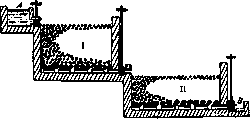
Figure 1. Scheme of a contact oxidizer: A-collecting reservoir for the accumulation of water clarified in the settling tank; I-first stage of the contact oxidizer; II-second stage of the contact oxidizer; B-outlet of treated water.
filling (from above) with sewage liquid and emptying (from below). The contact oxidizer is filled (1-2 hours) to the surface of the material with sewage liquid, which then stands in "contact" with the filtering material for 1-2 hours (hence the name "contact oxidizer"), after which it is discharged (1-2 hours), and in place of the water, the oxidizer is filled with air and stands empty for several hours (4-6 hours). During the "contact" (2 hours), suspended substances and colloids remaining in the sewage liquid after the settling tank settle on the surface of the material and are adsorbed by the highly developed surface of the pieces of material. At the same time, biochemical processes of destruction (mineralization) of the retained organic matter begin, which initially proceed at the expense of O2 dissolving in the liquid during the filling of the contact oxidizer, and then the same anaerobic hydrolytic and reductive processes that are encountered in settling tanks, septic tanks, and Imhoff tanks (see Basins). After draining the liquid, during the oxidation pause, the contaminants, firmly adhering to the pieces of slag and abundantly infected with the most diverse microbial population of the contact oxidizer, are subjected to the action of aerobic oxidative processes (up to nitrification), the products of which are absorbed and remain in the "biological" film, in the jelly covering the pieces of slag, and participate in the biochemical reactions occurring during the next "contact". Depending on the properties of the liquid, temperature, and the number of "fillings" on the contact oxidizer, it is possible to obtain a non-putrefying liquid after just one filling through the contact oxidizer. But usually, a secondary passage through a second, and sometimes a third, stage of the contact oxidizer is required. The second stage differs from the first only by the smaller size of the material (10-15 mm) and a somewhat shallower depth. In the second stage of the contact oxidizer, which receives already somewhat purified water, the processes of nitrification are manifested particularly sharply. The contact oxidizer is abundantly populated with worms, insect larvae, mites, and protozoa. The load on the contact oxidizer depends on very many conditions and fluctuates between 2-3 fillings per day. Initially, the water capacity of the contact oxidizer is about 40% (the volume of voids between the pieces of slag), but it gradually drops to 20-15% of the volume of the entire reservoir. This occurs due to the accumulation of suspended substances and colloidal jelly (of bacterial nature) in the body of the contact oxidizer, which is probably facilitated by poor aeration of the internal bottom layers of the contact oxidizer during the "oxidation" pause and complete anaerobiosis during "contact". A drop in water capacity below 20-15% necessitates resorting to washing the material, which is performed by unloading the slag onto screens washed with sewage liquid. This operation is required for the contact oxidizer every 2-3 years and presents great inconveniences in sanitary terms (odor, contact of workers with contaminated slag and sewage liquid) and is associated with significant monetary expense, which increases the cost of operation. In winter, contact oxidizers work quite properly under natural snow insulation. Among the advantages of contact oxidizers, it should be noted that, with proper care, they are tolerable near housing (there is no strong stench or flies). The liquid purified on the contact oxidizer is transparent, colorless, and does not produce sediment. The structure itself does not require a large difference in height between the opening of the pipe supplying the sewage liquid and the trough of the channel draining the purified water. A peculiar modification of the contact oxidizer is the so-called "plate" oxidizer, also proposed by Dibdin (1904) as a structure for preliminary treatment, for retaining suspended and colloidal parts of sewage waters, and for their aerobic processing (see Figure 2). The plate oxidizer is an open basin, 1.2 m deep, loaded with slate plates (or specially shaped tiles), which divide the entire volume of the reservoir into a multitude of shelves, the space between which are small settling tanks. This oxidizer is filled with raw sewage liquid, which stands in contact with the plates for two hours (settling period), after which it is drained, leaving the main mass of suspended substances on the "shelves" of the oxidizer. With the departure of the water, the space between the shelves is filled with air, in the presence of which (aerobically) an energetic decomposition of organic matter occurs, in which, besides bacteria, an abundant fauna (protozoa, mites, insects, worms) takes an active part. The oxidizer usually receives 2-4 fillings per day, and each time it is filled halfway. The sediment that accumulates in the oxidizer over time is easily removed by washing and is not foul-smelling. The plate oxidizer has not gained wide distribution. Contact oxidizers have not yet lost their significance in some cases and are quite
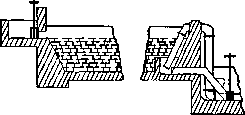
Figure 2. Diagram of Dibdin's plate oxidizer.
appropriate for small installations and for certain factory waters. In general, however, contact oxidizers in wide practice quickly gave way to "continuously operating oxidizers," or percolators, sometimes called "irrigation" biological filters or, even more incorrectly, "trickling filters." Of all these names, the French term "percolator" (lit. percolateur) is the most successful in essence. The percolator appeared almost simultaneously with Dibdin's contact oxidizer in America (Waring, 1891; Hazen, 1891) and in England (Lowcock, 1892; Stoddart, 1893; Corbett, 1893). It is interesting to note that the first three designers of the percolator used artificial aeration of the percolator (see Figure 3). The body of the percolator consists of pieces of filtering material (slag, foundry coke, etc.) of increasing size from top to bottom (from 10 to 40 mm); usually, percolators are given a height of about 2 m. The slag is loaded either directly onto the concrete base of the percolator or, better, onto a special second bottom, which ensures ventilation of the lower layers of slag and free drainage of the liquid. The sides of the percolator are not solid and consist either of large pieces of slag or of openwork brickwork to improve ventilation. But these devices are expedient only for small-sized percolators. The supply of air occurs, mainly, from above, together with the liquid, and very imperfectly. Therefore, the supply of air to the deep parts of the percolator is very weak: they are filled with N and CO2 and work oxidatively only at the expense of O2 bound in the upper layer, approximately 50 cm (Dunbar). The quality of purification is greatly influenced by the most uniform distribution of the liquid possible. This task is solved by a multitude of very different systems of "distributors." The main types of distributors are: 1) movable—in the form of automatically rotating devices (the principle of the Segner wheel), 2) movable—in the form of a self-moving filling wheel (Fiddian, Ham-Baker systems), 3) stationary—spraying water in a fountain, 4) the Dunbar cushion—a surface layer of fine material that slowly allows the liquid poured onto it to pass inside. The latter type of water distributor least satisfies the requirement of supplying air inside along with the water. With movable distributors, which are sometimes driven by a motor, the supply of liquid to the
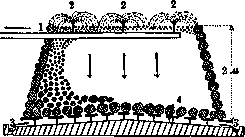
Figure 3. Diagram of a percolator: 1—supply of water clarified in a settling tank; 2—sprinklers (periodic action siphon not shown); 3—trough for purified water; 4—space under the second bottom.
The percolator operates continuously (hence the name "continuously operating" oxidizer). With sprayers, the periodicity of their action is ensured by an automatic siphon (e.g., every 5 minutes). In the percolator, the conditions for supplying oxygen to its population are so improved compared to the contact oxidizer that obtaining non-putrefying liquid (with high stability) is achieved in 15-20 minutes, which are spent on the percolation of the liquid through a 2-meter layer of slag. A second stage is usually not required. The load permissible per 1 volume of material is very different, depending on the concentration of the liquid, the time of year, and the uniformity of the inflow during the day. In America, the load is about two volumes of liquid per one volume of material (2:1), in England 1:1, in Germany 0.7:1, in Moscow 0.3:1. Imhoff calculates 0.13 cubic meters of material per 1 inhabitant, but for central Russian conditions, it would be safer to assume 0.24 cubic meters. In winter, the operation of percolators noticeably deteriorates: they require insulation, at least by means of the simplest wooden tent, provided with sufficient ventilation, which is especially necessary if the percolator is installed in an enclosed space. Irregular inflow of liquid (for example, the main mass over 8 hours) forces the calculation of the percolator volume to be based on the time of its actual operation, putting up with the inactivity of the percolator for 16 hours or distributing the inflow to it around the clock using a regulating reservoir. In the case of an exceptionally high concentration of sewage (water consumption less than 70 liters per person) or when treating industrial wastewater, a second stage of the percolator proves necessary. The liquid purified in the percolator, when it is working properly, is odorless, slightly opalescent, colored yellowish, and carries quite a lot of sediment, representing activated sludge washed out of the oxidizer, living and dead representatives of its abundant fauna (worms, psychoda larvae, podura), and their excrement. In a bacteriological sense, the operation of the percolator, like the contact oxidizer, does not provide a very high effect—a reduction of the "total number of bacteria" (growth on gelatin) and the intestinal group by 80-95%, and in this sense, other structures and other methods of the Biological Method of Sewage Treatment provide a much better effect (see Irrigation Fields). The disadvantages of percolators that complicate the conditions of their use are considered to be: 1) the above-described sediment carried out from the body of the oxidizer, although harmless, it gives an unattractive appearance to the purified liquid; 2) an abundance of small flies (Psychoda), the larvae of which develop in masses in the body of the percolators; 3) noticeable stench from the surface of the percolator, which is facilitated by the spraying of the liquid. To retain the sediment, either a secondary settling tank (exchange period of about 1 hour), a sand filter, or (for the warm season) a fish pond is arranged. In the case of sand filters and ponds, a very significant improvement in the purified water is achieved due to a strong reduction in the number of bacteria in it. Tree plantings and distance (200-400 m) serve as protection for residential buildings from odor and flies, which are carried mainly by the wind. In case of the need to disinfect the purified water (mostly with chlorinated lime), this is easily achieved in the secondary settling tank. If it is not there, a special device is required. The main advantage of percolators, compared to the contact oxidizer, is recognized as greater intensity of work, which is expressed in the saving of the area occupied by the percolator and, especially, in the possibility of avoiding frequent and expensive washing of the material. There are examples where a percolator worked without washing for 10 years or more, but here much depends on the quality of the sewage, the distribution system, the loading, etc. Biostations with one or another oxidizer, due to their great compactness, are often used for individual properties (barracks, hospitals, sanatoriums) and for small settlements (railway stations, workers' settlements). In this case, when designing them, a number of complications arise from the specific nature of the sewage and domestic features, but the main complication usually consists in the lack of attentive and conscious care for the purification plant. This explains why small biostations mostly work poorly. Technical supervision and laboratory control, even if periodic, are equally necessary for the proper operation of all these structures, regardless of their size. The applicability of the Biological Method of Sewage Treatment for the purification of industrial wastewater is determined by the properties of the latter, such as: the presence of organic matter, the absence of disinfecting substances, a reaction close to neutral, etc. Generally speaking, a positive test for "putrescibility" indicates the possibility of purification by the biological method. But the nature of the structures can only be clarified by direct experience. The admixture of fecal-domestic waters, generally speaking, facilitates the treatment of industrial waters by the biological method. Conversely, the admixture of industrial waters complicates the purification of fecal-domestic waters. It is interesting to compare the intensity of purification processes with various forms of the Biological Method of Sewage Treatment: Name of structure Number of inhabitants served per 1 ha (according to Thumm) Spray irrigation . . . The cost of construction and operation of the described structures included in the composition of purification biostations, as well as all other structures of the Biological Method of Sewage Treatment, depends to a large extent on local conditions, the most important of which are the quality and nature of the sewage and the climate. It is clear that foreign biostations cannot be an example in this regard. In the USSR, there are very few large biostations; one of the largest stations on the European continent is in Kharkov—percolators (2 stages) for 14,000 cubic meters, in Moscow—contact oxidizers (2 stages) for 5,000 cubic meters, in Simferopol—percolators (2 stages) for 1,230 cubic meters, in Moscow—an experimental station for 720 cubic meters. There are quite a few small stations (in individual properties), but information about them is unsystematized. Therefore, the data on the cost of constructing biostations given below have only an indicative value. The practice of building biostations in Moscow in recent years gives the following cost in pre-war rubles: for a station with a daily inflow of 2,500 buckets (30 cubic meters), from 350 inhabitants—7,500 rubles; for 5,000 buckets (60 cubic meters)—12,500 rubles; for 10,000 buckets—20,000 rubles; for 25,000 buckets (300 cubic meters)—35,000 rubles; for 50,000 buckets—55,000 rubles; for 100,000 buckets (1,200 cubic meters)—90,000 rubles. The construction of a station with a contact oxidizer for 5,000 cubic meters (in 1910, in Moscow) cost 410,000 rubles; for percolators, the cost would be about 250,000 rubles. Annual operating expenses for biostations are calculated very differently. In Moscow, for large stations, the pre-war cost of cleaning 1,000 buckets was about 32 kopecks (for contact oxidizers) and about 21 kopecks (for percolators); in Kharkov in 1923 (2 stages of percolators)—17.4 kopecks, and in 1924—22.2 kopecks. Data on the comparative economic assessment of various methods in the Biological Method of Sewage Treatment are given in the article Aeration of Sewage.
Related articles
Mentioned in
Cite this page
“Biological Method of Sewage Treatment.” Soviet Medical Encyclopedia. English translation of Bolshaya Meditsinskaya Entsiklopediya, 1st ed. (Moscow, 1928–1936), ed. N. A. Semashko. https://sovietmedicalencyclopedia.pages.dev/article/biological-method-of-wastewater-treatment/