Vegetations
Historical document, translated for reference. It reflects medical knowledge of the 1920s–30s and is not medical advice.
Summary
This article from the 1928–1936 Soviet Great Medical Encyclopedia defines vegetations as overgrowths of the epidermis and papillary layer of the skin. It details their various morphological types, clinical classifications as primary or secondary manifestations of dermatoses, and discusses etiological factors and predisposing conditions.
Encyclopedia article (1928–1936)
VEGETATIONS, vegetatio (syn.: acanthoma), a term accepted to designate growths of the epidermis and the papillary layer, rising above the level of the skin, of various shapes, located either in isolation or in discs of various sizes (flattened, cabbage-like, crest-like, etc.). Sometimes, for example, in acanthosis nigricans, vegetations can be universal. "Dry" vegetations are covered with a normal horny layer; "naked" ones have a surface that is moist, flesh-red, and soft, due to the absence of the horny layer; "warty" vegetations are covered with a thickened horny layer and have a dry, rigid surface of a yellowish or gray color. Vegetations can arise secondarily against the background of a preceding dermatosis, especially erosive or ulcerative, as a possible complication, temporary or permanent. In such cases, vegetations are usually naked. Arising primarily on skin that was previously unaltered, vegetations enter as a symptom into the general clinical picture of the dermatosis. In such cases, vegetations are usually dry, at least initially. Examples of secondarily vegetating dermatoses include lupus vulgaris, papular or tuberculoid syphilides, pemphigus, Duhring's disease, pyodermias (dermatitis vegetans of American authors), many dermatomycoses, psoriasis, the vegetative stage of Darier's disease, epitheliomas, etc. Examples of primarily vegetating dermatoses: warts, pointed condylomas (see figure), warty tuberculosis, acanthosis nigricans, etc. The etiology is insufficiently clear. Predisposing factors for the development of vegetations include: 1) specific conditions of heat, moisture, and friction present in skin folds, near natural openings, on hairy parts, and in hair funnels; 2) seborrhea
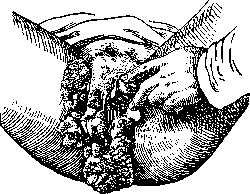
Pointed condylomas.
and hyperhidrosis; 3) venous and lymphatic stasis; 4) lack of cleanliness. Predisposing factors can also include other various peculiar conditions—metabolic disorders, etc. Immediate causes include external infection, especially pyogenic, fungal, or a filtrable virus; external causes include chemical irritation: alkalis (Cronquist), tar, arsenic (Bayet), etc.; and blood-borne influences of iodine, bromine, arsenic, etc. Vegetating dermatoses, having many common morphological features, are sometimes very difficult to recognize.
G. Meshchersky. VEHICULUM (Latin for carriage), or menstruum, or solvens, the name of a substance in which some other substance is dissolved. The soluble substance is called solvendum. Vehicle, constituens, or excipiens is also called in a prescription that indifferent substance which gives the medicine its form and serves as the recipient for all other components of the medicine. If such a substance is a liquid, it is then called menstruum. The vehicle in a prescription may also be absent.
Related articles
Mentioned in
Cite this page
“Vegetations.” Soviet Medical Encyclopedia. English translation of Bolshaya Meditsinskaya Entsiklopediya, 1st ed. (Moscow, 1928–1936), ed. N. A. Semashko. https://sovietmedicalencyclopedia.pages.dev/article/vegetations/