Psoriasis
Historical document, translated for reference. It reflects medical knowledge of the 1920s–30s and is not medical advice.
Summary
This 1930s encyclopedia entry defines psoriasis as a chronic skin disease characterized by scaly, pink-red papules. It discusses the historical terminology, the lack of a definitive etiology, and early theories regarding its hereditary nature and prevalence.
Encyclopedia article (1928–1936)
PSORIASIS, psoriasis vulgaris, is a chronic skin disease, the main symptom of which is pink-red, slightly elevated papules covered with loose, white, shiny scales. Psoriasis is a frequent disease; according to European and American authors, it accounts for 3% to 4% of all primary visits by skin patients. Toyama gives 0.3% for Japan. While it does not usually affect the general state of health, psoriasis can, however, be a cause of temporary disability in cases of extensive skin lesions, especially on the hands. The term psoriasis was used by ancient Greek authors to denote all kinds of scaly rashes. The terms psora, lichen, alphos, lepra (Indo-Germanic root “lap”—to peel) were used in a synonymous sense. The beginning of the study of psoriasis as a disease sui generis was laid by Willan, who called discoid psoriasis lepra graecorum (l. vulgaris, l. Willani), and the figured form psora leprosa, or subsequently psoriasis. This division of psoriasis was initially accepted by some French and English authors, but was later abandoned under the influence of Hebra. The etiology of psoriasis cannot yet be considered sufficiently clarified. It can be considered established with certainty that at least a portion of psoriasis cases are hereditary in nature, although the genetics of psoriasis are still far from being sufficiently developed. The sharply differing and relatively insignificant figures for familial psoriasis cases cited by individual authors (Poor—34.4%, E. Wilson—30%, Jordan—15%, Schamberger—5%) cannot be interpreted in the sense that the indicated percentage of familial cases fully covers the percentage of genotypic, hereditary cases. The incorrectness of such views stems from the fact that the presence of only one patient in a family by no means excludes the genotypic nature of the disease. Sporadicity may be a consequence of either a small number of children in a recessive disease or the polyhybrid nature of the disease and, therefore, the low probability that all the genes necessary for the disease would meet in many of the patient's close relatives; finally, in the case of a dominant monohybrid disease, there may be only one patient in a family either due to the occurrence of a new mutation (which is, admittedly, very rare) or due to variation under the influence of the genotypic or external environment. Whether all cases of psoriasis are genetically identical is difficult to say at the present time. The type of inheritance of psoriasis has in some cases the character of irregular dominance (see figure), and in other cases the disease is perhaps conditioned by a recessive gene, which is perhaps supported by the data of Zieler, who discovered 3% of consanguineous marriages among the parents of psoriasis patients, with the frequency of consanguineous marriages in the population being equal to 1%. There are no sufficient grounds to speak of a greater prevalence of psoriasis among Jews, but the percentage of cases with a hereditary family history among them is higher than among non-Jews.
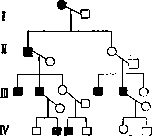
Heiner's case.
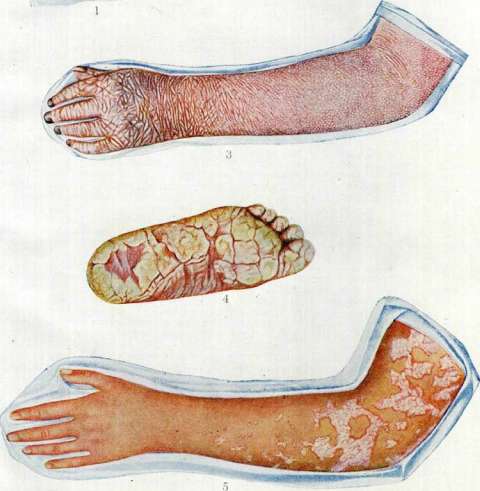
To the articles Pityriasis, Prurigo, Psoriasis. This is connected with the high frequency of consanguineous marriages among Jews. Psoriasis affects men and women to an equal degree. Very interesting, but requiring verification, is the indication by Kerkhoff regarding a positive complement fixation reaction between the serum of patients and an antigen prepared from Psoriasis scales, it being noted that the reaction may also be positive with the serum of an outwardly healthy parent. Another theory of the etiology of the disease is the parasitic one, the supporters of which, however, could not bring forward sufficiently convincing evidence in its favor. The parasites found in the scales and excretions of psoriatics by various authors are distinguished by amazing variety, and not a single microbe can be recognized to this day as the causative agent of Psoriasis. This circumstance, however, by no means excludes the role of various parasites in the etiology of Psoriasis: it is not excluded that a hereditary anomaly creates a predisposition to the introduction into the skin of various microorganisms (not necessarily specific to Psoriasis), as a result of which the disease in question develops. Lipschütz described special inclusions found by him in the cells of the Malpighian layer, similar to Guarnieri bodies, which is why he considered Psoriasis an infectious disease. The findings of Lipschütz were confirmed by Kyrle, who considered Psoriasis a disease related to smallpox, and by Prowazek. The parasitic theory, however, did not receive wide recognition; on the contrary, more and more facts are accumulating that speak against it. Pathogenesis. Even more contradictory are the opinions of various researchers regarding the pathogenesis of Psoriasis. Schamberg expressed the assumption of a hereditarily reduced viability of the epidermis, which responds to various non-specific irritations with parakeratosis with the formation of psoriatic elements. The author considers the staphylococcus to be the most frequent irritant. However, the evidence cited by Schamberg was not confirmed by other studies. The unilateral, metameric, or linear arrangement of psoriatic eruptions observed in a number of cases gave Polotebnov, Nikolsky, and others reason to create a nervous theory of Psoriasis, which is considered unconvincing by the majority of authors, since there are no regular pathological changes in the central or peripheral nervous system. The allergic theory of the pathogenesis of Psoriasis is supported by Zeidler on the basis of the comparative frequency of hay fever observed by him in psoriatics, vasomotor rhinitis in 22% of patients, and the possibility of artificially inducing a nasal symptom complex by injecting extracts from flower pollen. Unusually numerous studies of metabolism in Psoriasis have yielded the most contradictory results. In the literature, there are indications, refuted, however, by other authors, regarding a connection of Psoriasis with alimentary glycosuria, as well as the saturation of psoriatic families with diabetes, etc. Other studies have detected nitrogen retention, significant excretion of it with scales, increased nitrogen excretion in the intervals between recurrences of Psoriasis (Gramatchikov), acidosis (Gans, Kerkhoff), disturbances of lipid metabolism, and other anomalies. The endocrine theory of the pathogenesis of Psoriasis is also insufficiently convincing, despite a number of observations pointing to the role of glands of internal secretion in the development of Psoriasis. Thus, a thyrogenic symptom complex accompanying Psoriasis is described, as well as cases of the cure of Psoriasis during treatment with thyroidin. In other cases, symptoms of dysfunction of the sex glands were observed; cases of repeated self-cure of persistent Psoriasis at the beginning of pregnancy have been described, following the end of which the Psoriasis manifested itself again. A number of authors insistently point to the frequency of the onset of Psoriasis in the puberty period, thus connecting the development of the disease with the increased activity of the sex glands. However, against all these comparatively few cases of psoriasis accompanied by a disorder of the activity of any incretory gland or group of glands, one can contrast more numerous ones where neither thorough examinations of the endocrine apparatus nor organotherapy yield results. From what has been stated, it is evident that the pathogenesis of Psoriasis is still extremely insufficiently developed and is very unclear. Histological changes in Psoriasis are found both in the superficial layers of the dermis and in the epidermis. In the dermis, the changes have an inflammatory character: edema and elongation of the papillae, dilation of vessels, and perivascular infiltrates. Changes in the epidermis testify to a disturbance of the keratinization process: the granular layer disappears, the horny layer is sharply but loosely thickened, and the majority of the cells composing it contain nuclei (parakeratosis). The entire epidermis as a whole is thickened (acanthosis). In the intercellular spaces, single and grouped leukocytes are visible. Approaching the surface of the skin, the leukocytes accumulate in larger groups similar to microabscesses. This histological picture, common to all cases of Psoriasis, can be modified, intensifying either in the direction of acanthosis and papillomatosis (p. verrucosa), or in the sense of intensifying inflammatory phenomena (p. exsudativa), or in relation to the number and size of leukocyte accumulations (p. pustulosa). Clinic. Encountered at any age, Psoriasis most often begins within 5-10 years after puberty. Men apparently suffer somewhat more often than women. Psoriasis has a chronic course, sometimes interrupted by free, at times multi-year intervals. In the majority of cases, the eruption never disappears completely, and characteristic elements remain in the favorite places (elbows, knees). The periods of exacerbations and relapses are different in duration and intensity and, in the current state of knowledge, can neither be predicted nor prevented. Psoriasis is also characterized by symptoms on the part of the nails (often), the oral mucosa (very rarely), and the joints (rarely). Itching is usually absent but can be observed in the stage of acute eruption and especially in the presence of exudative phenomena. The most frequent localization of eruptions is the extensor surfaces of the limbs and the scalp. The eruption is generally symmetrical, but rare cases of unilateral Psoriasis have also been described. Skin eruptions, diverse in terms of quantity, size, and configuration of the elements, are extremely characteristic due to the constancy of the signs of the latter—a pink-red, slightly raised, sharply limited spot (sometimes a nodule), covered on the surface with silvery-white scales (see separate table, figs. 2, 4, and 5). Sometimes the scales are barely noticeable, but upon scraping, they become visible (stearin spot sign). With more energetic scraping, the scales are removed in the form of a film, and after their removal, one or several tiny droplets of blood appear on the surface of the spot (pinpoint bleeding sign). In the places of eruption, the secretion of sebum and sweat decreases and even ceases. The sizes of psoriatic elements range from a point to large disks. Developing backward in the center, merging with each other, and spreading along the periphery, they can form garland-like figures (p. serpiginosa). When the growth of the elements stops, a lighter, somewhat wrinkled border is sometimes noted around them (Voronov's pseudoatrophic rim). The reverse development of elements can proceed with the leaving of pigmentation or, conversely, more often depigmented spots (psoriatic leukoderma). Under the influence of inappropriate therapy (irritating ointments in the acute period of eruption, sometimes X-ray irradiation of the thymus gland), but often also without visible causes, the eruption can take on a universal confluent character, proceeding by the type of erythroderma. Sometimes, even after mechanical damage to the healthy skin of psoriatics, in some cases, psoriatic elements develop at the sites of damage (Koebner phenomenon). Atypical forms of Psoriasis are not rare. Most often, the exudative form is encountered with weeping and the formation of crusts, sometimes taking an oyster-like form (p. ostracea). Often, in this case, the eruption is localized by the reverse type, affecting the folds of the joints, the pubic area, and the genitals, and sparing the extensor surfaces. Very rare is the pustular form of Psoriasis (p. pustulosa), in which the primary element can be a small pustule, subsequently drying up and becoming covered with horny layers. P. pustulosa is usually combined with arthropathies and can end fatally. The connection of this form with ordinary Psoriasis still needs further study. Rare is also the verrucous form of Psoriasis with the formation of warty growths on the surface of the plaques. In exceptional cases, the development of cancer is observed on them. Nail lesions in Psoriasis are diverse. The most characteristic is the formation of numerous pits on the surface of the nail, resembling the surface of a thimble. Mucous membranes are affected very rarely. On the mucosa of the cheeks, rounded, whitish elements are described, differing from leukoplakia by a sharper limitation, sometimes of a dry, sometimes of an erosive type. Arthropathic Psoriasis is characterized by diverse phenomena on the part of the joints, ranging from painful sensations to the ankylosis of small and large joints. Some authors have found radiological changes in the joints even in the absence of clinical phenomena. Parapsoriasis. In 1902.
Brocq proposed this term for a group of rare chronic diseases similar, on the one hand, to psoriasis, and on the other, to lichen planus. Their etiology is even less known than the etiology of psoriasis. Common to them are: chronicity of the course, absence of itching, superficiality of the lesion, absence of infiltrative phenomena, and stubborn resistance to treatment. Desquamation is of varying intensity and sometimes is entirely absent. Since the time of Brocq, three main clinical types have been distinguished: 1) parapsoriasis en gouttes, 2) en plaques, 3) lichenoides. The synonyms for these terms are numerous but do not contribute anything essential to the understanding of parapsoriasis. Parapsoriasis en gouttes or pityriasis lichenoides chronica is characterized by small, spotted, usually isolated pinkish elements (from the size of a pinhead to a pea), covered with tightly adherent scales that resemble a wafer when scraped. Scraping easily causes petechiae but not pinpoint bleeding. Acutely progressing cases with hemorrhagic exudative and pustular phenomena resembling varicella have been described. In parapsoriasis en plaques or Brocq's disease, oval-round or irregularly shaped plaques up to 5-6 cm in diameter are observed, ranging in color from pink-red to dark brownish-red, covered with bran-like sparse scales and sometimes slightly atrophic. Parapsoriasis lichenoides or parakeratosis variegata is characterized by small papules resembling lichen planus. A combination of individual types in the same patient is possible. The occasionally observed lesions of the mucous membranes, the development of leukodermic spots, as well as polyadenitis, can sometimes make differential diagnosis from syphilids very difficult. The diagnosis of psoriasis, which is easy in typical cases and based on the morphological features of the primary psoriatic element, may prove more difficult in atypical cases resembling eczematids. Even histological examination may prove insufficient, and sometimes only long-term observation resolves the issue. Premycotic eruptions can simulate psoriasis. Psoriasis pustulosa, accompanied by arthropathies, may present significant similarity to generalized gonorrheal keratosis. Practically, it is important to distinguish psoriasis from psoriasiform syphilids. The supporting points are the following: the thickness of the infiltrate of syphilitic papules, their polymorphism, the absence of pinpoint bleeding, and finally, the totality of all other signs of syphilis. Psoriatic erythroderma is recognized by the presence of individual characteristic elements of psoriasis, which are sometimes revealed only during the regression of the erythroderma. The therapy of psoriasis is distinguished by an extreme variety of therapeutic agents and methods of their application, but none of them guarantees against relapses, and their practical value is determined mainly by the speed of eliminating visible phenomena. This goal is achieved most reliably by a combination of baths and ointments containing antipsoriatic medications: sulfur, ichthyol, salicylic acid, white precipitate of mercury, tar preparations, pyrogallic acid, chrysarobin, etc. Common to them is a reducing ability, and, according to Kerckhoff, their pharmacological action reduces to increasing oxidation processes in the skin. Other types of therapy (internal medications, light therapy, X-ray therapy, various opotherapy) have, in general, auxiliary significance. Of the medications used in ointment therapy, chrysarobin has the most energetic but also the most irritating effect, while sulfur has the least strong effect. Chrysarobin is inapplicable on the face and scalp, as it can cause severe conjunctivitis. It is also contraindicated in the acute stage of eruption, when only daily warm baths and rubbings with sulfur, ichthyol, or salicylic ointments are indicated. Subsequently, it is advisable to perform rubbings with green soap before the bath, and after the bath, apply an ointment with one of the listed medications, gradually increasing their concentration (2-5-10%), or combining various agents. Treatment usually lasts several weeks. Intravenous injections of sodium salicylate, recommended to enhance the external action of chrysarobin, are not entirely harmless to the patient, and likewise, all other types of intravenous therapy should hardly be used in everyday practice. Opinions are divided regarding nonspecific protein and vaccine therapy (staphylo-, strepto-, gono-, and other vaccines). Dozens of unsuccessful observations stand against single favorable ones. The same can be said about gold preparations. The manganese preparation recently proposed by Kerckhoff—Psorimangan—has a significant side effect and does not always yield good results. Of the internal medications, arsenic is most often used in increasing doses. Regarding the effectiveness of light therapy, as well as the method of its application, there is still no consensus. In combination with baths and rubbings of tar preparations, ultraviolet rays in moderate doses apparently bring the greatest benefit. X-ray therapy is indicated for limited lesions on exposed parts of the body if they stubbornly resist conventional therapy. It does not prevent relapses, and with its repeated use, great caution must be observed to avoid unpleasant consequences. Bucky's Grenz rays are apparently safer and no less effective. Opotherapy sometimes yields excellent results (thyroidin, ovarin, insulin), but they are very far from regular consistency. The use of these preparations is therefore advisable only in the presence of clear symptoms of endocrine disorders. Under the guise of opotherapy, there are the irradiations of the thyroid gland with irritating doses of X-rays proposed by Brocq. Without preventing relapses, this method of treatment produces both improvements and deteriorations. Interesting therapeutic attempts have been made recently. Scherber, based on Zeidler's data, attempted to treat psoriasis with injections of flower pollen extract. Mihajlovic and others successfully used extracts from skin scales, which, however, requires further verification.
Related articles
Mentioned in
Cite this page
“Psoriasis.” Soviet Medical Encyclopedia. English translation of Bolshaya Meditsinskaya Entsiklopediya, 1st ed. (Moscow, 1928–1936), ed. N. A. Semashko. https://sovietmedicalencyclopedia.pages.dev/article/psoriasis/