DRAINAGE (drainage, the draining of waterlogged areas)
Historical document, translated for reference. It reflects medical knowledge of the 1920s–30s and is not medical advice.
Summary
Drainage is the process of draining waterlogged areas through underground channels filled with stone, fascine, or brushwood, alongside open surface ditches. This technique was used to make very moist soil suitable for agriculture and forestry, and later evolved to include pipe networks for improving sanitary conditions in populated areas.
Encyclopedia article (1928–1936)
DRAINAGE, drainage, the draining of waterlogged areas through underground ditches filled with stone, fascine, or brushwood, along with draining by open surface ditches; it was known in ancient times and was used to make very moist soil suitable for agriculture and forestry. The construction of drainage by means of a special network of pipes is not more than a hundred years old, since when in England and Scotland, for the purpose of removing soil water to improve the sanitary condition of populated areas, drainage pipes began to be used. At the present time, when the problems of land reclamation are being widely addressed and the tasks of land improvement are understood not only in terms of creating conditions for proper irrigation or drainage, but also in terms of creating healthy living conditions for the population, drainage acquires special importance from a sanitary point of view. When planning the drainage of any area by means of drainage, the first step should be to find the cause of the water that causes the soil to become waterlogged. The water that causes moist and waterlogged areas can appear in the soil in the following cases. First, in the presence of impermeable soil layers and a flat surface, water after rains and snow melting cannot penetrate deeply into the ground, remains near the surface and strongly waterlogs such areas. Second, in flat areas surrounded by elevations with clay subsoil and with the presence of a spring that has no free outflow to lower places, the spring water will form waterlogged areas in such a locality. Finally, in the case of sandy subsoils that communicate with bodies of water (river, lake, pond), water from them at high levels penetrates into the sandy layers, raises the level of soil water and causes waterlogging of the area, penetrates into cellars of houses, causing dampness in walls, etc. Moist, waterlogged soils are poorly heated by the sun, and the average temperature of such places is lower than would be expected from their geographical position. Moist soils are poorly suited for creating favorable living conditions for the population. Dampness of walls and dampness of foundations cause a number of phenomena that adversely affect both the strength of buildings and the health of their inhabitants. Wooden parts of structures under the influence of dampness easily undergo decay processes and are often destroyed due to the growth of special harmful fungi (see House fungus). To these phenomena is added the harmful effect of dampness on the warmth of apartments: damp walls conduct heat better than dry ones. If the foundation or basement walls of a house are in contact with water or damp ground, then water by capillarity can rise in them several meters. In such cases, by surrounding the building with a ring network of drainage pipes laid below the foundation of the structure, it is possible to significantly lower the level of groundwater and thereby prevent the harmful effect of damp soil on the building and its inhabitants. In former times, the drainage network in the soil was usually laid from stone or slightly burnt clay pipes with a diameter of 75-100 mm, having on one half of their cylindrical surface a series of small elongated holes (Fig. 1). The pipes were laid with the smooth side on the bottom of a trench dug to the appropriate depth, connected to each other by special couplings and covered first with coarse, then with fine gravel, and then with the excavated soil (Fig. 2). Thus, small diameter underground pipelines - drains - were obtained. Through the joints and through the walls of which water from the soil entered the drains and then was directed into larger diameter drainage pipes - collectors, and then discharged into ditches, rivers, ravines, etc. At present, drainage is made of ceramic pipes of the sewer type with moss sealing of joints and gravel backfill. The flow of water to the drains occurs under the influence of pressure differences (Fig. 4), which decrease as they approach the drain. Water flows into the drain from all sides, including from below. If a building is favorably located with respect to the construction of drainage, by which the collected water can flow by gravity to lower areas of the surrounding terrain for further discharge into open natural watercourses, then such a drainage network can constantly maintain the groundwater level at the desired depth. In the absence of such favorable conditions, groundwater from the drainage network is first directed into a collecting well, from which it is then pumped to the surface by a pump for discharge along paved open ditches to flow into open bodies of water. Under favorable geological conditions of a given locality, when in a waterlogged area there is a permeable soil layer under an impermeable layer, a drilling well is made to this permeable horizon, into which the groundwater collected by the drainage network is discharged. When allowing drainage water to be discharged into deep aquifers, appropriate measures should be taken to prevent the entry of suspended substances along with the drainage water that could reduce the absorption capacity of the lower layers and thereby disrupt the proper operation of the well. In addition, it is necessary to ensure that there is no abuse in regard to the discharge of contaminated liquids from cesspools and garbage pits into the absorption well. The drainage system includes the following components: drains, collectors, inspection wells, ventilation devices. The distance between drains is the main factor determining the proper operation of drainage, and therefore is determined in relation to the time of maximum saturation of the soil with groundwater, for example, immediately after spring thawing of the soil or during a rainy summer. At other times, the groundwater level may decrease below their location regardless of the drains. The minimum allowable average velocity for drainage is 0.16-0.20 m per sec.; at lower velocities, deposition of substances suspended in water is observed. Drainage of large areas requires a slope of at least 0.002. The maximum length of each drain should be 200 m. The total length of drains entering the same collector should not exceed 1,000 m. The length of collectors should not exceed 1,000 m. The scope of application of drainage networks in agriculture is very limited, on the one hand due to the high cost of their installation, on the other hand due to the faster leaching of useful mineral substances from the soil compared to open ditches. Drainage is often used to lower groundwater when digging deep pits, when constructing underground tunnels, hydraulic structures, etc., as well as for draining residential areas. If there is a need for a very significant lowering of groundwater, then instead of the said horizontal drainage network, a series of vertical drainage tube wells is constructed. The wells are connected by one common suction pipe, through which water is pumped out of them by a pump, lowering the groundwater level sometimes by 5-6 m. It is not possible to achieve such a lowering with a horizontal drainage system due to the difficulty of laying horizontal drains and collectors at such a depth under water. Drainage is also used for collecting groundwater in the area of an aquifer in connection with the construction of water supply for populated areas. In this case, the drainage pipe (Fig. 3) is first covered with coarse, then with fine gravel with a thickness of 0.40 to 0.60 m. Regardless of these measures, a sanitary protection zone is established in the groundwater collection area. A drainage network in the form of a system of channels and pipes is also used for collecting purified water in large sand filters used for drinking water purification, as well as in oxidizers designed for biological purification of wastewater.
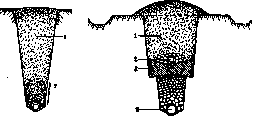
Fig. 2, drainage for drainage purposes: 1- excavated soil; 2- gravel or fine gravel.
Figure 3. Collection of groundwater for water supply purposes: 1- excavated soil; 2- drainage pipe; 3 - concrete or clay.
Related articles
Cite this page
“DRAINAGE (drainage, the draining of waterlogged areas).” Soviet Medical Encyclopedia. English translation of Bolshaya Meditsinskaya Entsiklopediya, 1st ed. (Moscow, 1928–1936), ed. N. A. Semashko. https://sovietmedicalencyclopedia.pages.dev/article/drainage/