Beach
Historical document, translated for reference. It reflects medical knowledge of the 1920s–30s and is not medical advice.
Summary
A beach is a shore of a sea, lake, or river used for swimming and sunbathing. The article describes different types of beaches, their characteristics, and requirements for proper sanitation and safety equipment.
Encyclopedia article (1928–1936)
BEACH (from the French plage - seashore), the shore of a sea, lake, or river, used as a place for swimming and simultaneously for taking sun and air baths. In geology, a B. is any gentle slope of a sea shore. Depending on the soil type, there are rocky, pebbly, sandy, and muddy beaches. Muddy beaches are unsuitable for swimming. Rocky beaches are poorly suited for swimming. Pebble beaches present fewer difficulties for swimmers: the smaller the pebbles and the more rounded they are, the more convenient the beach is for swimming. Sandy beaches offer the greatest convenience for swimming, constituting the fame of many seaside resorts. The gentle character of a beach, the slow, gradual increase in depth as one moves away from the shore (especially important for children's swimming) is of great importance for sea bathing. The best sandy, gentle beaches with fine sand are found in the USSR in Anapa, Yevpatoria, and on the Gulf of Finland (Sestroretsk and others). The requirements that are made for sea beaches in terms of physical and geological properties are fully applicable to lake and river beaches as well. Additionally, when choosing river beaches, it must be taken into account that during the hottest time of year the beach should have sufficient water for swimming. Beaches as places for mass swimming and taking sun and air baths must be appropriately equipped and developed. Changing facilities are arranged on beaches in various ways: a) portable woven or wooden booths (cabins) for changing one or two people are set up directly on the beach, closed on three sides; these booths are moved along the beach depending on the tide; b) small wooden booths are set up on poles at such a height that the floor of the booths remains above the water level during high tide and during a storm; a ladder descends from such booths to the beach; c) large wooden pavilions for changing (often shaped like a horseshoe in plan) are set up on the beach at some distance from the water on an elevation (or on poles); from these pavilions, walkways and ladders lead to the water; d) in the case where the shore is muddy or rocky, long gangways are built from the shore to the changing pavilion (bathhouse), which is constructed on poles over the water; e) in some resorts, mobile changing booths are set up on high wheels and are taken out to sea on the beach to the required depth.
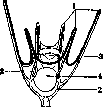
Ophiopluteus: 1-arms; 2-skeleton; 3- mouth; 4-stomach.
Sanitary equipment and sanitary supervision of the beach are of great importance. Places for swimming are chosen with the calculation that neither the beach itself nor the adjacent part of the water space are subject to pollution. The place for swimming should be located at some distance from residential buildings (river beaches are better chosen above settlements along the river flow), removed from the place where sewage waters are discharged and garbage dumps, port structures (piers, cargo, coal piers, oil loading devices, etc.), places where animals swim, etc. A sufficient number of toilets must be set up on the beach itself. Constant supervision of the sanitary condition of the beach is necessary. A number of measures must be carried out on the beach to prevent accidents during swimming and sunbathing. On the beach, the boundaries of those places where swimming is recommended for both skilled and unskilled swimmers must be clearly marked. Places for swimming for children and unskilled swimmers must be delimited by ropes on poles or anchors, floating boards, and other means. Means for saving drowning people must be available on the beach: life rings, belts, grappling hooks, boats. Constant duty of personnel trained in rescue work is necessary. In the changing pavilion, a separate medical room is allocated, equipped with stretchers, a couch, sheets, a supply of towels for rubbing, a box with medicines necessary for first aid. A weather service is organized on the beach: bulletins are posted indicating the air and water temperature at different times of day, the strength of the surf, the strength and direction of the wind. Observations of the intensity of sunlight, wind strength, and other meteorological elements are carried out during sea bathing and sunbathing hours in different parts of the beach. This information is communicated to bathers on the beach by posting colored signals on special signal masts or by radio through loudspeakers (Yevpatoria).
Related articles
Mentioned in
Cite this page
“Beach.” Soviet Medical Encyclopedia. English translation of Bolshaya Meditsinskaya Entsiklopediya, 1st ed. (Moscow, 1928–1936), ed. N. A. Semashko. https://sovietmedicalencyclopedia.pages.dev/article/beach/