ARENSBURG
Historical document, translated for reference. It reflects medical knowledge of the 1920s–30s and is not medical advice.
Summary
ARENSBURG is a mud and seaside resort in Estonia on the island of Ösel, operating from July 1 to September 1. The resort offers mud baths from the bay and Lake Vik, with sea bathing comparable to the Riga seaside, and is indicated for rheumatism, gynecological, and nervous diseases.
Encyclopedia article (1928–1936)
ARENSBURG, a mud and seaside resort at the town of the same name in Estonia, on the island of Ösel. Season from July 1 to September 1. Mud on the bottom of the bay and Lake Vik. Mud baths (from 1 to 10 buckets of mud per bath, usually 3 buckets). i Sea bathing is not inferior to the Riga seaside (see).- Water temperature from May to August from 16 to 18.5°; air temperature for the same period from 16 to 20°. The short winter, clean air, gardens and forests make Arensburg a good seaside resort. Indications: rheumatism, women's and nervous diseases. AREOLITIS (from Latin area-zone), inflammation of the areolar zone of the mammary gland; observed most often in connection with cracks, especially in nursing mothers (see Mastitis). AREOMETER (from Greek araios-rare, liquid and metron - measure), an instrument for determining the density of liquids and solids. Its main part is always an elongated balloon floating in the liquid, and a thin rod attached to it from above and protruding above the surface. For solids, the Nicholson A. is used (see figure 1). To its balloon B is suspended a cone C, which serves both for placing the test body on it and as ballast. First, load cup A until the rod of the instrument O is immersed to the mark applied to it. After this, the test body is placed on the cup and it is noted what weight must be removed so that the instrument rises again to the previous mark. The weight of the removed weight is equal to the weight of the body. The weight of water occupying an equal volume can be determined by moving the body t to the bottom of cone C: now cup A will have to be loaded with an additional weight, the weight of which will be equal to the weight of water displaced by the body.-A. Fahrenheit, used to determine the density of liquids, consists of a glass balloon and a rod attached to it with a plate on top. Based on the magnitude of the weight that must be placed on the plate to immerse the instrument to a certain mark, the desired density is calculated. Both the Nicholson instrument and the Fahrenheit instrument are A. with constant volume. At present, other types of areometers are more often used - A. with constant weight. These include, for example, the widely distributed A. Baumé (see figure 2). Based on Archimedes' law, the weight of a floating body is equal to the weight of water displaced by its submerged part. Consequently, the greater the density of the liquid being tested, the smaller part of the entire
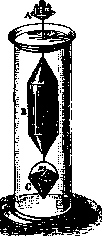
Figure 1.
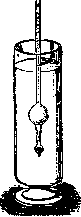
Figure 2.
body of the A. will be immersed in it. For accuracy of measurement, the part of the instrument protruding from the liquid is given the shape of a thin rod, on which, according to Baumé, certain conventional divisions are applied. The figure "0" is placed at the level to which the rod is immersed in distilled water (at 12.5°). If the A. is intended for testing liquids heavier than water, then this mark is placed at the very top. Then the instrument is immersed in a NaCl solution with a concentration of--15 parts salt to 35 parts water, and the level to which the rod is immersed is marked with the figure "15". The distance between both obtained marks is divided into 15 divisions and such divisions continue further down to "70". The value of the conventional divisions according to Baumé is as follows: According to Baumé: 0.0 13.2 24.2 33.5 41.5 48.4 54.4 59.8 64.5 68.6 72.6 Density: 1.0 1.1 1.2 1.3 1.4 1.5 1.6 1.7 1.8 1.9 2.0 For liquids lighter than water, Baumé constructed an A. that sinks to a certain conventional division "10" (not far from the lower end of the scale) in distilled water and to division "O" in a solution of 10 parts NaCl to 90 parts water. The divisions increase from bottom to top here. Their value is as follows: According to Baumé: 10.0 17.7 26.1 35.6 46.3 58.4 Density: 1.0 0.95 0.90 0.85 0.80 0.755 On the rods of some A., intended for various special purposes, divisions are applied that express the density directly. Such are, for example, A. intended for determining the density of sea water. In the latter case, entire series of A. are used, each of which is suitable only for densities lying in narrow ranges.
V. Shuleikin.
Related articles
Mentioned in
Cite this page
“ARENSBURG.” Soviet Medical Encyclopedia. English translation of Bolshaya Meditsinskaya Entsiklopediya, 1st ed. (Moscow, 1928–1936), ed. N. A. Semashko. https://sovietmedicalencyclopedia.pages.dev/article/arensburg/