Mud Treatment Facilities
Historical document, translated for reference. It reflects medical knowledge of the 1920s–30s and is not medical advice.
Summary
This article describes the design and operation of Soviet-era mud treatment facilities (mud baths), focusing on the two primary methods of heating mud: artificial (steam or water) and natural (solar). It details the infrastructure requirements, such as cabin layouts, mud preparation, and the technical challenges of maintaining mud properties during heating.
Encyclopedia article (1928–1936)
MUD TREATMENT FACILITIES (Mud Baths), medical institutions for treatment with mud. In the design of mud treatment facilities, two main types are distinguished: those with artificial heating of the mud, by water or steam, and those with heating of the mud by a natural method—the sun. Mud treatment facilities with artificial heating of the mud. The layout of cabins, changing rooms, and the mutual arrangement of rooms in mud treatment facilities of this type have much in common with bath buildings (see) for mineral baths, but differ from them in a number of essential details, which are determined by the methods of providing the mud procedure to the patient. Therefore, such mud treatment facilities should be divided into two subgroups: a) mud treatment facilities using local mud therapy (for example, Yessentuki, Pyatigorsk) and b) those providing the patient with a mud bath, analogous to a mineral bath. This type includes the Slavyansk, Odessa, Staraya Russa, Elton, Sergievsk Mineral Waters, Karachinsk (Siberia), Tinaki, Anapa, and a number of other, less significant mud treatment facilities. Those that have begun to function in recent years and those newly constructed in a number of cities for non-resort use of therapeutic mud belong in their design to subgroup "a." The most perfect type of mud treatment facility of the first subgroup is the Yessentuki facility. The building has three working levels. In the middle level are the storage areas for fresh mud, from which it flows by gravity to the lower floor, where the preparation of the mud takes place, its heating in special drums (see below), and delivery in buckets on a lift to the "working" corridors of the second floor. The working corridors are located in the middle of the building between rows of cabins. Each cabin consists of a room in which a couch is installed for receiving a mud pack, and a changing room. For every two cabins of this design, one bathtub is installed for washing. Between the cabins and the outer wall run corridors for the passage of patients. The advantages of such an arrangement of corridors consist in the complete separation of the working mud area from the clean area used by patients. In the building, besides this, there are excellent rooms for waiting and rest, as well as a number of auxiliary and service rooms. A shortcoming of such a mud treatment facility should be considered the low economic use of space, causing a high construction cost of the building. Heating of the mud occurs on the lower floor, from where the heated mud is delivered by elevator to the working corridors. Cold mud is also delivered here, and by mixing it with hot mud, a product of a certain temperature is obtained. The discharge of used mud is carried out through special pipes into special basins located in the courtyard of the mud treatment facility. The Pyatigorsk facility is of a less perfect type and is simpler in all its parts. Mud treatment facilities of the second subgroup, with the provision of mud baths of liquid consistency, have a significant difference, consisting of a) the installation in the cabins of additional bathtubs for washing the patient after they have received the mud procedure; b) the same bathtubs or showers in general bathroom areas; and c) special devices for filling the mud bath with mud. The latter is performed either by the installation of special hatches through which mud from a cart or mud tank located outside the bath building enters a stationary bathtub in the cabin (Slavyansk, Karachi, Sergievsk Mineral Waters, etc.), or by moving the mud from the mud tank into the bathtub using a special steam ejector (Staraya Russa), or finally by rolling the bathtub into the cabin through a special hatch made in the wall at floor level or below it, with preliminary filling of the bathtub with mud in the "mud" yard adjacent to the bath building (Lipetsk, Tinaki, Elton).
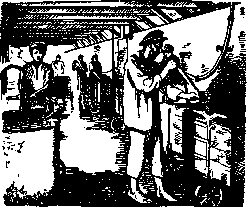
An extremely important and, to this day, not fully resolved issue for mud treatment facilities with artificial heating is the heating of the mud. The basic conditions for perfect mud heating must be considered the following: a) the mud should not come into contact with easily oxidizable or overheated walls, so that changes in its physical-chemical properties are minimal and, in particular, so that it does not dry out on the walls and lose its colloidal nature; b) the heating process must occur quickly enough not to cause oxidation of the mud, which is detected by a decrease in hydrogen sulfide, the free content of which should not decrease by more than 10-15% of the presence; c) the heating of the mud should not exceed the temperature permissible from a balneological point of view, i.e., it should not exceed 50-55°; d) the water content should not increase or decrease by more than 4%; e) the heating of the mud should not be expensive, and the amount of heat consumed for heating per unit weight of mud should be minimal. Practically, the warming of the mud to the necessary temperature is carried out by one of the following methods: a) by injecting steam through a special hose directly into the mud; b) by an ejector; c) by steam in special drums with hollow walls; and d) by means of a water bath. Steam heating, as special examinations have shown, possesses the enormous advantage of speed of action with the ease of piping steam to any sections of the mud treatment facility, but it inevitably dilutes the mud with fresh water due to steam condensation, which, however, does not introduce significant changes in its physical and chemical properties if the heating temperature does not exceed 50°. Fears associated with the possibility of the volatilization of amine bases from the mud when heating it with steam cannot be considered serious. At the same time, the possibility of producing steam heating for each bath separately to the required temperature in tanks and bathtubs that do not deteriorate from the action of the mud and, in turn, do not act on it chemically, forces one to recognize steam heating as a very practical method. Heating with steam above 50° leads to a thinning that increases with rising temperature, changing the consistency of the mud, and to changes in its chemical and physical properties associated with this process, as a result of which it cannot be recommended in the practice of mud treatment facilities. Heating the mud with a water bath to a temperature of approx. 50° least affects its physical-chemical properties; further heating causes changes associated with a more significant loss of water, which, however, can be eliminated by constructing a closed chamber with a mechanical stirrer inside. A disadvantage of heating with a water bath is the slowness of the process of raising the mud temperature when constant stirring is required. The main shortcoming of all devices currently available in mud treatment facilities for heating mud is the difficulty of obtaining uniform heating in all parts of the bath or pack and the difficulty of precise regulation of heating. Therefore, it should be considered most expedient to preheat the mud by one of the methods listed above, followed by further heating of the mud in thermostats having a constant temperature. In existing mud treatment facilities, the following technical installations are used for heating mud: a) In Yessentuki, special drums with hollow walls are used, between which high-pressure steam circulates. The mud enters one end of the drum, counter to the movement of the steam, and is moved to the opposite end by special blades sitting on the drum shaft. During its movement from one end of the drum to the other, the mud is heated to a certain temperature and then delivered in buckets to the places where the pack is made. Cold mud is also delivered here. By manually mixing portions of cold and hot mud, a pack of a certain temperature is obtained. b) In Pyatigorsk, a hot water bath is used. Buckets with cold mud are placed in boiling water heated by steam. Here the mud is slowly heated to the required temperature due to the heat from the water. c) In Staraya Russa, heating is performed using ejectors—special devices through which a jet of steam breaks through (the method is applied partially). As the steam passes, particles of mud are entrained, thanks to which the mud is not only quickly warmed but also receives forward movement in the desired direction. d) Elton, Tinaki, Sergievsk Mineral Waters, etc., use steam with a pressure of 4 to 8 atmospheres, which is introduced into the mud using a special hose or forks. (In cases "c" and "d," the warming occurs due to the condensation of steam in the mud, which is colder than the incoming steam. This results in some thinning of the mud, which does not happen with the heating indicated in points "a" and "b"). e) Odessa—in all three mud treatment facilities functioning on both limans, the mud is heated by steam through a hose directly in each bathtub (see Figure 1). The same method is applied in Karachi. A very important and serious issue for every mud treatment facility is the question of the reuse of used mud. This is prompted by: a) the progressive loss of mud from the lakes; b) the difficulties and high cost of extracting mud from the lakes; and c) the necessity of special processing of the mud each time (straining, rubbing, etc., to remove gypsum crystals, small stones, shells, debris, etc., from it). Devices that make it possible to use mud that has already been in the bathtubs are called mud regeneration basins. Figure 1. Preparation of diluted mud baths using steam heating.
Attempts to construct them have existed for a long time (Mainaki, Elton, etc.), but until recently they were unsuccessful, as knowledge of the biochemical processes occurring in mud lakes was very superficial. The first attempt to construct mud-regenerative basins, based on serious scientific research, was carried out in 1925 and 1926 in Staraya Russa on the basis of a special experimental study of Staraya Russa medicinal muds on-site by combining biological research with physical-chemical ones.
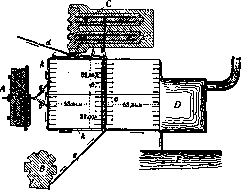
Figure 2. Plan of mud-regenerative basins in Staraya Russa: A and B—bath buildings No. 3 and No. 2; C—N. A. Semashko Mud Treatment Facility; D and E—lower and middle lakes; a—settling tank; b—trough to the basin with mineral water; c—trough to the water wheel; d—pipeline from the source; e—mud troughs; k—drainage trough. (works of Perfiliev and Shchukarev in 1923, 1924, 1925). Recently (1925–1928), similar works have been carried out or are being conducted on the Tambukan, Saki, Mainaki, and some other lakes. The Staraya Russa mud regenerators (see Figure 2) consist of 4 basins with wooden walls and a natural clay bottom, measuring 53.34 x 32.00 m each. The depth of the basins is 1.55 m. Thus, the capacity of each basin is equal to 2,645 m3, and the amount of mud contained in it is about 2,130 m3. Each treatment season, mud is taken from one pair of basins and, in a used state, after coming out of the baths, fills the other pair. In them, it remains under a layer of mineral water for a year, and during this period, it fully restores all its medicinal properties. The flow of liquid mud from the baths goes along wooden troughs (see Figure 3), by gravity, and with the help of shutters available in the troughs, the mud can be directed at will into any of the 4 basins, where it settles and from where the excess water flows out in the manner indicated below. Fresh mineral water also enters here through special troughs from the sources.
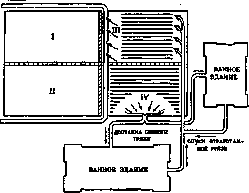
Figure 3. Scheme of mud circulation in Staraya Russa (I, II, III, IV—mud regenerators).
mineral water, which constantly washes the mud and thereby creates the best conditions both for its storage and for regeneration. The speed of water flow through the basins is calculated so that the removal of mud particles from them is impossible. After passing through the basins, the mineral water flows freely outward through spillways and is diverted into the river. The extraction of mud from the basins is carried out by a mud pump: a centrifugal pump that creates a vacuum in the intake pipes and then pumps the mud into settling basins (1928 installation). Mud treatment facilities with solar heating. The Saki facility (see Figure 4) should be considered typical of this type. It consists of three buildings for mud treatment, which house baths for washing and halls for sweating and rest. The reception of the mud medallion is carried out on special mud platforms, where the mud is delivered and where it is heated by the sun on a special wooden flooring. The delivery of mud to the platforms is carried out from the lake at dawn with the help of rail cars. The delivered mud is laid out in the form of medallions and then heated by the sun to the required t°. The size of the medallions is 1.85 x 1.25 m with a thickness of about 35 cm (see Figure 5). The extraction of mud from the bottom of the lake in Saki is carried out from rafts with scoops into boxes, which are then brought to a trestle with a rail track laid on it and rail cars moving along it. The mud is reloaded from the rafts into the rail cars and with their help is taken to the mud platforms, where the medallions are made. The layout of the tracks and buildings is clearly visible in Figure 6. The speed of heating a mud medallion by the sun depends on the salt content in the brine from which the mud was extracted. With
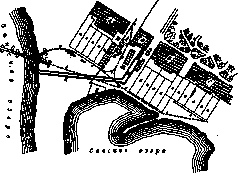
Figure 4. Plan of the Saki mud treatment facility: A, B, G—bath buildings No. 3, 1, 1; V—machine room; D—mud mixer; E—collection basin for mud; Zh—workshop; Z—chimney; I—boiler room; K—channel supplying brine from the lake; L—temporary basin for used mud; M—barracks for mud workers; S—trestle; a—mud platforms; c—track for mud delivery.
the presence of salt in the brine of less than 15–17° on the Baumé scale (see Hydrometer), the mud is not heated by the sun and requires "salting," i.e., the addition of salt. The role of salt, in the opinion of Burkser, consists in the formation of a heat-transparent crust on the surface of the mud, which prevents oxidation and evaporation of water, and consequently, the cooling of the mud. Salting must be carried out exclusively with NaCl; neither Glauber's nor magnesium salts give the same effect. Mud medallions in Saki, thanks to the high salt content in the brine, do not require salting. This operation is usually applied in Berdyansk. Due to the fact that solar heating depends on the presence of the sun and high outside air t°. Therefore, on cloudy, windy, or cool days, especially at the beginning and end of the season, one has to resort to artificial heating, usually steam, according to the methods indicated above. When constructing new mud treatment facilities with natural heating, it is desirable to observe the following standards, taking them per 1 medallion of the mud platform. Waiting room, about 0.3 m2, changing room, 0.55–0.60 m2, sweating room 1.5 m2, mud platforms 12–13 m2. The height of the sweating room should be no less than 6–7 meters in the presence of enhanced ventilation and full
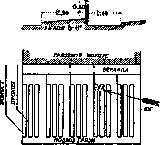
Figure 6. Scheme of the layout of a veranda for mud treatment (dimensions in meters).
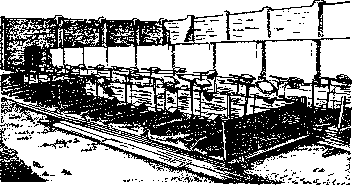
Figure 5. General natural mud baths in Saki. Prepared medallions under solar heating. Thermometers are inserted into the medallions under the crust.
Maximum solar heating, according to experiments at the Kuyalnik estuary, was achieved with the addition of salt up to 8% of the weight of the mud. Further addition of salt has no significance. For all mud treatment facilities with solar heating, the presence of a number of baths for providing patients with mud procedures with artificial heating of the mud is common. This happens due to the fact that solar heating depends on the presence of the sun and high outside air t°. Therefore, on cloudy, windy, or cool days, especially at the beginning and end of the season, one has to resort to artificial heating, usually steam, according to the methods indicated above. When constructing new mud treatment facilities with natural heating, it is desirable to observe the following standards, taking them per 1 medallion of the mud platform. Waiting room, about 0.3 m2, changing room, 0.55–0.60 m2, sweating room 1.5 m2, mud platforms 12–13 m2. The height of the sweating room should be no less than 6–7 meters in the presence of enhanced ventilation and full protection from drafts. The gaps between adjacent medallions are 0.35–0.40 m. The area of the platform for one medallion is about 3.65 m2. The desirable slope of the platform is from 5° to 6°. The platforms should be arranged in parallel rows, with no more than 20 medallions in each row. Passages 1.4 m wide are arranged between the platforms. To protect the patient's head, a special partition (along the entire length between the medallions) about 0.8 m high is made (see Figure 6). The extraction of mud from lakes for our mud treatment facilities is currently carried out almost everywhere, with the exception of Staraya Russa and the Kuyalnik estuary, by primitive means, usually by hand, with scoops from rafts or piers. The use of mechanical methods for lifting mud from the bottom of the lake could be technically implemented very easily and simply, but it is not yet being done for reasons of the relatively high cost of the devices, which is not justified by the quantities of mud lifted from the bottom of the lakes, which for large mud treatment facilities reaches a norm of no more than 300–400 m3 for the entire treatment season. In view of this, it turns out to be much more profitable to lift the mud by hand. However, such a method, while being economical in relation to the mass of extracted mud, is difficult for the workers engaged in the extraction of mud, who are forced to work in water saturated with salt. The protective measures usually taken by workers in this case (canvas suits, rubber boots) achieve the goal only to a weak degree, and the issue of mechanizing mud extraction should be considered overdue. The above-mentioned method of lifting mud by means of a mud pump (dredger), first used in Staraya Russa, has every chance of widespread adoption. The usual method of delivering mud from the lake to the bath building is by hand, using rail cars on rail tracks. In Slavyansk, a train of 5–6 rail cars is delivered by a tank locomotive—a "cuckoo." The capacity of a rail car varies—from 0.6 to 1.5–2.0 tons. Recently, in the Saki mud treatment facility, a convenient type of rail car with mud discharge from a side opening has been used. The opening is covered by a special shutter, which is easily opened, making it possible to release mud from the rail car in any quantity, from a small portion to the complete emptying of the rail car.
N. Gavrilov.
N. Zvorykin.
Related articles
Mentioned in
Cite this page
“Mud Treatment Facilities.” Soviet Medical Encyclopedia. English translation of Bolshaya Meditsinskaya Entsiklopediya, 1st ed. (Moscow, 1928–1936), ed. N. A. Semashko. https://sovietmedicalencyclopedia.pages.dev/article/mud-treatment-facilities/