Bean
Historical document, translated for reference. It reflects medical knowledge of the 1920s–30s and is not medical advice.
Summary
This article discusses the nutritional composition of the common bean, including its protein, carbohydrate, and mineral content, as well as its digestibility and medical indications, such as in diabetes and chronic constipation.
Encyclopedia article (1928–1936)
BEAN, one of the species of the legume family, relatively rich in proteins and purines (see Legumes, Vegetables). Among the proteins of the bean, plant globulins (legumin) predominate, which, when boiled in hard water, form an insoluble compound with calcium (for food, beans should be boiled in soft water or soda should be added); immature grains also contain amino acids. Among all vegetables, the bean, like other legumes, is the richest in purines: dry beans contain 0.05-0.27% uric acid, depending on age, maturity, and soil conditions. Among carbohydrates, starch predominates in mature grains, while dextrin and sucrose predominate in young ones. Fats are contained in the form of lecithin (0.81%). The dry residue contains about 40% potassium and the same amount of phosphoric acid. The seed coats and intercellular partitions are rich in fiber and pectins, which makes digestion of beans difficult and requires prolonged soaking and boiling. Beans are consumed as food in the form of young green pods and in the form of mature grains, which are well-suited for dry storage. In the former form, the content of sugar, salts, and vitamins predominates; in the latter, proteins, lecithin, and starch. The digestibility of dry beans reaches 75% for proteins and 90% for carbohydrates, and is even higher in finely ground form (puree) and when boiled with the addition of soda. Still
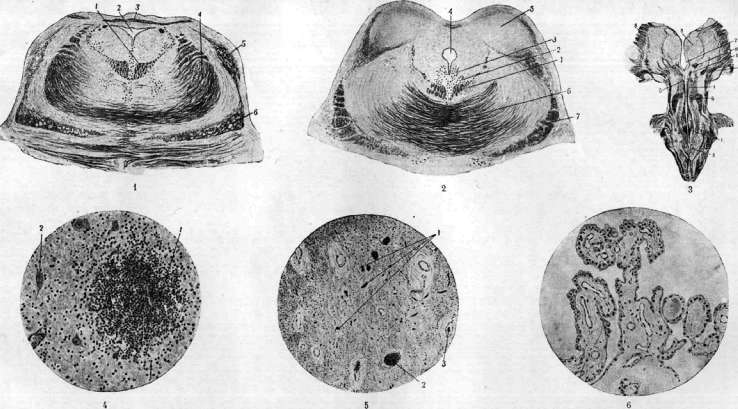
Figure 1. Transverse section of the pons Varolii at the level of the decussation of the trochlear nerve: 1-posterior longitudinal fasciculus; 2-fourth ventricle; 3-decussation of the trochlear nerve; 4-superior cerebellar peduncle; 5-lateral lemniscus; 6-medial lemniscus. Figure 2. Transverse section of the brainstem at the level of the nucleus of the trochlear nerve: 1-posterior longitudinal fasciculus; 2-nucleus of the trochlear nerve; 3-nuclei of the oculomotor nerve; 4-cerebral aqueduct; 5-superior colliculi; 6-decussation of the superior cerebellar peduncle; 7-medial lemniscus. Figure 3. Longitudinal section of the brain passing through the third ventricle: 1-posterior longitudinal fasciculus; 2-third ventricle; 3-thalamus; 4-nucleus of the hypoglossal nerve; 5-lateral nucleus of the oculomotor nerve; 6-superior cerebellar peduncle; 7-red nucleus; 8-internal capsule. Figure 4. Changes in the subthalamic region in Sydenham's chorea: 1-inflammatory infiltration; 2-nerve cells in a state of neuronophagia. Figure 5. Change in the region of the lentiform nucleus in Sydenham's chorea: 1-petechial hemorrhage; 2-thrombosed vein with an expanded lymphatic space and edema within it; 3-organized venous thrombosis with an edematously expanded perivascular space (after Moreau). Figure 6. Choroid plexus.
higher it is in hulled beans (freed from the skin), but this product has not come into wide use among us. Due to the high content of digestible proteins, beans, like all legumes, can to a certain extent replace meat. They are especially indicated in the following cases: 1) in diabetes, along with oatmeal, potatoes, etc., for periodic carbohydrate loading, especially in acidosis (Falta, Noorden, M. Labbe); 2) in chronic constipation, especially of a spastic nature, due to the property of beans to loosen fecal masses and increase their volume, which accelerates their movement through the intestinal tract. Contraindications: diarrhea, flatulence, heart and lung diseases (danger of increased gas formation in the intestines), uric acid diathesis, oxaluria.
Related articles
Mentioned in
Cite this page
“Bean.” Soviet Medical Encyclopedia. English translation of Bolshaya Meditsinskaya Entsiklopediya, 1st ed. (Moscow, 1928–1936), ed. N. A. Semashko. https://sovietmedicalencyclopedia.pages.dev/article/bean/