BAZHENOV
Historical document, translated for reference. It reflects medical knowledge of the 1920s–30s and is not medical advice.
Summary
Nikolai Nikolaevich Bazhenov (1857-1923) was a Russian psychiatrist who served as director of psychiatric hospitals in Ryazan and Voronezh, and later as chief physician of the Moscow Preobrazhenskaya Psychiatric Hospital. He was known for his liberal views, innovative approaches to patient care, and was the first psychiatrist in Russia to organize family-based care for the mentally ill.
Encyclopedia article (1928–1936)
BAZHENOV, Nikolai Nikolaevich (1857-1923), professor of psychiatry; in 1881 he graduated from the medical faculty of Moscow University and became an extra-ordinary intern at the Preobrazhenskaya Psychiatric Hospital in Moscow. As a young doctor, B. was arrested for political unreliability. From 1886 to 1889 he was director of the Ryazan zemstvo (district) psychiatric hospital, which he had organized. Many years later, he also built and organized a zemstvo psychiatric hospital in Voronezh. In 1904 he was appointed chief physician of the Preobrazhenskaya Psychiatric Hospital in Moscow (now the First Psychiatric Hospital). From 1910 B. was professor of psychiatry at the Moscow Higher Women's Courses (now the Second Moscow State University). Combining the work of professor and chief physician, Bazhenov created a clinic and expanded the hospital by building a new building. B. reorganized patient care by introducing the institute of physician-interns and nurses, instead of overseers and "uncles". B. was a typical liberal, a man of exceptional independence of thought, breadth of outlook, originality of views, and bold initiative. B. was the first psychiatrist in Russia to organize family-based care for the mentally ill in Moscow, first in the patronage at the village of Semenovskoye, and later in the city of Voskresensk. In 1915, in connection with the imperialist war, B. was appointed authorized representative of the Red Cross for the care of mentally ill soldiers on the Caucasus, and in 1916 he was attached to the Russian expeditionary corps (France-Salonika). In 1923, while living in Belgium, B. became seriously ill and returned to Moscow, where he died on March 23, 1923. List of works (up to 1909) - see Bazhenov N. N., "History of the Moscow Dolgauz", published by the Moscow City Public Administration, M., 1909. BASALIOMA (from Latin basis - foundation and -oma ending to denote a tumor), a term proposed in 1900 by Krompecher for designating special
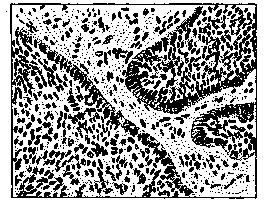
basal cell carcinoma; at the periphery - cylindrical cells filling the basal layer of the flat epithelium.
cancerous tumors that retain in their proliferations the type of the basal, main layer of epithelium [basal cell carcinoma (cancer from basal cells)]. The most typical are B. of the skin, which are usually flat, often superficially ulcerated tumors. Upon microscopic examination among the connective tissue stroma, nests and branching strands are visible, consisting of a solid mass of small epithelial cells, with the cells at the periphery of the nests and strands having a cylindrical shape (see figure) and arranged here like a palisade adjacent to the connective tissue base (similar to the cells of Malpighi's layer of the stratified squamous epithelium). Often the epithelial cells of B. have a spindle-shaped form, resembling fibroblasts, which gives such tissue a resemblance to sarcoma. In some B. among the epithelial cells, small cysts with serous or colloid contents are observed, sometimes resembling glandular lumens. These various pictures give Krompecher reason to speak of solid, cystic, and adenoid types of B. B. of the skin originate either from the cells of Malpighi's layer of the epithelial covering or from the basal cells of the hair follicles and skin glands. Some researchers assume that most often B. have as their starting point epithelial cells detached during the embryonic formation of the skin. The course of B., compared to other skin cancers, is much more benign: they grow very slowly, extremely rarely give metastases; rarely recur after surgery; due to these clinical features, in former times they were not classified as malignant neoplasms, but were characterized by the name "ulcus rodens". Besides the skin, B. of a similar type develop in the mucous membranes covered with stratified squamous epithelium, and according to Krompecher - also from various glands and glandular coverings; tumors of this latter type include B. of the bronchi, stomach, intestines, uterus, mammary gland, etc., consisting of nests of epithelial cells with a palisade of cylindrical cells at the periphery. In particular, Krompecher includes adamantinomas (see) of the jaws, carcinoids (see) of the intestine and the so-called mixed tumors of the salivary glands among the basaliomas of mucous membranes and glands.
Related articles
Cite this page
“BAZHENOV.” Soviet Medical Encyclopedia. English translation of Bolshaya Meditsinskaya Entsiklopediya, 1st ed. (Moscow, 1928–1936), ed. N. A. Semashko. https://sovietmedicalencyclopedia.pages.dev/article/bazhenov/