District Heating
Historical document, translated for reference. It reflects medical knowledge of the 1920s–30s and is not medical advice.
Summary
District heating refers to the centralized production and distribution of heat to consumers over long distances. This system represents an advancement in heating technology, offering greater efficiency through large-scale heat generation and distribution networks.
Encyclopedia article (1928–1936)
DISTRICT HEATING, centralized production of heat, its planned distribution and supply to consumers at considerable distances from the production site. District heating in the form of area heating, supplying a group of buildings located in one territory from a central boiler plant, represents a new stage in the development of central heating technology for individual buildings from separate, individual boiler plants. If a large area with significant thermal energy consumption is served by district heating, this heat supply is sometimes provided not from one but from several large boiler plants. In all these cases, the heat carriers are high or low pressure steam or hot water, the latter mostly in a superheated state of 110-130°C. Steam as a heat carrier is used primarily when it is required for technological purposes in production processes or when an enterprise with an already well-preserved steam heating system (steam pipelines) is connected to the district heating network. In cases where heat is required for heating, ventilation and hot water supply in residential, public and new industrial buildings, the most rational solution is to use hot water as the heat carrier. According to a 1926-27 survey in Moscow, in ordinary individual boiler plants producing steam or hot water, the coefficient of efficiency in house boiler plants averaged 40-50%, while in boiler plants of industrial enterprises it averaged 60%. This shows, firstly, that heat losses in individual boiler plants are very significant, and secondly, that in large boiler plants supplying heat to entire enterprises, the coefficient of efficiency is higher than in small individual house boiler plants. Large boiler plants may have better equipment, more rational fuel combustion, regulating instruments and highly qualified personnel. Therefore, when there is a large number of buildings more or less closely located to each other in one area (workers' settlement, urban district, hospital, industrial enterprise, etc.), it is advisable and economically advantageous to install centralized district heating from one or several large boiler plants, thermal stations, or heat and power plants (HPPs). Recently, for heat supply, not only thermal stations and heat and power plants but also so-called thermal power plants (TPPs)—boiler stations that generate electricity using steam (steam boiler, steam turbine, etc.)—have been used. Power plants that generate only electricity operate similarly to individual boiler plants with a coefficient of efficiency of 25%. Most of the thermal energy contained in fuel is lost with flue gases, in pipelines, due to imperfect insulation, and especially significantly (up to 50-60%) with exhaust steam. The latter loss occurs when water that cools unused exhaust steam and condenses it back into water is heated. After this, the cooling water is most often discharged at 25-30°C into the nearest body of water, for example, a river. The river water is noticeably heated over considerable distances from the station. In other cases, this loss occurs during condensation of exhaust steam in cooling towers. The coefficient of efficiency of power plants can be increased by utilizing the heat from exhaust steam for heat supply to the surrounding area. However, since this heat is available in the form of very low pressure steam (on condensing power plants operating with special coolers-condensers, pressure is reduced even to 0.04 atm) and does not provide sufficient thermal and economic effect, in thermal power plants steam is extracted before its power is fully utilized in the steam turbine. Steam is extracted at a pressure of 2-4 atm, i.e., at a pressure at which it can be used with the greatest advantage for heat supply to the surrounding area. Less electrical energy will be generated than at a condensing power plant—only 12-14% of the thermal energy of the fuel. The extracted steam is either transported for use in steam, steam-water or steam-air heating and hot water supply in industrial enterprises, or this steam is passed through a boiler, a special water heater, from which hot water is then transported for heating and hot water supply in residential, public and industrial buildings. Steam at 2-4 atm heats water in the boiler to 110-130°C, condensing in the process and returning to the boiler; steam going directly to building heat supply or for technological processes also condenses. This water from condensate, as well as water that has cooled when heating rooms in heating systems, can be additionally reheated, returned to the boiler and used for secondary conversion into steam or superheated water. This return of cooled water to the boiler is accomplished by means of centrifugal pumps installed on the return pipes of the network. Thus, up to 50-70% of the thermal energy of fuel can be used for heat supply. The entire combined system of utilizing thermal energy of fuel for both generating electrical energy and heat supply can operate with a coefficient of efficiency of thermal power plants of up to 80%. The heat supply systems in individual buildings (heating systems and hot water supply systems) do not differ from ordinary central heating and hot water supply systems operating from separate, individual boiler plants (see Heating). Heat networks in district heating, through which heat is transported to individual consumers from heat and power plants or thermal power plants to individual buildings and back to the stations, are designed in various ways: two-pipe, three-pipe, four-pipe and multi-pipe systems. In two-pipe systems, steam or hot water is supplied to the consumer through one pipe (supply pipe), and condensate or cooled water returns through another pipe to the boiler (return pipe). In a three-pipe system, there are two supply pipes and one return pipe: one of the supply pipes is designed only for summer consumption, while both together are designed for full winter consumption. In a four-pipe system, there are two supply pipes and two return pipes. In multi-pipe systems, pipelines are distinguished according to the type of consumers: separate ones for residential buildings, separate ones for industrial enterprises, baths, factory kitchens, etc. Pipelines are either made from welded iron pipes or from pipes connected by flanges. The pipes are laid in passable channels, tunnels, sometimes together with the water supply network (Fig. 1), in non-passable channels containing only heat pipelines (Fig. 2); they are also laid underground without channels, only on specially prepared foundation, without special covering (in this case, the trench with the pipeline is filled with some insulating material, for example, aerated concrete, a porous and durable material), and above-ground. In all cases, the pipeline must be well insulated against heat loss. The economic advantages of district heating are: 1) high coefficient of efficiency in utilizing thermal energy of fuel; 2) due to the good equipment of thermal power plants and thermal power plants, it is possible to use local low-grade fuel—peat, Moscow region coal, etc.—after appropriate processing and enrichment (crushers, mills and fuel drying); 3) reduction in transportation costs due to delivery of fuel to one or several large boiler plants
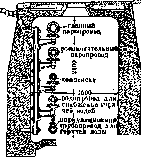
Fig. 1. Passable underground channel for district heating.
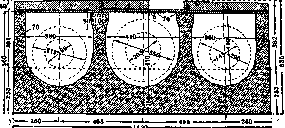
Fig. 2. Channel for three-pipe system.
through the use of cheaper waterways for transportation and through centralized ash removal; 4) reduction in operating costs, since for heating a district, district heating plants and combined heat and power plants require less personnel than individual boilers; 5) some reduction in the useful floor area of buildings used for boiler rooms compared to what is required with individual boilers. Sanitary and hygienic advantages of district heating: 1) The possibility of choosing the location and placing the district heating plant or combined heat and power plant in the most favorable location from a sanitary-hygienic point of view in a populated area or district. When choosing a location, it is possible to take into account the direction of prevailing winds, which will result in the least air pollution with smoke and soot compared to the mass of sources of these harmful emissions from individual boilers. 2) Least pollution of streets during fuel delivery and ash removal. 3) Improvement of the sanitary and cultural level of the population through the supply of households with cheap hot water for domestic needs—kitchens, baths, laundries, baths, etc. The first district heating installation was implemented in the USA, in New York, in 1879. At present, this installation supplies steam to more than 1,200 buildings with a radius of action up to 1 km. In America, in large cities with multi-story buildings, district heating is a very important factor in resolving the issue of urban transportation and its loading of city streets. In the USA there are now about 400 district heating installations. In Germany, the first district heating plant was built in Dresden in 1900 for heating the center of the city with its museums and other large public buildings. In the USSR, the first experimental heat pipeline was built in Leningrad in 1924-25. In Leningrad, a significant part of the city center is now heated by district heating; the power of the network in 1931 was the first in Europe. In Moscow by 1931 there were 4 power plants with district heating installations. 5% of the total amount of thermal energy consumed by Moscow was covered by district heating. In 1937, with consumption of heat in the form of steam and hot water in the amount of 22,900,000 megacalories (millions of calories), 85% of this amount will be covered by district heating. From other cities of the USSR with district heating installations: Leningrad, Saratov, Novoe Sormovo, Smolensk, Yaroslavl, Pskov, Kharkov and others. All new socialist cities will be heated by district heating—Magnitogorsk, Stalinsk and others. The significance of district heating in the USSR in the development of socialist construction is enormous, and it is understandable the attention that was paid to this important issue in the national economy by the June plenum of the Central Committee of the VKP(b) in 1931 and the XVI Congress of the VKP(b) in 1934. The socialist forms of economy in the USSR, the absence of privately-owned competing enterprises, and the planned nature of construction—all this, in contrast to the capitalist economic system, provides all the prerequisites for the development of district heating.
Related articles
Cite this page
“District Heating.” Soviet Medical Encyclopedia. English translation of Bolshaya Meditsinskaya Entsiklopediya, 1st ed. (Moscow, 1928–1936), ed. N. A. Semashko. https://sovietmedicalencyclopedia.pages.dev/article/district-heating/