Ice
Historical document, translated for reference. It reflects medical knowledge of the 1920s–30s and is not medical advice.
Summary
This article from the 1928–1936 Soviet Great Medical Encyclopedia details the physical properties of ice, its formation in nature (including river and anchor ice), and the technical methods for its artificial production using refrigeration machines.
Encyclopedia article (1928–1936)
ICE is formed from water when its temperature drops to zero and below. During the formation of ice from water, gases and partially salts are released. The volume of water increases by more than 8% upon freezing. The specific gravity of water at 0° = 0.99987; the specific gravity of ice at 0° = 0.91674. The increase in water volume upon freezing must be taken into account in water supply engineering. The freezing of water when it stagnates in insufficiently protected water supply pipes often leads to pipe rupture and the cessation of water supply. Upon cooling, ice contracts, which may explain the formation of cracks in large bodies of water. Upon heating, it expands. The coefficient of expansion of ice (according to Schumacher) is 0.000052356. The specific heat capacity of ice is half that of water and is equal to 0.504. The thermal conductivity of ice is 0.504 (according to Desains). Optically, ice is a birefringent body. Ice conducts electricity just as poorly as water. Ice can form either as a result of direct freezing of water at temperatures below 0° or as a result of the transformation of snow, partly under the influence of the penetration of freezing water, but mainly under the influence of pressure. Different types of ice, formed in one way or another, differ from each other in the character of accumulation, thickness, and structure; hence their physical-geological significance is far from identical. Ice originating from the direct freezing of water can be divided into several varieties, namely: ground ice, forming in one way or another in the earth's crust, river ice, lake ice, and sea ice. Ice originating from the transformation of snow, especially under the influence of pressure, forms ice sheets and flows—glaciers—on land. In general, both lake and river ice represent, in their structure, an aggregate of crystals of the hexagonal system, which, growing together in parallel, are arranged with their long axis perpendicular to the freezing surface. On the surface of rivers and lakes, ice forms upon a drop in temperature all the more easily and quickly the purer the water and the calmer it is. The freezing point of saline waters is in direct dependence on the percentage content of salts, i.e., the freezing point is proportional to the strength of the solution: the more salts, the lower it is. Sea water freezes at -2.5°. In sea ice, the presence of calcium and magnesium carbonate and sulfuric acid has been proven. Salt is contained either in the form of a mechanical impurity or in the form of crystals. The thickness of the ice crust varies: in Siberia, it reaches from 1 to 2.5 m. The ice crust consists of a dense ice mass for approximately 2/3 of its thickness, and the last third, facing the water, consists of vertically standing thin plates, with up to 3% NaCl contained in the ice mass as a mechanical impurity. The formation of so-called anchor ice is of enormous importance, especially in the USSR. The diverse role of anchor ice manifests itself both in its huge influence on the entire winter regime of rivers—not only northern but even southern ones—and in a whole series of complications caused by it to hydraulic structures, especially water pipes and power plants using water energy. In the period preceding freeze-up, ice of a peculiar structure (lamellar, jagged, granular) forms on the bottom of rivers and on underwater objects, which, by the predominant place of its formation, is called anchor ice; individual formations of anchor ice sometimes break off from the bottom and float to the surface, where they are known by the names of slush, frazil, and sludge. Accumulations of said ice under the surface ice cover formed downstream create ice dams, causing floods, and its formation on the intake ends of water pipes clogs them and causes a suspension of water supply. Thus, Leningrad was deprived of water for some time in 1894 and 1914 for this reason. The Warsaw water supply, fed from the Vistula River, has repeatedly suffered from anchor ice. In our Caucasian rivers (Terek, Teberda, Araks, Kura), the formation of anchor ice is very often observed, which has repeatedly caused great complications for the Tiflis water supply. The causes of anchor ice formation have not been definitively established. Ice has found wide application for household and technical purposes (see below, glaciers). The complexity of storing and harvesting large stocks of ice, especially in southern countries, the high cost of transporting ice over long distances, and the necessity of having cooling below zero for some branches of industry have made the harvesting of ice by artificial means necessary. In the production of artificial ice, three methods of significant temperature reduction are mainly used: 1) the conversion of a solid body into a liquid state either with the help of a liquid (dissolving salts in water) or with the help of a solid body (table salt with snow)—cooling mixtures; 2) the evaporation of liquids; 3) the expansion of gases. In preparing cooling mixtures, cases of dissolution are chosen that are accompanied by the greatest absorption of heat and in which the resulting mixtures have the lowest possible freezing temperature. Mixtures consisting of water and certain inorganic salts satisfy these conditions. In practice, the merits of cooling mixtures are determined not only by the degree of their cooling but also by their cost. In this regard, the most advantageous is the use of ammonium nitrate, which is most often used in ice machines. A more advantageous and common method is the evaporation of liquids. Of the numerous liquids proposed for obtaining ice, water, ammonia, ethyl and methyl ethers, and sulfurous acid have found practical application. Ammonia is mainly used. Artificial ice is produced by ice-making machines, which are essentially refrigeration machines. Refrigeration machines are divided into the following systems: A. Compression, based on the preliminary compression of certain gaseous bodies (NH3, SO2, CO2, etc.), their conversion into a liquid, and subsequent evaporation. B. Absorption, based on the absorption of a gaseous substance and its subsequent evaporation from the liquid by heating the solution. C. Air-compression, based on the phenomenon that when compressed air expands with a drop in pressure, its temperature also drops. D. Steam-water-vacuum machines, based on the evaporation of water at low temperatures due to air rarefaction by passing water vapor through it. The principle of the design of cooling machines can be seen from Fig. 1, which gives a picture of such cooling; this is the so-called Carré apparatus.
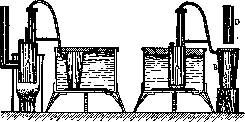
Figure 1. (Carré). In cylinder A, there is a strong aqueous solution of ammonia; ammonia is removed from it by heating to 130°, which, due to its own pressure, condenses in the double-walled vessel B. If one now cools cylinder A and simultaneously lowers into vessel B, which is surrounded by a poor heat conductor, cylinders D filled with water or saline solutions, then the ammonia in vessel B begins to boil and rapidly evaporates; upon evaporation, the temperature drops, and the liquid contained in the cylinders freezes. Based on this same principle, large refrigeration (absorption) machines used for obtaining ice are constructed. The design of such absorption machines is shown in Figure 2; boiler A is half-filled with a concentrated solution of ammonia; upon heating, ammonia exits through tube 1 and passes into dryer C, from which it goes through tube 2 into the coil of condenser B; through tube 3, the gas passes into a valve located in the lid of the ice-maker D and leading into the coil. At first, this valve is completely closed, then barely opened, so that the gas acquires a pressure of 10-12 atm.; furthermore, it is cooled in the condenser, in which the coil is surrounded by cold water. Cooling and pressure convert the ammonia into a liquid state. In the coil of the ice-maker, which is immersed in a solution of calcium chloride, the entered [ammonia] begins to evaporate.
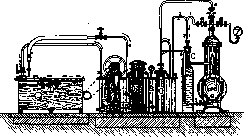
Figure 2.
through the tap, ammonia removes heat from calcium chloride, thanks to which the water located in the vessels placed there freezes. Ice slabs of 10, 12, 15 kg or more are obtained. The ammonia evaporated in the coil passes through pipe 4 into the absorption apparatus E. At the same time, the liquid, deprived of ammonia, passes through tube 5 from boiler A into cylinder D, from where it goes through tube 6 into the small coil of condenser B, and from there through tube 7 also into the absorption apparatus E, where it again absorbs ammonia: through tube 8, the solution is sucked out by pump F and driven through tube 9 into cylinder G, and from there through tube 10 into vat A. Thus, the operation of this machine can proceed continuously. Instead of absorption machines, machines for the formation of ice by means of compression are also used. Previously, air was used for the indicated purpose, but in view of the high cost of operation and the mass of inconveniences associated with the use of air, the latter was replaced by ether, sulfurous acid, ammonia, and CO2. The exhaust gas is sucked in by a pump and then condensed into a liquid, which flows back into the vessel for new evaporation. Artificial ice has all the physical properties of natural ice. Ice-making equipment of the generally accepted type consists of a compressor, a condenser, a regulating valve, and an ice generator with auxiliary devices. The formation of artificial ice occurs either due to the circulation of brine between ice molds or by the direct evaporation of a refrigerant between them. The quality of ice depends on the quality of the water from which it is prepared. When using ice for internal consumption and in its direct contact with cooled food products, it is necessary to impose on it the same strict requirements that are imposed on drinking water. Numerous studies have shown that pathogenic microbes are preserved in ice for months. For example, during cholera epidemics in Leningrad, cholera vibrios were repeatedly found in ice (Conradi, Rommeler). Paratyphoid bacilli were found in ice. Direct experiments with the freezing of microbes indicate that these microbes, whose reproduction is delayed in ice, retain their viability and virulence upon thawing. Therefore, it is necessary to demand that ice for internal consumption be obtained from water that is impeccable in hygienic terms, and that natural ice be taken from bodies of water that are absolutely protected from pollution. For bacteriological examination, a piece of ice is subjected to repeated passage through a burner flame and is thus freed from microorganisms accidentally adhering to it. The piece of ice treated in this way is then subjected to thawing in a sterile dish and examined according to the methods for water examination.
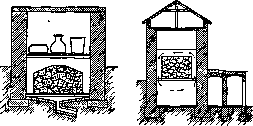
I. Khetsrov. Icehouse, a structure serving for the storage of primarily perishable food products and cooled with the help of ice. The sanitary significance of an icehouse lies in the fact that it protects products from spoilage, while at the same time preserving their freshness. At the present time, with the development of technology, mechanical refrigeration is increasingly used, as a result of which icehouses of the ordinary type are built only in smaller households. Icehouses must be available everywhere where one has to deal with perishable products (meat, poultry, fish, dairy products, eggs), since cold is the only method of preserving their quality. When building an icehouse, it must be borne in mind that for successful storage, a low temperature alone is insufficient; a certain air humidity and ventilation are also necessary. Moreover, different products require different temperatures. In equal measure, the relative humidity of the air and the conditions of ventilation are different for different products, as can be seen from the table below. Icehouses of the ordinary type cannot fully satisfy the needs for the storage of perishable products. For this, mechanized refrigerators (see) are necessary, where the temperature and air circulation can be easily regulated. In an icehouse, however, it is possible to maintain a temperature of +3 to +5° with an amplitude of fluctuations of 3-6°. A temperature of +2 to +4° is quite sufficient for the storage of chilled meat, butter, canned goods, smoked meats, lard, and margarine for a limited time (2-3 weeks). A humidity of 70-75% is desirable. It is extremely important to have reserves of ice, which are stored in special icehouses (ice storage facilities). Their task is the long-term storage of ice. To achieve this goal, special requirements must be imposed on such icehouses. First of all, the largest possible quantity of ice must be preserved; this is achieved by proper insulation of the structure, as well as by the drainage of water resulting from the melting of the ice. Then, the quality of the ice must be preserved, i.e., it must be protected from contamination, from the possibility of infection by sewage, and from the penetration of foreign odors into it. Finally, the ice storage facility must be arranged so that access to the ice, and its loading and unloading, are convenient. In addition to these requirements, the choice of location for the ice storage facility is of great importance in sanitary terms: it must be located far from cesspools and refuse pits, it should be located in the shade if possible in order to protect it from the sun's rays; the soil must be dry. To prevent dampness, impermeable paper is laid in the lining of the walls, and the walls themselves are protected from contact with the ice. The floor is made impermeable or permeable to water; in the first case, the ice is placed on wooden grates, and the water is drained through pipes having a hydraulic seal so as not to allow the penetration of outside warm air inside. The floor can also be permeable; in such cases, it is made of a layer of peat, gravel, or sawdust. As insulating materials, those that change their properties little from dampness are used. These include slag, gravel, peat, brushwood; sawdust and wood shavings are also used. Ceilings are made of various materials: wood, concrete, stone, iron, and are necessarily well insulated. To drain the water formed as a result of dripping on the ceilings, it is recommended to make the latter vaulted, draining the water along gutters located at the springings of the vaults. Roofs must be constructed of poor conductors of heat: straw, wood, roofing felt, roofing paper, etc. In icehouses serving only for the storage of ice (passive ice storage facilities), the latter is stacked not particularly tightly, so that it is easier to separate it when releasing it. In icehouses in which the stored ice is used for cooling cold rooms (active ice storage facilities), it is stacked very tightly, which is very important for preventing premature melting. Icehouses serving for the storage of products must satisfy the following conditions: they must ensure 1) a certain temperature, dryness of the air, continuous air circulation, and sufficient ventilation; 2) the preservability of ice reserves, i.e., the same conditions must be met as in icehouses serving for the storage of ice; 3) access to products and to the ice, as well as convenient stacking of the ice. Continuous air circulation depends on the arrangement of the cooling surfaces; these must be above or to the side of the room. There is an extraordinary multitude of types of icehouses. They are distinguished by the arrangement of the ice in them. In the USSR, icehouses with bottom (underground) ice storage are more often built (Fig. 3). Such icehouses are the
Figure 3. Diagram of an underground icehouse.
Figure 4. Diagram of an above-ground icehouse.
least convenient and cannot be considered satisfactory from a sanitary point of view. The fact is that in such icehouses, the ice cools only those layers of air that are in direct contact with it. These layers of air, having cooled, become heavy and remain motionless above the ice. Due to this immobility, the air cannot deposit excess moisture on the ice, which makes it damp. The upper layers of air, however, remain poorly cooled. Thus, icehouses with bottom cooling are characterized by poor air circulation, its humidity, and the unevenness of the lower and upper layers of air in the cold chamber. It goes without saying that the storage of products under such conditions is not expedient, especially since in icehouses of this kind, products are usually placed
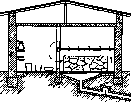
Figure 5. Side arrangement of an icehouse.
Type of stored products | Temperature | Humidity (%)
Chilled meat | 0 to +5 | 75-80
Frozen meat | -8 to -6 | 70-80
...directly on the ice, which contributes to their contamination. The most suitable are iceboxes with top (above-ground; Fig. 4) and side (Fig. 5) ice storage. In iceboxes with above-ground storage of ice, the latter is located above the products being cooled, as a result of which cold air, being heavier, sinks down and cools all the stored products. With this method of icebox construction, the most perfect air circulation is achieved, because cold air sinks down and gives way to warm air rising upward. The temperature in such an icebox is very uniform. The same results are achieved in iceboxes with side storage of ice. The latter are even more convenient, because in iceboxes with top storage of ice, the air in the cold chamber can condense its vapors on the ceiling and cause very significant dripping. For this reason, at the present time, the most suitable type of icebox must be considered the icebox with side storage of ice, especially since its construction is simple and the cost is inexpensive. Such an icebox can be used in any household, both in the city and in the countryside. The conditions achieved in an icebox with top and side storage of ice (continuous air circulation, its dryness, and uniform temperature) are of extremely great importance in a sanitary regard, because they ensure good preservation of the products located in the icebox. For storing small current stocks of products for a short time (in a dining room, sanatorium, living quarters, etc.), room iceboxes (Fig. 6) are quite suitable. They are a cabinet with double walls, between which insulating material (felt, cork sheets) is located. The cabinet is divided into two compartments: a smaller one, in which the ice is located, and a larger one with shelves for products. In order to achieve the best storage conditions, the ice is sprinkled with salt; then in the compartment for storing products, the temperature drops to +2°, +3°, and even to 0°.
E. Barkhan. Ice as a therapeutic agent, proposed at one time by Baudens for local cooling of diseased tissues, has in general the same effect as a cold compress (see) or a Leiter cooler, but to a greater degree. In this case, not only the skin is cooled, but also the underlying tissues;
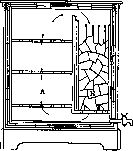
Figure 6. Room icebox in cross-section: A-compartment for products; B-compartment for ice.
due to the contraction of small vessels in the given area, blood congestion, absorption, and exudation are reduced, as well as the conductivity of nerve tissue; inflammatory phenomena are limited, irritation and compression of nerve endings are reduced, and at the same time, pain is also reduced. - The most important indications for the use of ice. 1. Acute inflammatory processes in the initial stage, especially general and local inflammation of the peritoneum, meninges, acute orchitis (of gonorrheal origin), acute hemorrhoidal phlebitis. 2. Fresh bruises and other types of injuries with hemorrhage into tissues without damage to the integument. 3. Rush of blood to the brain, headaches and delirium on this basis, increased excitability of the central nervous system. 4. Sharply expressed excitation of cardiac activity. - Contraindications are trophic changes of the skin on the basis of circulatory disorders, general exhaustion, and senile marasmus, because in this case, tissue necrosis can occur relatively easily. - Methodology and technique. Ice in pieces the size of a walnut is placed in a bag made of waterproof fabric (mostly rubber). In order for the bag to fit the body better, it is filled with ice approximately halfway, and the air is released. To avoid excessive cooling, a towel or a piece of some material is placed between the bag and the body. For greater convenience of application in various areas of the body, ice bags are manufactured in various shapes. For the head-in the shape of a helmet, for the ear-in the shape of a hollow ring with four loops for attaching ribbons, for the neck-in the shape of a sausage. In those places where it is difficult to keep the bag from slipping, or in case of sharp pain, which may increase even more from the pressure of the weight of the bladder, it is suspended on an arch or two crossed sticks attached to the bed above the patient. This is especially appropriate in case of inflammation of the peritoneum. In the absence of a real bag, one can tie ice in a piece of oilcloth or tarpaulin. Ice melts more slowly if about 50 g of NaCl is added to the bag. In the absence of ice, it can be replaced by cooling mixtures of the following composition: ammonium chloride and potassium nitrate, 100 g each per 320 g of water, or the same salts in the same amount + 160 g of sodium sulfate per 230 g of water. Internally, ice is used in small pieces as a remedy that reduces or stops nausea and vomiting. In this case, it is necessary to use ice made from clean water.
G.
Gurevich.
Related articles
Cite this page
“Ice.” Soviet Medical Encyclopedia. English translation of Bolshaya Meditsinskaya Entsiklopediya, 1st ed. (Moscow, 1928–1936), ed. N. A. Semashko. https://sovietmedicalencyclopedia.pages.dev/article/ice/