Liquids
Historical document, translated for reference. It reflects medical knowledge of the 1920s–30s and is not medical advice.
Summary
This article from the 1928–1936 Soviet medical encyclopedia defines liquids from a physical perspective, describing their molecular properties, behavior, and role in biological processes. It covers surface tension, compressibility, and the distinction between liquids and gases, including the concept of critical temperature.
Encyclopedia article (1928–1936)
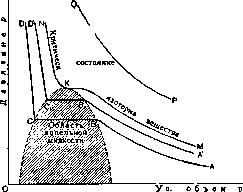
Liquids, from a physical point of view, can be considered a substance whose molecules can easily be moved relative to one another, the expenditure of forces for this movement being insignificant. Liquids play a huge role in biological phenomena, water being the basis of all processes occurring in living tissues. It is enough to point out that the organism contains about 58% water by weight, so one can say that the organism, in its essential and basic part, consists of water. This circumstance shows the enormous importance of liquids in life processes. Many phenomena of a pathological character depend entirely on changes and disorders of the functions of the organism associated with the absorption and release of water. Phenomena of nephritis, edema, and ascites are conditioned by changes in the functions of cells, by virtue of which water is unable to be normally excreted or bound by tissues. Due to the mobility of the particles, liquids do not retain their shape and take the shape of the vessel into which they are poured. Liquids are characterized by the fact that, poured into a vessel, they form a surface of separation with a gas, representing a horizontal plane located normal to the force of gravity. In their physical properties, liquids are sharply divided into 2 classes - capillary liquids (or proper liquids) and gases. The difference between a capillary liquid and a gas lies in the fact that the molecules of a capillary liquid are close to one another and are bound by forces that prevent these molecules from dispersing in the surrounding space. The molecules of a gas are at a significant distance from one another, this distance depending on the external pressure. These distances relative to the size of the molecules are such that one can consider the molecules of a gas as material points, which have almost no volume. The forces acting between gaseous molecules are negligible, and they can be neglected. The peculiarities of a capillary liquid and a gaseous liquid depend, therefore, on the different distance of the molecules and the associated difference in the magnitudes of molecular forces. If a sealed vessel with a liquid is heated, it can be shown that, starting from a known temperature, the liquid and its vapors lose the boundary of separation, the difference between the gas and the liquid disappears, and the entire contents of the tube appear homogeneous. The temperature at which this phenomenon occurs for a liquid is called the critical temperature, or, as Mendeleev, who first investigated this phenomenon, called it, the temperature of absolute boiling of the liquid. The cause of the phenomenon lies in the fact that at the critical temperature the liquid loses the cohesion of its particles and turns into a substance in which the particles possess the properties of gaseous particles. The theory of the transition of a liquid at a certain temperature from a capillary state to a gaseous state was developed in the works of van der Waals, who showed that liquids can be continuously translated from a capillary-liquid state into a gaseous state. These transitions can be characterized by the following diagram: let us plot the value of the specific volume v, i.e., the value of the volume corresponding to a unit mass of liquid or gas, on the abscissa axis, and the pressure p on the ordinate axis. Let us study the phenomenon of compression at a constant temperature. If a substance is investigated at a sufficiently high and constant temperature, for example if carbon dioxide is worked with at room temperature, then, compressing the gas, one obtains ever smaller volumes, the product of the pressure p and the specific volume v representing a constant value (Boyle-Mariotte's law), pv = const, (part AB, see figure). At some moment, when the compression of the liquid becomes sufficiently large and the molecules can exert a significant influence on one another, the gas passes into a liquid state. A surface of separation is formed in the substance, separating the saturated vapor from the liquid. When the saturated vapor is compressed, its pressure p remains constant, and the vapor passes into a liquid (part BC). Finally, when all the vapor located under the liquid condenses and turns into a capillary liquid, under the piston in the apparatus there will be exclusively a capillary liquid, the compression of which is extremely small and requires enormous pressures (part CD). If a higher initial temperature is taken, then the limits of the volumes where capillary liquid is observed will be smaller, for example C1B1 for a higher temperature. Finally, a liquid can be heated to such a temperature that the liquid will form saturated vapors only at one point (point K, in the figure). This will correspond to the critical temperature (curve MKN), passing to which one falls into the region of a gaseous state, characterized for temperatures far from the critical one by the gas's obedience to Boyle-Mariotte's and Gay-Lussac's laws (curve PQ). (The area where a separation exists between the liquid and the vapor is outlined by a dotted line and shaded in the figure.)
P. Lazarev.
The particles of a liquid lying near its surface (forming a surface layer) are drawn inward by the lower-lying molecules into the liquid, while the particles lying in the depth of the liquid are attracted by their neighbors equally in all directions. Such forces acting on the surface particles of a liquid perpendicular to its surface and calculated per 1 cm2 of it give the molecular pressure K = "j (according to van der Waals). From this it is also clear that to increase the surface of a liquid by 1 cm2, i.e., to extract a certain number of particles from inside the liquid into its surface layer, work must be expended. This work of forming 1 cm2 of the surface of a liquid ($\sigma$), called surface tension, is measured in erg/cm2=dyn/cm and accumulates in the surface layer in the form of an excess of free (so-called "surface") energy of its molecules $\alpha$ s (s-surface) (see Surface Tension, Capillarity). A liquid mass left to itself always, in a spontaneous process (at v and t° = const.), strives to minimize free energy, i.e., to minimize the surface s, taking the form of a sphere. A sphere at a given volume possesses the smallest surface, and it must be considered as the natural form of all liquids. Thus, small drops of a liquid, the form of which is little distorted by the force of gravity, are spherical, if they lie, for example, on an uncoated plate (drops of water on paraffin, mercury on glass). The small compressibility of a liquid, $\beta$ = ----.--, i.e., the relative decrease in the volume of a liquid with an increase in pressure p by 1 atm [$\beta$ is measured in inverse atmospheres (atm)-1], is explained by the fact that liquids are already compressed by a very large molecular pressure (see table). Basic molecular properties of liquids (at t° = 20°). Liquids Glycerin . . . - Glycol . . . - Ethyl alcohol . - Benzene .... 72,8 65,0 46,7 21,6 28,8 18.5 85 46.7 81,0 56,2 41,2 27,0 2,3 1.9 0.7 1.00 For different liquids $\beta$ changes inversely with molecular cohesion, i.e., $\beta$ and $\alpha$ (see table); so, for mercury ($\sigma$=460 erg/cm3) we have a very small $\beta$=3.9.10-6 (atm)-1. All liquids are usually associated to a greater or lesser extent, i.e., their particles are complexes of simple molecules. Thus, liquid water consists mainly of "dihydrate" (H20)2 and "trihydrate" (H20)3. With an increase in temperature, the degree of association of liquids usually falls. The association of liquids is conditioned by their polarity, i.e., the presence in their molecules of asymmetrically located polar groups manifesting secondary valences (OH', NH', COOH'). The molecules of polar liquids (water, amines, alcohols, organic acids) can be considered as electric dipoles (see): Intermolecular forces in polar (associated) liquids are large; they are characterized by a large surface tension, internal pressure, latent heat of evaporation, and dielectric constant (see table). Nonpolar liquids (hydrocarbons) are not associated (so-called normal liquids) and possess a low dielectric constant, a small surface tension, etc. The greater the difference in polarity of two contacting liquids, the smaller their mutual solubility and the greater the surface tension at the boundary between them. With a decrease in the difference in polarities, mutual solubility of liquids grows, and liquids close in polarity mix with one another in all respects (water, alcohol, acetone). (See also Capillarity, Surface Tension, Viscosity.)
P. Rebind.
Related articles
Mentioned in
Cite this page
“Liquids.” Soviet Medical Encyclopedia. English translation of Bolshaya Meditsinskaya Entsiklopediya, 1st ed. (Moscow, 1928–1936), ed. N. A. Semashko. https://sovietmedicalencyclopedia.pages.dev/article/liquids/