MENDELEEV
Historical document, translated for reference. It reflects medical knowledge of the 1920s–30s and is not medical advice.
Summary
Dmitri Mendeleev (1834-1907) was a renowned Russian chemist who created the periodic table of elements, revolutionizing chemistry. His work spanned multiple scientific fields including chemistry, meteorology, and industrial applications.
Encyclopedia article (1928–1936)
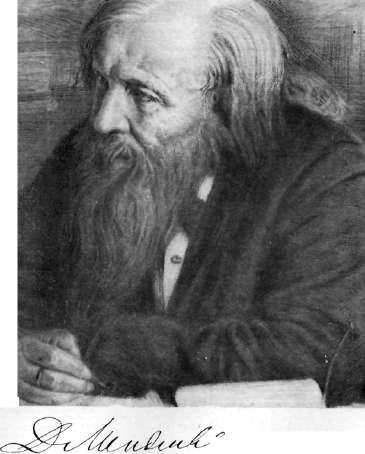
MENDELEEV Dmitry Ivanovich (1834-1907), greatest of Russian chemists, was born in Tobolsk, in the family of the director of the Tobolsk Gymnasium, as the nineteenth child. In childhood his upbringing and education were supervised by his mother, to whom he owed a great deal. After graduating from the Tobolsk Gymnasium at age 16, he entered the Higher Pedagogical Institute in St. Petersburg, which he graduated from in 1854. In early 1856 he defended his candidate's dissertation on isomorphism (St. Petersburg, 1856) and in the same year his master's dissertation "Specific Volumes" (St. Petersburg, 1856). In 1859 he was sent abroad for two years, where he first worked in Paris under the guidance of Regnault, and then in Heidelberg. Here he set up a small private laboratory, where he studied capillarity, thermal expansion and compressibility of liquids, and conducted his famous research on the "absolute boiling point", later called the "critical temperature". Upon returning to St. Petersburg in 1861, he published an original course in organic chemistry (St. Petersburg). In 1863 he was elected professor at the Technological Institute, became interested in a number of industrial and agricultural problems, made several trips to the Caucasus to study the Baku oil fields, and advocated for the development of the oil industry in Russia. In 1865 he defended his doctoral dissertation on the combination of alcohol with water (J. Russ. Phys.-Chem. Soc., 18.37, vol. 5, pt. chem., sec. 1, p. 335), which had great technical significance, creating the basis for a rational system of alcoholometry, used in Holland and Germany, and later in Russia, and at the same time great scientific value, as it first stated the basic principles of the chemical theory of hydration. In 1867 M. was elected to the chair of chemistry at St. Petersburg University, where he taught until 1890; during student unrest he took the side of the students, resigned, and transferred (in 1893) to service in the more liberal Ministry of Finance, where he became head of the newly organized Main Chamber of Weights and Measures. Here he created a number of departments, conducted delicate research in metrology, especially on the theory of analytical balances and on the renewal of Russian standards of length and mass. The result of these researches was three works, of which the last and most important was "Experimental Research on the Oscillation of Balances" (St. Petersburg, 1898; reprinted in 1931). The scientific interests of M. were extremely broad and diverse. He much occupied himself with the study of gases and vapors, he was interested in the earth's atmosphere, air resistance and meteorological phenomena. Under his editorship appeared the large course in meteorology by Mon. In 1887 he undertook a solo flight in a free balloon without a pilot and made a series of meteorological observations during a solar eclipse. Studying the oil industry, he became interested in the origin of oil and created an original theory of its mineral origin. From the oil industry the interests of M. spread to other industrial and economic problems. M. belongs the idea of "underground gasification of coal", the experimental development of which is being carried out in our country. He wrote "Explanatory Tariff" (vols. 1-3, St. Petersburg, 1891) and "Toward the Knowledge of Russia" (St. Petersburg, 1906), in which he proved the necessity of industrializing our country. In the last years of his life he worked much on assignments from the military department and created a new type of smokeless powder, "pyrocollodion", which gave excellent results. Finally M. was interested in painting, and in his house for many years gathered a circle of wandering artists". Despite such diversity of occupations and interests, the main work of M.'s life remained his work in chemistry. In this field he created the chemical theory of solutions, which affirmed the presence of chemical bonds and definite chemical compounds between the constituent parts of the solution. In his time this theory did not have great success, because at that time, under the influence of the work of van't Hoff, Arrhenius and Ostwald, the physical view of solutions began to be established. But then, when the enthusiasm for the physical theory passed, the views of M. revived in the form of the hydrate theory. The greatest work of M., which brought him world fame, which brought Russian chemistry to the forefront of world science, was his creation of the periodic system of elements (see), basically completed in 1869. This periodic table of Mendeleev was the first successful attempt at a rational classification of elements and was soon accepted by chemists all over the world. Especially its success was promoted by the circumstance that M. had the courage to predict the properties of elements unknown in his time, which should fill the empty cells of his table. Even during his lifetime in France, Norway and Germany were discovered the elements predicted by him (Ga, Sc and Ge) and their properties exactly corresponded to the expectations of M. The "noble gases" (He, Ne, Ar, Kr, Xe) discovered later in England also easily fitted into M.'s system, which had to be supplemented with a new (zero) group. The success of M.'s system was so great that a dispute broke out around it about priority. M. himself did not participate in it. His honor was defended by English scientists who argued with the Germans. M.'s system brought him world fame and loud glory: he was awarded orders and medals, elected honorary member and doctor of many foreign academies and universities. Only the Russian Academy did not see fit to make him its member: in view of the sharpness of M.'s character, he was on bad personal terms with many academicians. M.'s periodic system successfully withstood the test of time: in the field of the doctrine of elements and their atoms since the time of M. the greatest discoveries have been made and a new science of the structure of matter has been created. Nevertheless, the table created by M. did not require change, and the systematization of elements proposed by him is confirmed by the latest works. To some extent only its interpretation has changed: M. attributed the main role to the atomic weight of the element, at the present time this role is played by the serial number in M.'s table, equal to the number of charges of the nucleus. But the order of elements remains the same, and almost all the empty places in his table gradually filled up. The most important role of this system is that it to this day pushes scientists to search for new paths and generates new amazing discoveries. Its most complete exposition the periodic system of M. found in his remarkable course in chemistry "Fundamentals of Chemistry", which had 8 editions in Russian during M.'s lifetime and 4 editions after his death. In addition it was translated into German and French and in England was published 3 times. Engels, characterizing M. as the creator of the periodic system, says: "Mendeleev, applying unconsciously the Hegelian law of the transition of quantity into quality, accomplished a scientific feat which can boldly be placed alongside the discovery of Leverrier, who calculated the orbit of the still unknown planet-Neptune". Being a great revolutionary in chemistry, M. was distinguished by conservatism in understanding socio-political life, was a principled opponent of socialism. His activity took place in a period when the bourgeoisie played a progressive role, and M., fighting for the development of industry and agriculture on a capitalist basis, remained in the thrall of his class and his time. But the demands that Mendeleev made in regard to the use of natural wealth, industrialization of the country, chemicalization of agriculture, development of the Arctic, study of the atmosphere, etc., could only be satisfied to a very small degree under the conditions of the capitalist system and are only now being realized.

Related articles
Mentioned in
Cite this page
“MENDELEEV.” Soviet Medical Encyclopedia. English translation of Bolshaya Meditsinskaya Entsiklopediya, 1st ed. (Moscow, 1928–1936), ed. N. A. Semashko. https://sovietmedicalencyclopedia.pages.dev/article/mendeleev/