Periodic System of Elements
Historical document, translated for reference. It reflects medical knowledge of the 1920s–30s and is not medical advice.
Summary
The Periodic System of Elements, established by Dmitri Mendeleev in 1869, organizes elements based on their atomic weights and chemical properties, showing periodic relationships that allow prediction of element characteristics and their compounds.
Encyclopedia article (1928–1936)
Periodic System of Elements, periodic law. For a long time, attempts had been made to establish the dependence of the properties of elements on their atomic weight: Döbereiner (1817) pointed out triads of similar elements between which almost equal differences in atomic weights were observed (e.g., Ca=40.1, Sr=87.6, Ba=137.4), then de Chancourtois and A. R. Newlands (1862) indicated the "law of octaves" and others, but only D. I. Mendeleev in 1869 most fully clarified the connection between individual groups of elements. Soon, in 1870, Lothar Meyer, independently of Mendeleev, in his article "On the Nature of Chemical Elements as a Function of Their Atomic Weight" expressed views similar to those of Mendeleev. The basic principle of Mendeleev's system can be formulated as follows: the chemical and physical properties of compounds formed by elements are in a periodic dependence on the magnitude of their atomic weight. Mendeleev arranged the elements in order of their atomic weights, and it was found that there is, as it were, a periodicity in the properties of element compounds, and every eighth element repeats the properties of the element taken first in the count: Na is similar in properties of its compounds to Li, Mg to Be, Si to C, Cl to F. Thus, if all elements are arranged in order of increasing atomic weight, a clear periodicity of the properties of their compounds is observed, therefore Mendeleev proposed to call such a system of arrangement of elements periodic. The law of periodicity he discovered was formulated as follows: the properties of simple bodies, as well as the form and properties of element compounds, are in a periodic dependence, or, expressing it algebraically, form a periodic function of the magnitude of their atomic weight. Such a periodic appearance of similar elements could be more clearly detected when all elements were placed in a table, which Mendeleev placed in the first edition of his "Fundamentals of Chemistry" and then in subsequent editions (ending with the eighth in 1905), somewhat changing the form of the table, although it remained essentially unchanged. Before the discovery of the so-called "noble gases" (argon, helium, neon, etc.), the tables contained 8 vertical rows (groups) designated by Roman numerals and 12 horizontal ones. Groups contain similar elements forming natural families; in each group there are elements belonging to even and odd series. After the discovery in 1894-95 of argon and its analogues, a special "zero group" was added (Tables 1 and 2). The elements follow one another in arithmetic sequence of their atomic weights. If, starting with the lightest metal, lithium, we arrange Li = 6.94; Be = 9.02; B = 10.82; C = 12.00; N = 14.01; O = 16; F = 19.00; Na = 23.00; Mg = 24.32; Al = 26.97; Si = 28.06; P = 31.02; S = 32.06; Cl = 35.46, it turns out that the properties of elements change gradually: from the typical metal lithium through B, C, N we pass to the most typical metalloid fluorine. The same is observed in the second row: VIII). In the first row, Mendeleev placed hydrogen; in the second row are He, Li, Be, B, C, N, O, F; the third row begins with neon (Ne) in the zero group, followed by Na, Mg, etc. Thus, the jump from halogens (F, Cl) to metals of Group I, which was observed from 1871, was smoothed out by the establishment of the zero group: fluorine is an element with sharply expressed electronegative properties, sodium with similarly electropositive ones; the transition from the first to the second occurs through neon - a completely neutral element in which both opposite electricities seem to be completely balanced. The same can be said about the transition from chlorine to potassium through argon, from bromine through krypton to rubidium, from iodine to cesium through xenon. In general, the transition of elements of odd series: 3rd, 5th and 7th to elements of even series 4th, 6th, 8th occurs through elements of the zero group (explanation from the point of view of the electronic theory of atomic structure is given below). The transition from even series (4th, 6th, 10th) to odd ones (5th, 7th and 11th) occurs through Group VIII, which contains 3 elements in each series: in the 4th Fe, Co, Ni, in the 6th Ru, Rh, Pd and in the 10th Os, Ir, Pt. Starting from the 4th series, large periods are observed, consisting of two small ones; there are 3 such periods: the first consists of the 4th and 5th series, the second of the 6th and 7th, the third of the 10th and 11th. This double periodicity is manifested in the fact that elements of even series in each group, e.g. Li, K, Rb, Cs or Ca, Sr, Ba, show greater similarity among themselves than elements of the even series and the following odd series (e.g. K and Cu, Ca and Zn). The same can be said about elements of odd series: for example P, As, Sb in Group V, Cl, Br, J in VII, etc. In general, it can be noted that elements of odd series have some common properties, e.g. elements belonging to odd series of IV, V, VI and VII groups can form gaseous hydrides, organometallic compounds, etc.; they are mostly diamagnetic, while elements of even series are paramagnetic, etc. Examination of the element table leads to the following conclusions: 1. One of the basic properties of an element determining its place in the periodic system is its atomicity (valence) - the ability of its atom to combine only with a certain number of other elements, and the most characteristic are the valences of elements with respect to oxygen and hydrogen (or halogen). The composition of the highest salt-forming oxygen compounds is determined by the group number: elements of the first group form oxides of the general formula R2O, the second - RO (R2O2), the third R2O3 and so on up to R2O8 (RO4). The group number indicates the number of oxygen atoms combining with two atoms of the element, in other words - the atomicity (or valence) of the element with respect to oxygen. The first group includes monovalent elements, the second - divalent, the third - trivalent..., the seventh - heptavalent. Starting from Group IV and ending with VII, elements C, N, O, F and elements of odd series form gaseous hydrides in which they show atomicity (or valence) with respect to hydrogen different from that with respect to oxygen, and the sum of valence units with respect to oxygen (A) and hydrogen (R) equals 8 (A+R = 8). Thus, for these elements, it is necessary to distinguish valence with respect to oxygen (electropositive) and with respect to hydrogen (electronegative), the first increasing with the group number (from 1 to 8), while the second, most sharply manifested in elements of IV, V, VI and VII groups, decreases when moving from elements of Group IV as described above. Knowing which group an element belongs to, one can directly say what its valence is with respect to both oxygen and hydrogen. 2. Elements of the 2nd series (Li, Be, B, C, N, O, F), called typical by Mendeleev, have the smallest atomic weights and are the most common in the upper layers of the lithosphere and atmosphere. 3. As for the position of metals and metalloids, three directions can be indicated along which a gradual and correct change of the electropositive metallic character into the electronegative metallicloid occurs. A. The first direction was indicated at the very beginning, namely - in the first horizontal rows from elements of Group I to VII we observe the transition from metals to metalloids. B. In the same group, when moving from top to bottom, an increase in the metallic properties of elements is observed, and consequently an increase in the basic properties of their oxides with increasing atomic weight: this is observed for elements of both the first (I and II groups) (e.g. K, Rb, Cs and Ca, Sr, Ba) and especially IV-VII (e.g. C, Si, Sn, Pb or N, P, As, Sb, Bi), and even in Group VII, iodine (the halogen with the highest atomic weight) shows metallic properties: in iodine monochloride (ICl) and iodine trichloride (ICl3), iodine behaves as a metal with respect to chlorine. From the above, it follows that the most electronegative element should occupy the right upper place (which is occupied by fluorine), and the most electropositive metal (cesium) the left lower place. Thus, "each element in the periodic system has a place determined by the group and series in which it is located. The group and series indicate the magnitude of atomic weight, properties and form of the highest oxide, hydrogen and other compounds - in a word, the main quantitative and qualitative characteristics of the element". If in a certain group there are elements: R1, R2, R3, and in the series where one of these elements, for example R2, is located, there is before it element Q, and after it element T, then the properties of R2 are determined by the properties of R1, R3, Q and T. Thus, atomic weight R2 = ¼(R1+R3+Q+T). For example, the atomic weight of selenium, located between sulfur (S=32), tellurium (Te=127.5), arsenic (As=74.96) and bromine (Br=79.92), equals ¼(32 + 127.5 + 74.96 + 79.92) = 78.58, i.e. close to the found 79.2. Similarly, other properties of selenium and its compounds could be determined if they were not known.
Mendeleev, upon establishing the Periodic System of Elements, pointed out that it could serve to predict the properties of still unknown elements. When arranging elements in order of increasing atomic weights, Mendeleev encountered the fact that between the atomic weights of calcium and titanium there is a gap of eight units, between zinc and arsenic - ten units, but this circumstance did not disturb Mendeleev, and he placed titanium in Group IV, and arsenic in Group V, while the empty spaces he filled with three unknown elements, to which he gave the names: eka-boron, eka-aluminum (Ea = 68-70) and eka-silicon (eka-silicon) (Es = 72). Soon the predictions of the properties of new elements received confirmation. In 1875, Lecoq de Boisbaudran discovered in zinc blende an element which he named gallium, suitable in properties to those predicted for eka-aluminum; in 1880, Nilson discovered scandium and pointed out that there remains no doubt that scandium is eka-boron, and in 1885, Winkler found germanium, the properties of whose compounds fully coincide with those predicted for eka-silicon. In his article, Winkler writes: 'There can hardly exist a clearer proof of the correctness of the doctrine of the periodicity of properties than the fertilization of the hitherto hypothetical 'eka-silicon'; it constitutes of course more than a simple confirmation of a bold hypothesis, it marks an outstanding expansion of the chemical field of vision, a giant step in the field of knowledge.' Mendeleev not only predicted the properties of new elements, but, guided by the Periodic System, proposed to change the atomic weight of certain elements; indium (In = 114.8) and uranium, for which he proposed to double the previous atomic weight, i.e., to accept U = 239, instead of 119. Atomic numbers. Isotopes. Pleiades. Thanks to the successes of physics and chemistry at the end of the 19th and beginning of the 20th centuries, there occurred a sharp revolution in views on the structure of matter and on the atom. According to classical theory, atoms of bodies were the basic, indestructible, as it were, cornerstones of the universe, which cannot be destroyed or altered by any forces. Such was the view of atoms held by scientists such as Maxwell, Mendeleev, and many others. This view was based on the fact that in chemical reactions atoms are chemical individuals. Mendeleev defended this point of view to the end of his life, and characterized the idea of a single matter entering into the composition of all atoms as a utopia. At the present time, the complexity of the structure of atoms has been confirmed by many experiments, and several models of the structure of atoms from protons and electrons have been proposed, but despite this the Periodic System has only received confirmation, because according to new theories the places of elements in the Periodic System, indicated by Mendeleev, must be preserved.--The basic position of Bohr's theory [later developed by Kossel and others] is that atoms of each element represent a complex system consisting of a positively charged nucleus, around which rotate electrons, the orbits of which are arranged in several layers. The number of all electrons surrounding the nucleus is equal to its positive charge. This follows from the fact that atoms of elements in the free state are electrically neutral. As Moseley showed (1911), the magnitude of the positive charge, determined on the basis of X-ray spectra, or in other words the number of planetary electrons is equal to the atomic number or serial number indicating the order of arrangement of elements in the Periodic System. In 1920, Rutherford and Chadwick by direct experiment determined that the charges of the positive nuclei of atoms of copper, silver, and platinum are equal to +29.6 e, +46.3 e and +77.4 e. The atomic serial numbers, determined from X-ray spectra, are 29, 47 and 78. From this it can be seen what important significance the experimental determinations of the magnitude of the positive charge of the nucleus have. The serial numbers of elements on the basis of Moseley's method were determined for all elements, starting from hydrogen and ending with uranium (92). For the first 20 elements, up to and including calcium, the serial numbers are close to half the atomic weight (Table 3). The arrangement of elements on the basis of serial numbers confirmed the correctness of the previous order of elements indicated by Mendeleev, and secured the place for iodine (J = 126.9) after tellurium (Te = 127.5), for nickel (Ni = 58.96) behind cobalt (Co = 58.97) and for argon (Ag = 39.88) before potassium (K = 39.10). These deviations received a simple explanation in the new formulation of the Periodic System: the Periodic System represents a classification based on the number of planetary (i.e., surrounding the atomic nucleus) electrons; the properties of elements are a periodic function of their atomic serial numbers, and not atomic weights. The determination of serial numbers of elements made it possible to learn how many and which elements are still undiscovered. Thus the places of rare earth metals (from 59 to 72) were determined (Table 3). It was found that both homologs of manganese are missing - masurium (with serial number 43) and rhenium (Re = 186.31, serial number = 75), the homolog of iodine (serial number 85) and cesium (serial number 87). Of these, rhenium has been found and is quite well studied; as for masurium, indications relating to it cannot be considered firmly established. The discovery of isotopes (see) introduced a new change in the concept of atomic weight. Since the place occupied by an atom in the Periodic System is determined by the magnitude of the positive charge of the atomic nucleus, atoms of different weights, but with the same nuclear charge, will fall into the same place and, having the same chemical properties, cannot be separated from one another. The atomic weight determined under such conditions represents some average value for different atoms occupying the same place in the Periodic System, for the so-called isotopes. A group of several isotopes forms a pleiad, as Fajans named it. The difference between atomic weights of isotopes can reach 4 or more units. Explanation of the Periodic System from the point of view of the electronic theory of atomic structure. Of the two main constituent parts of an atom of each chemical element - the nucleus and its planetary electrons - only the number of outer electrons and their arrangement on orbits directly influence the properties of the element, while the nucleus influences only insofar as its electric charge determines the number of planetary electrons and their distribution over individual orbits. The number of electrons in the outermost layer is subject to significant fluctuations: from one to eight. The hydrogen atom has one electron, the helium atom has 2, they form the first sphere (or first ring). With lithium begins the second layer, in which lithium has one electron, beryllium has 2, boron has 3, carbon has 4, nitrogen has 5, oxygen has 6, fluorine has 7, neon has 8 electrons. Then comes the third layer, in which the number of electrons again increases from one in sodium to 8 in argon. Then comes the 4th layer, in which the same increase is observed from 1 in potassium to 7 electrons in manganese. Each period always begins with an element with one outer electron and ends with an element with eight outer electrons; then in the sequential formation of elements these eight electrons become internal and again one outer electron appears, characterizing the atom of the first element of the next new period - the next alkali metal. There is a great difference in the properties of an atom, which depend on the outer and inner rows of electrons.
While the properties of the atom, depending on the inner electron shells, change sequentially from element to element, as shown by Moseley for the oscillation numbers of X-rays, the properties of elementary atoms, depending on the outer shell of electrons (primarily chemical properties), change periodically. The electrons of the outer shell (or valence) are most easily separated, and their number determines the number of units of positive valence 42 i (atomicity) of the atom; thus, it is 0 in the helium atom, 1 for the monovalent lithium atom, 2 for the divalent beryllium atom, etc. The number of outer electrons in the neon and argon atoms is 8; neither argon nor neon enter into chemical compounds, i.e., they do not exhibit any positive valence, consequently none of their outer electrons can be separated in any chemical process, and this indicates that a layer of 8 electrons is very stable. Thus, the combination of 8 electrons forming the outer shell of the atom in the gases of group 0 possesses the highest stability. The layer of one electron is the least stable, and from it one electron is easily separated (i.e., a cation is formed); the layer of 2 electrons is somewhat more stable, etc.; the layer of 7 electrons tends to add 1 electron to itself to form a stable combination of 8 electrons; the layer of 6 electrons tends to add 2 electrons to itself, but with less force, etc. Based on this concept of atomic structure, Kossel very simply explains many chemical phenomena and in particular complex chemical compounds. The formation of compounds can be explained by considering purely electrostatic forces. Thus, for example, the process of the formation of sodium chloride (NaCl) is explained as follows: first, an electron from the outer shell of the sodium atom is detached from the atom and joins the outer shell of 7 electrons of the chlorine atom. Thus, 2 ions are obtained: Na+ and Cl; both have stable outer shells of 8 electrons. Ions carrying opposite charges attract each other and form the NaCl molecule. The valence of an element with respect to oxygen is determined by the number of electrons in the outer shell: thus, sodium has 1 electron in its outer shell, Mg-2, Al-3, Si-4, P-5, S-6, Cl-7. Then follows argon with 8 electrons in the outer shell, and the valence of the element drops to 0. A similar picture is observed further: after the 7-valent elements of group 7 come the elements of group 0, and in each series the valence increases from element to element by 1 unit, to drop to 0 in the chemically inactive elements of group 0. Comparing the number of electrons in the outer shell with valence, one can conclude that the elements of group 0 possess a shell of 8 electrons, distinguished by the greatest strength, a shell of 8 electrons cannot either give up or accept electrons, but on it a new shell of electrons can form from 1, 2, 3, etc. electrons. When a chemical compound is formed from elements, the outer shell of electrons around each element takes on the most stable structure of 8 electrons (see above NaCl). Electrostatic attraction of oppositely charged atoms holds them within the crystal lattice. When sodium chloride enters a medium with a high dielectric constant (for example, water), the electrostatic attraction weakens so much that the crystal breaks down into free ions: Na+ and Cl-. When chlorine acts on magnesium, the latter gives up 2 electrons to two chlorine atoms (one to each), itself receives 2 positive charges and a stable 8-electron shell, similar to the neon shell. Around the chlorine atoms, each receiving a negative charge, 8-electron shells are also formed, similar to the argon shell. Due to electrostatic attraction, magnesium combines with 2 chlorine atoms. In a similar way, the formation of AlCl3 and others can be explained. Connected with the tendency to form a stable 8-electron system is the observed law according to which all elements occupying the 1-4 places before the elements of group 0 (i.e., F, O, N, C and their analogues) form gaseous hydrides. All these elements, having received the corresponding number (1, 2, 3, 4) of electrons from hydrogen atoms, form an 8-electron shell, just like the noble gases. For the elements of groups I and II, the 1 and 2 electrons in the outer shell are weakly held and, being released, join one or two hydrogen atoms. The metal receives a positive charge, the hydrogen atoms a negative one, and a solid salt-like hydride is formed, in which hydrogen possesses the properties of a metalloid. In the same way, the above-mentioned law is explained, according to which the sum of the electropositive and electronegative valence of elements of groups IV-VII is equal to 8. For example, phosphorus is trivalent with respect to hydrogen, from three atoms of which it can receive 3 electrons: the outer shell, in which there were 5 electrons, becomes an 8-electron shell, and the phosphorus atom receives 3 negative charges, by virtue of which it holds around itself 3 positively charged hydrogen atoms. In this way, the structure of phosphine (PH3) can be explained. When chlorine (or oxygen) acts on phosphorus, it gives up 5 electrons to 5 chlorine atoms (one to each), receives 5 positive charges and attracts 5 electronegative chlorine atoms (see PCl5). In the same way, the structure of phosphorus anhydride can be explained: 2 phosphorus atoms give up 10 electrons (5 each) to 5 oxygen atoms, each of which receives 2 electrons. Thus, around each of the phosphorus and oxygen atoms, 8-electron shells are formed, and the phosphorus and oxygen atoms carrying electric charges of opposite signs form a stable molecule of phosphorus anhydride P2O5. Carbon has the same valence, equal to 4, with respect to both hydrogen and chlorine: in the formation of methane, the carbon atom receives 4 electrons from 4 hydrogen atoms, in the formation of carbon tetrachloride (CCl4), 1 carbon atom gives up 4 electrons to 4 chlorine atoms; one electron each. This ability of the carbon atom to both give up and accept the same number of electrons explains the constant valence of carbon in most carbon compounds. In general, the maximum valence of an element with respect to oxygen (Uo) is determined by the number of outer electrons passing to oxygen atoms, while the valence with respect to hydrogen (Htn) is equal to the number of electrons that need to be obtained from outside (from a hydrogen atom) so that the number of electrons in the outer shell reaches eight. It is clear: Uo + UH = 8. But it should be noted that this rule is not observed when an atom does not give up an electron but receives it, as is the case in the formation of hydrides of alkali and alkaline earth metals. The theory of the structure of the atom of elements leads as a necessary consequence to the following number of chemical elements in each period of the P.s.e.: in I-2, in II and III 8 each, in IV and V 18 each, in VI and VII 32 each, which is actually observed, with the exception of the last, seventh period, where only the first few of its members are known. Bohr, on the basis of theoretical principles, indicated quite accurately the number of elements in each period and explained why this number is exactly as given. From this, in detail, we will indicate that in the formation of these elements new electrons enter the fourth (counting from the outside) electron shell, and the three shells lying above it will contain for all these elements the same number of electrons. As a result, all these elements should be almost identical: all of them should be trivalent in terms of the number of electrons in the outermost shell, and they will differ little in chemical properties. Thus, a place was found for 15 rare earth metals, whereas previously it was not known where to place them in the P.s.e.: they occupy those places in the system of elements that they should occupy according to the arrangement of electrons in the atom, i.e., all one after another in group III, in the 8th series, sequentially places 57-71.
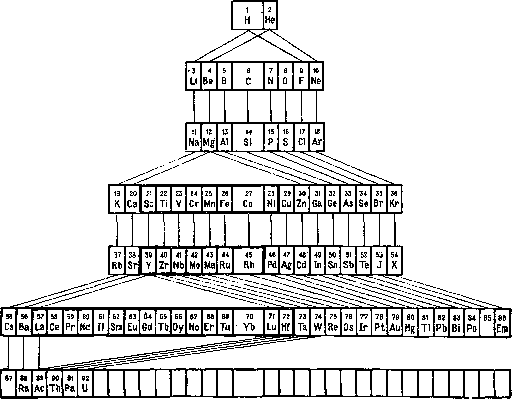
and not the other. In the figure, the arrangement of elements in the new form of the P. s. e., first proposed by Thomsen, is presented. Each period of elements is located in a horizontal row. Elements that formed normally are not marked in any way; those that formed abnormally are enclosed in a black frame, with elements that are doubly abnormal enclosed in a black frame in the second row from the bottom. Elements with similar properties are connected by lines; in this way, it is easy to trace the group of alkali metals, the group of alkaline earth metals, the group of halogens, etc. With the normal order of formation of the next new element, the incoming electron is placed in the outermost orbit and becomes part of the group of valence electrons that determine the valence of the atom. The valence of such an element will differ by one unit from the valence of the previous one. With the abnormal order, the new electron occupies one of the orbits already formed in the previous period, i.e., not the outer one but the inner one. As a result, the number of outer electrons for a certain number of consecutive elements remains the same - consequently, their valence and their chemical properties must be similar to each other. This is observed in the middle of the IV and V periods, where we have Fe, Co, Ni and Ru, Rh and Pd. The greatest influence of the abnormal order of entry of new electrons should be manifested in the "doubly abnormal" elements located in the VI period. Without dwelling on
Related articles
Mentioned in
Cite this page
“Periodic System of Elements.” Soviet Medical Encyclopedia. English translation of Bolshaya Meditsinskaya Entsiklopediya, 1st ed. (Moscow, 1928–1936), ed. N. A. Semashko. https://sovietmedicalencyclopedia.pages.dev/article/periodic-system-of-elements/