Atomic Nucleus
Historical document, translated for reference. It reflects medical knowledge of the 1920s–30s and is not medical advice.
Summary
The article explains the nuclear theory of atomic structure proposed by Rutherford in 1911, describing the atom as a system with a positively charged nucleus and orbiting electrons. It details the development of this theory from early experiments, the discovery of protons, and the eventual model of nuclei composed of protons and neutrons.
Encyclopedia article (1928–1936)
ATOMIC NUCLEUS. The nuclear theory of atomic structure was proposed by Rutherford in 1911. According to this theory, an atom represents a complex system consisting of a central, positively charged nucleus and negative electrons rotating around it in orbits similar to planets around the sun. Almost the entire mass of the atom is concentrated in the nucleus, while its size compared to the size of the atom is negligible. At a distance of 3-10-12 cm from the center of the nucleus, it can still practically be considered as a geometric point. Recent research gives for the value of the nuclear radius (assuming it has the shape of a sphere) a value on the order of 10-12-10-13 cm. The appearance of the nuclear theory of the atom was preceded by carefully performed experiments by Geiger and Marsden (1909-1910) regarding the scattering of alpha particles emitted by radioactive elements when passing through thin layers of matter. The regularities obtained in these experiments of the distribution of scattered alpha particles at various angles to the direction in which these particles were initially moving indicated enormous electric fields concentrated in the center of the atom. Interpretation of the results of these experiments was impossible from the standpoint of the then accepted Thomson model of the atom, which assumed the positive charge of the atom to be "spread" throughout its entire volume. The search for an explanation of the results of the Geiger-Marsden experiments led Rutherford to create the nuclear theory of the atom. The nuclear theory quickly gained universal recognition and has become by the present time one of the most verified and fruitful physical theories. The most important quantities determining all properties of the nucleus (just as of the atom as a whole) are its charge and mass. Since the atom as a whole is electrically neutral, the charge of the nucleus, measured in units equal to the elementary charge e (e=4.77-10-10 absolute electrostatic units), determines the number of planetary (extra-nuclear) electrons, and consequently also the ordinal number of the element in the periodic system of Mendeleev. The physicochemical properties of the atom are thus determined by the charge of its nucleus. Even before Rutherford created the nuclear model of the atom, it was known from the study of radioactive transformations that radioactive decay essentially represents the transformation of one element into another. On the other hand, the discovery of isotopes (atoms having different atomic weights with the same charge Z, chemically inseparable from each other) showed that, provided the isotopes are separated, the atomic weights of elements are expressed by numbers very close to integers. Oxygen, for example, turned out to consist of three isotopes: the main one (O16) with an atomic weight of 16.00 (in Aston units) and small amounts of two others (O17 and O18) with atomic weights close to 17 and 18. The facts presented made it highly probable to assume that the nuclei of all elements are built from some identical particles. Such particles could be the nuclei of the simplest element-hydrogen. This assumption turned into certainty when Rutherford in 1919 managed to show that when bombarded with alpha particles emitted from radium C', nitrogen atoms from the latter eject particles that turned out to be hydrogen nuclei-protons. This was the first successful attempt at artificial splitting of the atomic nucleus. Over the next five years, Rutherford together with Chadwick managed to split the nuclei of 12 more elements. With the exception of carbon and oxygen, which resisted splitting, these atoms included all light elements between elements 5 (boron) and 19 (potassium) of the periodic system. In all cases, a proton was ejected from the nucleus. The Rutherford-Chadwick experiments, along with the fact that during radioactive decay the emission of electrons from nuclei is observed, made it possible to consider the nuclei of elements as built from the same initial particles-protons and electrons. The mass of the nucleus should in this case be determined mainly by the mass of the protons making up its composition, since the mass of an electron is much less than that of a proton. If we denote by M the integer closest to the atomic weight, then a nucleus having charge Z should consist of M protons and M-Z nuclear electrons. Thus, the nucleus of the element following hydrogen in the periodic system-helium (Z=2; M=4)-consists of 4 protons and 2 electrons. The nucleus of the last element of the system-uranium (Z=92; M=238)-contains 238 protons and 146 electrons. Due to the fact that during radioactive decay the ejection of a heavy particle of the same type, namely an alpha particle, is observed, it must be assumed that in nuclei where Z≤A, every 4 protons and 2 electrons form a closer combination-an alpha particle. The weak point of the model presented lies in the assumption of the existence of free electrons in the nucleus, which in some questions leads to a serious discrepancy between theory and experiment. For example, the theory requires for nuclei with an odd number of electrons (nuclei with even Z and odd M) a significantly larger magnetic moment than is observed experimentally. In view of this, Ivanenko and Heisenberg after the discovery of the neutron (a particle with charge 0 and mass approximately equal to the mass of a proton) proposed (1932) another model, in which nuclei are assumed to be built from protons and neutrons. Consequently, a nucleus characterized by charge Z and mass M will consist of Z protons and M-Z neutrons, the alpha particle representing from the point of view of this theory a combination of 2 protons and 2 neutrons.
The radius of the nucleus U(T) and,
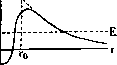
Being a complex formation, the nuclei of certain elements, due to reasons depending on their internal structure, spontaneously decay with the emission of α- or β-particles. To explain α-decay, Gamow in 1928 proposed a theory based on the assumption of the applicability of quantum-mechanical concepts to the nucleus. According to this theory (also applicable to the case of artificial fission), the atomic nucleus is surrounded by a potential barrier formed by the superposition of Coulomb repulsion forces and still unknown attraction forces, the action of which is strongly manifested at distances less than r0, and rapidly diminishes at distances greater than r0. An approximate scheme of the barrier is given in the figure. Here, along the abscissa axis, distances from the center of the nucleus are plotted, along the ordinate axis—values of potential energy. Inside the potential well formed by the barrier, the particles making up the nucleus are located at quantized energy levels. The apparatus of quantum mechanics, applied to such a model, gives a certain probability that a particle occupying level E will fly out of the nucleus, although its energy is below the height of the barrier. From the point of view of classical physics, this would be impossible. In the collision of an α-particle with a nucleus (artificial fission), the following cases are possible: 1) upon collision, the nucleus is excited and then transitions to a state with lower energy, emitting a γ-quantum; 2) as a result of the collision, one of the constituent parts of the nucleus is ejected, and the original nucleus is transformed into the nucleus of another element. The striking particle in this case either remains in the nucleus or leaves, taking with it some residual energy. According to Gamow's theory, the probabilities of these processes can be calculated. Comparison with experiment gives satisfactory results in all cases. The question of the nature of the forces, under the action of which the nucleus, having particles of the same sign charge in its composition, maintains its integrity, has not yet been resolved. It is only certain that these forces are very significant and vary with distance more rapidly than according to Coulomb's law. The grandeur of these forces can be judged by the magnitude of the binding energy of the nucleus, i.e., the energy released in the formation of the nucleus from its constituent elements. On the basis of the fact that according to the special theory of relativity mass is equivalent to energy (E=mc2, where E is energy, m is mass, c is the speed of light), the binding energy of the nucleus can be obtained from the mass defect (the deficiency of the mass of the nucleus compared to the mass of the particles from which it is built). For most nuclei, the mass defect can be easily calculated. For example, the mass of a helium nucleus (α-particle) is 6.598·10-24 g, and the mass of the 4 protons and 2 electrons making it up is 4·1.6609·10-24 + 2·9.035·10-28 = 6.645·10-24 g. The mass defect of helium is thus 0.047·10-24 g, which is equivalent to an energy of 4.23·10-5 ergs. This energy is enormous. The transformation of only 1 g of hydrogen into helium would release energy equal to the work of 900 thousand horsepower of the Dniproges station for 16 minutes. Hence the practical value of studying the atomic nucleus and the conditions of its transformation is clear. Modern experimental means (Wilson chamber, Geiger-Müller counters, etc.) make it possible to obtain a fairly clear idea of the nature of the 'reactions' occurring during nuclear transformations. In this case, the fulfillment of the laws of conservation of mass and energy, charge and momentum is assumed. Nuclear fission is currently carried out by various means. These means are α-particles, γ-rays, protons and deuterons (isotope of hydrogen having a mass equal to 2) accelerated in an electric field, and neutrons. The latter are especially suitable for the purpose of nuclear fission, since, having no charge, they do not experience the repulsive action of the nuclear charge and therefore can more easily penetrate the nucleus. Let us cite some of the most interesting nuclear reactions, first agreeing to denote nuclei by the chemical symbols of the corresponding elements, their charges by numbers at the bottom right, and finally the integers closest to the atomic weight—by numbers placed on the right side of the symbol at the top. 1. Fission of the nitrogen nucleus by an α-particle (Rutherford's experiment, 1919): N147 + He42 → O178 + H11. The meaning of this reaction is as follows: the nitrogen nucleus (N147) captures an α-particle (He42) and emits a proton (H11). Since the sum of the charges of the original members is 9, and the sum of the masses is 19 units, after the ejection of the proton, the residual nucleus must have a charge of 8 and a mass of 17, i.e., it will be the isotope of oxygen O178. 2. Production of neutrons by the action of α-rays on beryllium nuclei: Be94 + He42 → C126 + n10, where n10 is a neutron. 3. Fission of boron by deuterons: B115 + H21 → C126 + n10 + hν. In addition to the neutron, a γ-quantum hν is emitted in this reaction. 4. Fission of lithium by fast protons: Li73 + H11 → He42 + He42. In this reaction, first carried out by Cockcroft and Walton, two α-particles are formed, and the energy of these particles (=17.6 million electron volts) significantly exceeds the energy of the proton causing the fission. However, due to the fact that only a small part of the protons turns out to be effective for this reaction, the overall energy balance remains negative. In 1933, Curie and Joliot discovered that in some nuclear reactions, unstable nuclei are obtained, decaying with the emission of positrons—particles discovered shortly before (1932) by Anderson. The positron has the mass of an electron and one positive elementary charge. The discovered phenomenon was named artificial radioactivity. It was observed during the bombardment of aluminum, magnesium, and boron with α-particles. The reaction is written as follows: Al2713 + He42 → P3015 + n10. The resulting unstable nucleus of the phosphorus isotope decays according to the formula: P3015 → Si3014 + (+01), where (+01) denotes a positron. Following the discovery of Curie-Joliot, Fermi discovered another type of artificial radioactivity, excited by neutrons and accompanied by the ejection of ordinary electrons from the nucleus. The discovery of artificial radioactivity posed a new difficult task for the theory—to explain how electrons and positrons exist in the nucleus. Before the discovery of positron radioactivity, the place of residence of electrons in the nucleus was neutrons, considered complex particles consisting of a proton and an electron. β-decay was preceded by the fission of a neutron into a proton and an electron. To explain positron decay, it is necessary to make the opposite assumption that the complex particle is a proton, being a combination of a neutron and a positron. The contradiction is apparently eliminated by solving the question in the sense that both the proton and the neutron are elementary particles, and the formation of electrons (or positrons) occurs already in the process of nuclear reaction. One of the arguments in favor of this assumption can be the phenomenon discovered in 1933 by Curie and Joliot and simultaneously with them by Chadwick, Blackett, and Occhialini of the transformation of a hard photon (hν > 1 million electron volts) into the so-called 'pair,' consisting of an electron and a positron. One of the difficult problems facing the physics of the atomic nucleus until very recently is the creation of a theory of β-decay. The explanation of the continuous β-spectrum observed in radioactive decay gave some physicists reason to believe that the law of conservation of energy is not fulfilled in nuclear processes. However, in 1934, a work by Fermi appeared, giving a theory of β-decay, in which the law of conservation of energy is recognized as being fulfilled. In Fermi's theory, a hypothetical particle—the neutrino—figures, which has no charge and has a mass close to 0. Lit.: Aston F., Isotopes, M.-L., 1923 (2nd ed.); Atomic Nucleus, collection of reports of the 1st All-Union Nuclear Conference, L.-M., 1934; Bronshtein M., Structure of Matter, L.-M., 1935; ibid., Electrons, Atoms, Nuclei, L.-M., 1935; Gamow G., Structure of the Atomic Nucleus and Radioactivity, L.-M., 1934; Korsunsky M., Neutron, L.-M., 1935; Kurchatov I., Fission of the Atomic Nucleus, L.-M., 1935; Lukiretsky P., Neutron, L.-M., 1935; Mott N., Wave Mechanics and Nuclear Physics, L.-M., 1936; Mysovsky L., New Ideas in the Physics of the Atomic Nucleus, Publishing House of the Academy of Sciences of the USSR, M.-L., 1935.
Related articles
Mentioned in
Cite this page
“Atomic Nucleus.” Soviet Medical Encyclopedia. English translation of Bolshaya Meditsinskaya Entsiklopediya, 1st ed. (Moscow, 1928–1936), ed. N. A. Semashko. https://sovietmedicalencyclopedia.pages.dev/article/atomic-nucleus/