Radioactivity
Historical document, translated for reference. It reflects medical knowledge of the 1920s–30s and is not medical advice.
Summary
Radioactivity is the property of certain chemical elements to spontaneously transform into other elements, accompanied by the emission of energy in the form of various corpuscular and radiant radiations. This phenomenon was discovered by Becquerel in 1896 and has since led to the identification of numerous radioactive elements.
Encyclopedia article (1928–1936)
RADIOACTIVITY, the property of certain chemical elements to spontaneously transform into other elements. This transformation or radioactive decay is accompanied by the release of energy in the form of various corpuscular and radiant radiations. The phenomenon of R. was discovered in 1896 by Becquerel. He found that salts of U give off radiation that acts on photographic plates and imparts electrical conductivity to air. Further research showed that the emission of "Becquerel rays" is an atomic property of U, independent of the chemical compound in which it is found. Systematic studies of all known elements revealed that besides U, only Th possesses significant R. (G. Schmidt and M. Curie, 1898). Subsequently, weak radioactivity of K and Rb was also discovered. In studying natural compounds of U, it turned out that their R. is much greater than would be expected from their U content. The hypothesis put forward by M. Curie, that this anomaly is associated with the presence of unknown strongly radioactive elements in uranium minerals, was confirmed. Through long and painstaking work, P. and M. Curie succeeded in isolating new elements Po (1898) and Ra (1898) from the uranium pitchblende of Joachimsthal (Czechoslovakia),* whose R. exceeds that of uranium many times over. This marked the beginning of the discovery of a series of new radioactive elements or radioelements, the number of which reaches 40. Radioactive radiations. In nature, the radiations of radioactive elements are not homogeneous. In 1902, E. Rutherford proposed the names alpha, beta, and gamma rays for the three types of radioactive radiations possessing the following properties: alpha rays are formed by positively charged rapidly moving material particles of atomic size and are weakly deflected in electric and magnetic fields in the direction corresponding to the deflection of canal rays; they are very strongly absorbed by matter; beta rays are particles of negative electricity (electrons); they are deflected much more strongly by a magnetic field and are quite similar to cathode rays. Their penetrating power is significantly greater than that of alpha rays; gamma rays are not deflected in a magnetic field and carry no charge; they possess the greatest penetrating power (Fig. 1). Alpha particles carry a double elementary positive charge equal to 9.55×10⁻¹⁰ CGSE. In nature, they are identical to the nucleus of a helium atom; alpha particles leave the atom with a certain initial velocity characteristic of each alpha-emitting radioelement; this initial velocity ranges from 1.4×10⁹ to 2.06×109 cm/sec. In air, due to their large mass, alpha particles move almost in straight lines, gradually expending their kinetic energy in collisions with gas molecules and causing strong ionization. Alpha particles have a certain range of flight; after traveling this distance, they lose their charge and ability to cause characteristic effects and become ordinary helium atoms. The magnitude of this range or "path" of alpha particles depends on the initial velocity of the particle and the absorbing substance. The path length of alpha particles is characteristic of each radioelement and ranges from 2.67-8.62 cm in air at 0° and 760 mm. In solids, alpha particles are stopped by a layer of about 0.1 mm thickness. Beta rays of most radioactive substances form several groups with different initial velocities, the distribution of which is studied by the deflection of beta particles in a magnetic field (beta-ray spectrum). The initial velocities of beta particles range from 8.7×10⁹ to 2.947×1010 cm/sec., i.e., up to 0.988 of the speed of light. When passing through matter, beta rays are scattered much more strongly than alpha rays, with little change in their velocity. Their absorption follows a law close to a simple exponential Id = I0e-kd, where Id is the intensity of radiation that has passed through thickness d, I0 is the initial intensity, and k is the absorption coefficient. A characteristic value can be the thickness of a layer of some substance, for example aluminum, that absorbs beta rays by half. For different beta rays, this layer is 0.001-0.05 cm of aluminum. The hardest beta rays of RaC are completely absorbed by 2 mm of lead. Gamma rays are in nature completely analogous to X-rays and are characterized by a wavelength of 10-9-10-11 cm. The absorption of gamma rays is accompanied by scattering and the appearance of secondary beta and gamma rays. Approximately, absorption is expressed by the simple exponential law I=I0e-μx, and in the first approximation the relation μ/ρ = Const is satisfied.

Beta rays of most radioactive substances form several groups with different initial velocities, the distribution of which is studied by the deflection of beta particles in a magnetic field (beta-ray spectrum). The initial velocities of beta particles range from 8.7×10⁹ to 2.947×1010 cm/sec., i.e., up to 0.988 of the speed of light. When passing through matter, beta rays are scattered much more strongly than alpha rays, with little change in their velocity. Their absorption follows a law close to a simple exponential Id = I0e-kd, where Id is the intensity of radiation that has passed through thickness d, I0 is the initial intensity, and k is the absorption coefficient. A characteristic value can be the thickness of a layer of some substance, for example aluminum, that absorbs beta rays by half. For different beta rays, this layer is 0.001-0.05 cm of aluminum. The hardest beta rays of RaC are completely absorbed by 2 mm of lead. Gamma rays are in nature completely analogous to X-rays and are characterized by a wavelength of 10-9-10-11 cm. The absorption of gamma rays is accompanied by scattering and the appearance of secondary beta and gamma rays. Approximately, absorption is expressed by the simple exponential law I=I0e-μx, and in the first approximation the relation μ/ρ = Const is satisfied.
where q is the density of the absorbing substance. The value of μ for γ-rays of various radioelements ranges from 1,000 to 0.12, which corresponds to a thickness of Pb layer that absorbs the rays by half, 10-4-5.5 cm. Theory of radioactive decay. To explain radioactive phenomena, Rutherford and Soddy proposed in 1902 the theory of atomic decay, fully confirmed by subsequent experiments. Atoms of radioactive elements are unstable formations and undergo spontaneous decay, subject to the law of chance. In this process, intra-atomic energy is released in the form of radiation, and the atom undergoes transformation, turning into another chemical element with completely different properties, for example, the metal Ra turns into RaEm—an inert gas. The fundamental law of radioactive decay is formulated as follows: the amount of substance ΔN decaying in a time interval Δt is proportional to its available amount N and the time interval Δt, i.e., ΔN = -KNΔt or Nt = N0e-λt, where N0 is the initial amount, Nt is the amount at time t. The proportionality coefficient λ is called the radioactive constant, or decay constant of the radioelement. More intuitively, each radioelement is characterized by a half-life period, i.e., the time interval during which its initial amount decreases by half, or the average lifetime τ. The half-life period T, the average lifetime τ, and the radioactive constant λ are related as follows: T = 0.6931τ = 0.6931/λ. For various radioelements λ = 1.3 × 10⁻¹⁵-10-11 sec., corresponding to T = 5.2 × 10¹⁷ sec. (1.65 × 10¹⁰ years) to 10-11 sec. Between λ and the range of α-rays R there exists an empirically found relation by Geiger and Nuttall: lgλ = -A + BlgR, where A and B are constants. The graphical representation of the Geiger-Nuttall law gives for the three radioactive families U-Ra, Th, and Ac approximately three parallel lines. This law has to be used, among other things, for determining the radioactive constants of rapidly decaying substances. Radioactive phenomena are not affected by any external influences affecting the electron shells of atoms. This indicates that radioactivity is a property of the atomic nucleus. Phenomena of radioactive decay are accompanied by the ejection of α- or β-particles from the atomic nucleus. This circumstance provided the first proof of the complex structure of the atomic nucleus, which contains as structural elements electrons, protons, neutrons, and He nuclei. The regularities observed in the distribution of wavelengths of γ-rays and velocities of β- and α-particles indicate the existence of stable states in the nucleus corresponding to certain energy levels. γ-radiation is apparently connected with intranuclear transitions of α-particles from one energy level to another, with the wavelength of the γ-ray being determined from quantum relations. In radioactive transformation accompanied by the ejection of an α-particle from the nucleus, it must pass through a potential energy level significantly exceeding its own energy, which it possesses in the nucleus. From the point of view of classical theory, it is impossible to explain the ejection of an α-particle from the nucleus through this "potential barrier". Theories of radioactive decay, based on the principles of wave mechanics, make it possible to explain the ejection of α-particles from the nucleus. At the same time, it is possible to find a theoretical expression for the relationship between the velocity of α-particles and the decay constant of the atom, satisfying experimental data. Assuming that α-particles in the atomic nucleus possess the same energy with which they leave the nucleus during decay, we obtain the initial value for estimating the absolute values of energy levels in the atomic nucleus. These values are of the order of 106 volts (in the notations of atomic physics). Some authors assume that atomic nuclei are built exclusively of protons and neutrons without the participation of negative electrons. β-radiation of radioactive elements forms, on the one hand, groups of electrons of certain velocities, probably appearing as a result of the photoeffect caused by γ-radiation of the nucleus in the electron shells of the atom, and on the other hand, β-particles ejected from the nucleus possess velocities of very different values (continuous magnetic spectrum of β-rays). β-transformation is recently connected with the decay of a nuclear neutron into a proton and an electron or with the transformation of a photon (quantum of γ-radiation) in the nucleus into a positive and negative electron, followed by the ejection of the negative electron from the nucleus. The energy relationships in the nucleus associated with β-radiation appear still not quite clear. The doctrine of the atomic nucleus is currently in a stage of vigorous development, bringing brilliant and unexpected discoveries, for example, the discovery of the neutron (a neutral particle whose mass is very close to the mass of the proton) and the positive electron, or positron. When a radioactive atom decays, another radioactive element is usually also obtained. Thus, decay series or radioactive families of sequentially transforming radioelements are formed. The law of radioactive decay makes it possible to calculate the amount of any member of the series for each moment of time under given initial conditions. In practice, the following cases are most important. 1) Decay of a separate radioelement, for example RaEm; the amount of the radioelement at any moment can be expressed as: Nt = N0e-λt; N0 is the initial amount (at t = 0). 2) Formation from a radioelement with a very long lifetime (the amount of which practically does not change during the considered time interval), for example, the formation of UX (half-life period 24 days) from U (half-life period 109 years). In this case, the number of atoms of the forming element N2 at time t can be expressed through the number of atoms of the parent element N1 and the corresponding decay constants as follows: N2 = N1(0)e-λ2t + N2(0)(1 - e-λ2t) 3) The case of radioactive equilibrium, when a constant ratio of the numbers of atoms of successive elements in the decay series is maintained. In this case, the equalities are maintained: N1λ1 = N2λ2 = ... = Nkλk, if the considered series contains k elements (figure 2, growth and decay of ThX). The transformation of radioelements is always accompanied by α- or β-radiation. No case is known where radioactive transformation would be accompanied only by γ-radiation. The radiation from radioactive transformations led to the discovery of a large number of new elements. When attempting to place radioelements in the periodic system, difficulties arose, as the number of free places proved insufficient. These difficulties were overcome as a result of studying the chemical peculiarities of radioelements. Boltwood, who in 1906 discovered a new radioactive element ionium, showed that its chemical properties completely coincide with the properties of the element thorium. Furthermore, similar chemical identity was found in a series of radioelements (Ra and MsTh, Po, RaB, ThB, AcB, etc.), and in 1910 Soddi expressed the idea that these elements possess fundamentally identical properties and their separation by chemical methods is impossible. A group of such chemically indistinguishable elements is called, on the proposal of Fajans, a pleiad, and the elements themselves, on the proposal of Soddi, isotopes, since they occupy the same place in the periodic system. At the same time, Soddi suggested that non-radioactive elements may also be a mixture of fundamentally inseparable elements of different atomic weights, which explains the fractional values of the atomic weight of most elements. This idea of Soddi found brilliant confirmation in the works of Aston, who discovered isotopes of ordinary elements by the method of positive rays. The concept of isotopy made it possible to place all radioelements in the periodic system. They include 10 pleiads, located in the last two rows of the periodic system (figure 3). The characteristic elements or dominants of a pleiad of radioactive isotopes are elements with the longest lifetime, or stable elements. At the same time, five of them, Ra, Em, Po, Ac, and Pa, are new elements that have taken their places in the groups of the periodic system.
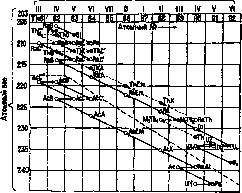
Figure 2. Growth and decay of ThX in days. Figure 3. Groups of the periodic system
fall into places in the periodic system, while the others occupy places previously held by known radioelements U and Th and inactive Pb, Tl, Bi. The greatest difference in atomic weight among radioactive isotopes does not exceed 8 units. Thus, radioactive transformations allowed for a deeper understanding of the physical meaning of the periodic law and the concept of a chemical element. It turned out that the position of an element in the periodic system is determined not by the atomic weight of the element, as was previously assumed, but by the magnitude of the positive charge of its atomic nucleus. All properties of isotopes related to the electron shells of the atom are practically identical within the accuracy of our experiments (atomic volume, transition rate from one state to another, thermal change in dimensions, magnetic susceptibility, spectra, etc.). They differ, besides their radioactive properties, only in those features that are related to the mass of the nucleus, for example, in the fine structure of the spectrum and in negligible differences in diffusion constants. The latter circumstance forms the basis of attempts to separate isotopes, which, as a result of painstaking work, have led to partial success. During radioactive decay, transformation of elements occurs, following the following shift rules (K. Fajans). 1) After the emission of an alpha particle, the element shifts two places to the left in the periodic system. 2) In beta transformation, the element shifts one place to the right (direction of arrows in Fig. 3). These rules indicate that radioactivity is a property of the atomic nucleus, because the emission of an alpha particle, carrying two elementary positive charges, reduces the charge of the nucleus by two units, which corresponds to a decrease in the atomic number by two units. The beta particle carries away one negative charge, i.e., it increases the positive charge of the nucleus, and consequently its atomic number by one unit. As a result of radioactive transformations, two different elements can occupy the same place in the periodic system.
Radioactive families. All known radioelements form three radioactive families, or series: the U-Ra family, the Ac family, and the Th family. The U and Th series are independent, while the Ac series, according to all data, is connected with the U-Ra series, starting from one of the uranium isotopes (actinouranium). Fig. 4 shows a diagram of the radioactive families with their transformations. Of greatest practical interest are the radioelements Ra and MsTh, as they possess very high radioactivity and are a source of strongly radioactive elements with short lifespans (e.g., RaEm, ThX, etc.). Among other chemical elements, K and Rb possess weak radioactivity with the emission of beta and gamma rays. Apparently, only the isotope of K with atomic weight 41 is radioactive, and the decay product is Ca with atomic weight 41, the presence of which in an ancient mineral containing K was obtained analytically. The half-life of K is taken as about 10^12 years. It is possible that isotopes of uranium and thorium with different atomic weights also have different radioactive properties. Hevesy recently discovered weak radioactivity of samarium with the emission of alpha rays.
Radioelements in geophysics. Although industrial deposits of radioactive ores are very rare, radioelements in a dispersed state are extremely widespread in nature, and their presence can be detected due to the high sensitivity of measuring equipment in practically any sample of rock or mineral. In the analysis of radioactivity of rocks, the determination of Ra and Th content by the emanation method is usually limited. In decreasing order of radium and thorium content, rocks are arranged as follows: acidic igneous rocks 2.5-6.4 × 10^-10 g Ra per 1 g and 1.6-2.3 × 10^-5 g Th per 1 g; basic rocks (basalts) 1.5 × 10^-10 g Ra and 0.9 × 10^-5 g Th; sedimentary rocks 0.9-1.5 × 10^-11 g Ra and 0.4-1.4 × 10^-5 g Th. At the same time, the ratio of
Dominant Atomic weight 238.2
232.1
Valence VI
IV
Atomic number 92
Symbol U
Th Radioactive elements and their genetic connection (230)
(230)
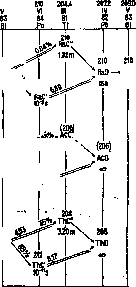
20a 18,Sd !1,2d 3,92s tf-KT's 38m 2,16m Ч&-(210) K McC'^ 5-10's 232 228 , 228 228 ' 224 220 216 212 212 Th-ifi-Msni,--------MsTh2- MTK^hXt!iThFjn^?rhA=-iThB=-ThC fl.1.4s 10,6h 60,8m 1,в5ГО,0a 6,7a 6,13h 1,! 3.64d 54,5s 210 206 -RaE-«-RaF^RaG 4,85(1 138,5d Доми-го»та Символ U Атомный номер92 ВалентностьУ! Th 90 IV Ra Ac Th 90 IY Ra Em Bi Po 83 84 V VI =-► обозначает a-превращеиив,- Po Pb Bi Po Tl 56 84 82 83 84 81 0 VI IV V VI 111 Символы и обозначения.- обозначает в-превращение, и-ураи, ТЬ торий. Pa-протактиний. Ra-равий, Em-зманация, Po-полонийЛо-ионийА-аитиний. MsTh-мезоторий. RdTh- раЭиоторий, RdAc-Da3iiaiKTMtiM* Pb 82 Рис 17G честв тория и урана выдерживается приблизительно постоянным и равняется в среднем 2,2. При рассмотрении вертикального распаделе- ния радиоэлементов в земле получается следующая картина: во внешней гранитной оболочке 3>.10_12 s Ra; в следующем базальтовом слое 0,77 .10_12з Ra; в сульфидном слое 0,1. . Ю-12 г Ra и в железном ядре 0,01 . Ю-12 г Ra. Такое распределение радиоэлементов играет существенную роль в тепловом режиме внутри земли. Содержащиеся в твердых породах радиоэлементы, в особенности газообразные эманации, попадают в почвенные растворы и газы и разносятся благодаря диффузии и переносу токами вод и воздуха как в атмосфере, так и гидросфере земли. B частности радий и торий в минимальных количествах обнаруживаются в воде морей (порядка 10~14 a Ra в 1 см3), источников и т. п. Особенный интерес представляет наблюдаемое часто повышенное содержание радия в водах буровых скважин, приобретающих иногда значение промышленного месторождения радия. Минеральные источники содержат преимущественно эманацию радия в количествах, значительно превышающих равновесное c растворенным в них радием. B качестве терап. фактора применяется вода источников, содержащая RaEm, продукты ee распада. B последнее время выдвинулся вопрос и o медицинском применении вод, содержащих растворенный радий.-Содержание радиоэлементов в почве не безразлично для растительности, и имеются указания на связь плодородия почвы c ee P. B атмосферном воздухе содержатся как эманации радия и тория в количествах порядка 1 атома в 1 еж3 для RaEm и примерно в 1 000 раз меньшем для ThEm, так и продукты их распада. Излучениями радиоэлементов в воздухе и почве объясняется большая часть ионизации нижних слоев атмосферы. Содержание радиоэлементов в атмосфере довольно быстро убывает c высотой благодаря радиоактивному распаду. Действия радиоактивных излучений. 1) Bce радиоактивные излучения производят ионизацию газов; сильнее всего действуют a-лучи, действие /?- иу-лучей значительно слабее. B меньшей степени ионизация "наблюдается y жидких и твердых диэлектриков. 2) Энергия радиоактивных излучений переходит при поглощении их материей в тепло. При этом наибольший эффект дают также a-лучи, обладающие максимальной энергией. Теоретически количество выделяемого тепла можно подсчитать, зная энергию излучений и кинетическую, энергию остатка распавшегося атома. Экспериментально тепловое действие особенно тщательно изучено для Ra; 1 г Ra выделяет в час 25 кал., a вместе c продуктами распада 170 кал. 3) Сильные радиоактивные препараты светятся сами и вызывают свечение ряда тел. Вспышки на экране сернистого цинка, вызываемые отдельными a-частицами (сцинтилляции), позволяют сосчитать a-частицы, излучаемые радиоэлементами.4) Многие вещества меняют свою окраску под действием радиоактивных излучений. 5) Радиоактивные лучи действуют на фотографическую пластинку. Прикладывая к фо гографической пластинке плоско отшлифованную поверхность куска радиоактивной руды, можно получить радиографию распределения радиоактивных минералов по поверхности образца. 6) Под действием радиоактив- ных излучений происходят хим. реакции, связанные гл. обр. c вызываемой ими ионизацией; нек-рые действия /3-лучей на коллоиды объясняются отрицательным зарядом самих /5-частиц. 7) Действие радиоэлементов на живой организм сказывается в виде местных и общих явлений и сильно зависит от дозы. Действие радиоактивных излучений выражается в общем утомлении организма, изменении состава крови (уменьшении числа белых кровяных шариков и др.). При местном воздействии Д-лучей больших количеств радиоэлементов может получиться ожог, трудно поддающийся излечению. Молодые клетки наиболее чувствительны к действию излучения. Введение внутрь организма больших количеств радиоэлементов влечет за собой смерть. Незначительные количества радиоэлементов оказывают благотворное действие на организм. Практические приложения P. 1) Свойство радиоэлементов ионизировать газы нашло свое применение в изготовлении радиоактивных коллекторов, служащих для измерения электрического поля, гл. обр. при исследованиях атмосферного электричества. Для этой цели употребляются обыкновенно a-из-лучатели 1o или Po. Последний приходится периодически возобновлять, т. к. он распадается наполовину в 137 дней. 2) Радиоактивные Em могут быть использованы при определении газопроницаемости различных веществ. 3) Весьма разносторонне используются радиоэлементы в медицине как путем излучений" сильных препаратов (гл. обр. Ra), применяемых при лечении опухолей и т. п., так и путем непосредственного действия сравнительно малых концентраций радиоэлементов в виде радиоактивных ванн, вдыхания воздуха, содержащего эманацию радия, в эманаториях, питье естественных и. искусственных радиоактивных вод. При лечении большими количествами радия часто пользуются вместо радия его эманацией. Эту замену можно произвести, т.к. излучения, действующие на ткани при радиотерапии, даются не самим радием, a продуктами распада эманации. Эманацию получают в запаянных стеклянных трубочках путем периодической откачки из раствора, содержащего-большое количество радия (порядка 1 г). Такие «эманационные машины» имеются в крупных радиологических институтах. Количество и качество вторичных излучений в весьма сильной степени зависят от материала, поглощающего y-излучение источника, на что надо обращать особое внимание при лечебном применении. 4) Радиоэлементы (гл. образ. Ra, MsTh и RaTh) применяются в качестве активаторов при изготовлении светящихся составов. 5) Излучением больших количеств Ra или эманации пользуются для просвечивания толстых металлических отливок. 6) Слабые радиоактивности находят применение в сельском хозяйстве для удобрения и в животноводстве, напр. для активирования кормов. 7) Разностороннее применение радиоэлементы нашли в химии, т. к. благодаря чрезвычайной чувствительности методов измерений P. возможно проследить за минимальными количествами вещества. 8) Свойство радиоактивных излучений окрашивать некоторые твердые тела применяется для изменения окраски драгоценных камней. 9) Радиоактивные методы применяются в геологии для определения абсолютного возраста горных пород и для разрешения нек-рых других вопросов. 17» Рисунок 5. ^-lillllll-Ь-»-б Радиоактивные измерения. Для количественного измерения радиоактивных веществ употребляется почти исключительно метод, основанный на ионизации. B случае очень сильных препаратов возможно пользоваться для измерения ионизационных токов чувствительным гальванометром. Для измерения же малых количеств радиоэлементов пользуются электроскопами и электрометрами. Важнейшие схемы применяемых приборов представлены на рис. 5. 1) Измерения по a-лучам. Исследуемое вещество P помещается в тонко измельченном виде в плоской чашечке на дно «ионизационной камеры» электроскопа (рис. 5 a) или электрометра (рис. 5 б). Ионизационный ток измеряется по скорости спадания листка электроскопа, отсчитываемой по окулярной шкале микроскопа. При этом необходимо учитывать собственное спадание листка под влиянием дефектов изоляции и ионизации воздуха внутри прибора, определяемое специальным наблюдением в отсутствии радиоактивного вещества. При измерении c электрометром пользуются или методом зарядки или же компенсационными методами. При измерениях по a-лучам берут обычно слой вещества толщиной порядка 1 мм. Такой слой будет насыщенным для a-излучения, т. e. a-лучи из нижних частей уже поглощаются в самом активном веществе и не выходят наружу. При этом измеряемая ионизация приблизительно пропорциональна концентрации радиоэлементов в препарате. Обычно измерения производятся по сравнению c эталоном, содержащим известное количество определяемого радиоэлемента, напр. U, в равновесии c продуктами распада. Или же результаты выражают в урановых единицах, причем под урановой единицей подразумевается одностороннее излучение 1 смг насыщенного для a-лучей слоя окиси уранаи308.B абсолютных единицах это соответствует току на
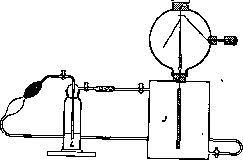
Рисунок б.
saturation 1.73.103 CGSE. In the case of an infinitely thin layer (e.g., the active deposit obtained in the presence of emanation on solid bodies and consisting of their decay products), ionization is proportional to the amount of radioelement in the preparation. 2) Measurements of gamma rays. Due to the great penetrating power of gamma rays, it is possible to use them to measure the amount of radioelements (usually Ra, RaEm or MsTh) in hermetically sealed preparations. Measurements are made by comparison with a standard containing a known amount of Ra. When measuring small amounts of Ra on the order of 10-6-10-7 g, they are placed inside the instrument by a special device. When measuring large amounts - from 10-4 g and above - the test preparation is placed at some distance outside the instrument. 3) Measurements of small amounts of RaEm are made by alpha rays in an electrometer with an ionization chamber adapted for introducing Em inside it. Usually, it is necessary to measure Em from an aqueous solution, in which case Em is distilled into the ionization chamber with an air current by circulation (figure 6) or by some other method. Next, the ionization caused by the alpha rays of Em and its decay products is measured. This determines, for example, the content of RaEm in the water of springs. This same method is used to determine small amounts of Ra in solution. The test solution is placed in a gas washing bottle L and freed from Em by blowing air through it for 10-30 minutes. Then the vessel with the solution is hermetically sealed and left for several days to accumulate Em. Next, Em is transferred to the measuring instrument J, where its amount is determined. The accumulation of emanation occurs according to the formula E=E∞(1-e-λt), where E is the amount of Em accumulated during time t, E∞ is the amount of it in equilibrium with radium in this solution. Numerically, E∞ is equal to as many curies of emanation as there are grams of Ra in the solution. The standard is a solution with a known Ra content on the order of 10-8-10-9 g. By means of Em, it is possible to measure 10-10 g and even 10-12 g of Ra. 4) The counting of individual particles is performed either by the scintillation method or by appropriately amplifying the ionizing effect of individual particles or pulses (Geiger counter). Artificial radioactivity. By bombarding atomic nuclei with rapidly moving particles, it is possible to produce artificial transformation of elements. "Projectiles" for such bombardment can be alpha particles of radioelements, which, upon hitting atomic nuclei, knock out their constituent elements, mainly H-particles ("hydrogen nuclei"). This phenomenon was discovered by Rutherford in 1919. The reverse case is also possible - the synthesis of a new element due to the lodging of the bombarding particle in the nucleus. When bombarding atomic nuclei with fast protons obtained in strong electric fields, Cockcroft was the first to observe the artificial transformation of elements with the emission of alpha particles. In this case, for example, the lithium nucleus, by absorbing a proton, transforms into two helium nuclei. Work with artificial radiations has begun in a number of countries and is rapidly leading to success, opening up new and very great possibilities in the study of the atomic nucleus and in attempts to harness intra-atomic energy. The basic measurement method used in the study of artificial transformations of elements and processes associated with the passage of individual rays through matter is the Wilson chamber method, based on the property of water vapor to condense on ions and making it possible to observe and photograph the paths of individual particles (figure 7). Similar results are obtained by the use of photographic plates with a thick emulsion layer (the method of L. V. Mysovsky). The Geiger counter is also used.

Figure
Figure 7. The Wilson chamber method.
Related articles
Mentioned in
Cite this page
“Radioactivity.” Soviet Medical Encyclopedia. English translation of Bolshaya Meditsinskaya Entsiklopediya, 1st ed. (Moscow, 1928–1936), ed. N. A. Semashko. https://sovietmedicalencyclopedia.pages.dev/article/radioactivity/