Molokovka
Historical document, translated for reference. It reflects medical knowledge of the 1920s–30s and is not medical advice.
Summary
Molokovka is a balneological resort in the Far Eastern Krai, 19 km southeast of Chita, known for its carbonated radioactive mineral waters used for treating anemia, fatigue, nervous diseases, and obesity. The article also describes various types of breast pumps (Molokovka devices) used for milk extraction, including mechanical and electric models with their advantages and indications.
Encyclopedia article (1928–1936)
Molokovka, a balneological resort in the Far Eastern Krai, 19 km southeast of the city of Chita; located in a narrow valley of the Molokovka River, a right tributary of the Ingoda, surrounded by spurs of the Chersky mountain range. Mixed forest. The climate is sharply continental. Average temperature in June +12°C, July +19°C, August +16.5°C. Season from June 1 to September 1. The therapeutic agent of the resort is carbonated radioactive water, which is used for baths. There are two mineral springs, with water temperature of about +1°C. The radioactivity of the first source reaches 290-326 Mach units, the second-105 Mach units. The bathhouse has 8 cabins and 14 baths. Indications: anemia, overfatigue, nervous diseases, obesity. Accommodations for patients are small houses accommodating up to 100 people. There is a club building. Transportation from Chita is by horse and automobile.

Figure 1.
Figure 2.
consisting of a glass cap with a reservoir, from which two rubber tubes with nozzles extend: one goes into the child's mouth (or a bottle), the other the mother sucks, creating a vacuum in the reservoir. In the child's nozzle there is a valve that allows vacuum even if the child stops sucking. The valve often breaks, the apparatus is difficult to keep clean, and there is a danger of the mother's saliva getting into the child's mouth. From this point of view, apparatuses in which the mother's mouth is replaced by a rubber balloon have an advantage. M. with a balloon were designed by Ibrahim, Kaupe (Kaupe modification), and others. In the USSR, the old model (Fig. 2) is still used today. This is a type of Birovsky jar: a wide glass cap with a small (35 cm³) milk reservoir ending in a thick rubber balloon. Balloons are not durable, milk easily gets into them, and cleaning the apparatus is difficult. The Ibrahim modification (Fig. 3) tries to correct these shortcomings by bending the neck of the funnel upward with the balloon, and the reservoir has an opening at the bottom facilitating its cleaning. For suction to
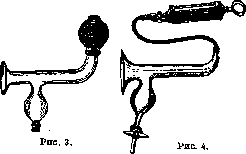
occur vigorously, it is necessary to constantly move the cap away from the nipple and then press it tightly again-the procedure is sometimes painful for the mother.-Finally, Yashe successfully modified the design of M. by introducing mechanical vacuum with a pump (Fig. 4). A glass funnel 9 cm in diameter is tightly applied to the breast. Its narrow end is connected by a rubber tube to a
metal pump that creates vacuum by piston movements. The nipple is deeply drawn into the funnel, compressed by its walls, and according to Yashe, the analogy with the sucking act is great. The mother does not tire; at the same time, emptying of the breast is complete, milk flows into the glass reservoir, from which it is released into a sterile bottle by turning a tap. The breast pump is sterilized by boiling. A modification of this apparatus is the Rogan-Chalot breast pump. In Europe and especially in America, electric M. are widely used at present, which obviously have great advantages, although there is no experience with them in the USSR yet. They are a modification of cow milking machines used on large farms and look like a small box with a plug for connection. Vacuum is created by an internal pump, the piston of which is driven by electrical energy; the piston movements, i.e., the suction force, can be individually regulated; milking is painless and very convenient for mass milking-at collection points, in institutions. The American Abt apparatus (1921) is most valued; this apparatus is credited with a significant role in the prevention of mastitis due to good, gentle, and aseptic emptying of the breast at the beginning of galactophoritis. In Germany, Scheer proposed his model in 1926. The high price of these apparatuses limits their use to clinics and institutions. In the Thoenes and Hausch apparatuses, vacuum is created by the force of a water jet.-M. serve mainly for complete emptying of the breast in order to increase gland secretion. It is recommended to use M. for breast extraction three times a day for the prevention of hypogalactia. Other indications: danger of infection (syphilis) from mother to child and vice versa, as well as weakness or inability to suck (premature infants, cleft palate). Hand expression is preferable, but sometimes, especially in the first days, it is impossible due to pain, and then M. can be of great help. Use of M. should be avoided in the presence of nipple cracks. The most rational should be recognized as electric M., and then the Yashe apparatus (modification of its "Primissima").
Related articles
Cite this page
“Molokovka.” Soviet Medical Encyclopedia. English translation of Bolshaya Meditsinskaya Entsiklopediya, 1st ed. (Moscow, 1928–1936), ed. N. A. Semashko. https://sovietmedicalencyclopedia.pages.dev/article/molokovka/