Mollusks
Historical document, translated for reference. It reflects medical knowledge of the 1920s–30s and is not medical advice.
Summary
Mollusks are a well-defined type of invertebrate animals with soft bodies, typically bearing shells. They include classes like bivalves, gastropods, and cephalopods, and play significant roles as food sources, in pearl production, and as intermediate hosts for parasitic diseases.
Encyclopedia article (1928–1936)
MOLLUSKS, or soft-bodied animals (Mollusca), are a well-defined type of invertebrate animals. The body is soft and undivided, and typically bears a shell. The skin forms a mantle fold that covers the body or fuses along its edges with the body surface. The mantle secretes a hardening substance that forms the shell. In cross-section, the shell consists of an inner nacreous layer, a middle porcelain layer, and an outer leathery layer. The mollusk's body is partially attached to the inner surface of the shell. In the pearl oyster, the nacreous substance can layer over sand grains or parasites located between the shell and the mantle; thus, pearls are formed. Mollusks move by means of a flat, foot-shaped (Fig. 2) or wedge-shaped (Fig. 0) "foot." The muscles are smooth; movement is very slow. The most important classes of mollusks are: a) bivalves, or lamellibranchs (Lamellibranchiata) with a bivalve, usually symmetrical shell (Fig. 1); b) gastropods, or snails (Gastropoda) with the ventral side of the body transformed into a "foot"; the shell is spirally coiled, asymmetrical (Fig. 2, 4, 7-15), and may be reduced; and c) cephalopods (Cephalopoda, for example squid Lo-ligo). The most highly organized mollusks with a well-differentiated head bearing 8-10 appendages covered with suckers, called tentacles; they swim rapidly (Fig. 3). Mollusks feed either on plant food or plankton, or are predators. They typically live in water, marine or fresh; many species are terrestrial. They are either dioecious or hermaphroditic. In hermaphrodites, cross-fertilization is commonly observed. From the eggs of many mollusk species, larvae emerge.
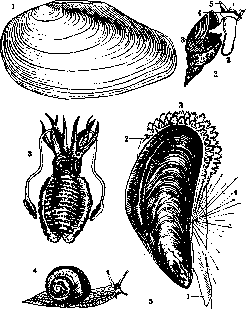
Figure 1. Duck mussel (Anodonta). Figure 2. Pond snail-Limnaeus stagnalis: 1-eyes; 2-foot; 3-respiratory opening; 4-oral lobes; 5-tentacle. Fig. 3. Cuttlefish-Sepia officinalis. Figure 4. Garden snail-Helix pomatia. Figure 5. Mussel-Mytilus edulis: 1-foot; 2-anal siphon; 3-mantle edge; 4-threads of the byssus attachment substance.
For mollusk larvae, the early formation of the shell rudiment is characteristic. Typical mollusk larvae resemble the trochophore of annelid worms. Some mollusks are viviparous. Significance of Mollusks. Benefits: a) some mollusks are edible-oysters (Ostrea edulis), cockles (Cardium edule), mussels (Mytilus edulis, Fig. 5), all from bivalve mollusks; the grape snail (Helix pomatia, Fig. 4); some cephalopods (octopuses) are also eaten (frutti di mare of Italians); some gastropod and cephalopod mollusks can serve as food for pigs; their importance as food for fish is significant; b) mollusk shells can be used to obtain calcium salts and various handicrafts (buttons, etc.); c) pearl is obtained from some marine and freshwater mollusks (Margaritina margaritifera); d) from the "ink sac" of the cuttlefish, the dye sepia is obtained (Sepia officinalis; Fig. 3); e) fossil mollusks serve as index organisms for determining the geological age of strata and deposits. Harm from Mollusks. 1. Toxicity of Mollusks. Some species are primarily poisonous as they possess poisonous glands; for example, Dolium or Tritonium (Mediterranean Sea), the salivary glands of which secrete a 4% sulfuric acid, used to dissolve the calcareous shell of echinoderms that serve as food for mollusks. In the octopus, the exact host, the parasite passes from the first host (mollusk) to the second (crab, fish) when the second eats the first. The role of mollusks in the epidemiology of human trematodosis consists of a) contaminating water or aquatic plants with emerging
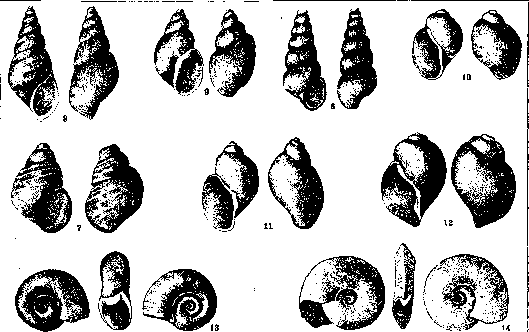
Figure 6. Oncomelania nosophora. Figure 7. Bythinia striatula. Figure 8. Melania libertina. Figure 9. Limnaea truncatula. Figure 10. Bullinus contortus. Figure 11. Bullinus Dybowskii. Figure 12. Physopsis africana. Figure 13. Planorbis metidjensis. Figure 14. Segmentina hemisphaerula. (Octopus, Cephalopoda) the poisonous pair is the posterior pair of salivary glands, whose secretion paralyzes crabs. The described forms have no practical significance for humans. When living in contaminated water, some mollusks, for example mussels (Fig. 5), Cardium, oysters (Fig. 15), acquire harmful properties and cause poisoning when consumed (see Mytilotoxin). Prevention of mollusk poisoning consists of keeping mollusks in clean seawater for a long time. 2. Mollusks as transmitters of infections. A number of authors have shown that oysters, when kept in seawater containing typhoid bacteria, became ill and died. Eating infected oysters can lead to a person contracting typhoid fever. Bacteria can enter oysters from the ice in which they are stored. 3. Mollusks as intermediate hosts of helminths. This role of mollusks is great and significant, particularly in relation to the epidemiology and prevention of helminthic diseases in humans and animals. In mollusks, some stages of the life cycle of various flukes (Trematoda) occur. Human flukes have only gastropods as their intermediate hosts. Trematode larvae actively penetrate mollusks and also actively leave them at the appropriate stage of development. In cases where there are two intermediate
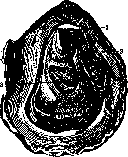
Figure 15. Oyster with one valve of the shell removed: 1-anterior end of the mantle; 2-cross-section of the adductor muscle; 3-gill fillets. 4. Technical harm from Mollusks. Teredo navalis (Lamellibranchiata) - "shipworm," bores wood (piles, ship sides, dams), thereby being a serious pest; "stone-borer" Pholas, which bores stones, has the same property. The dreissena (Dreissena polymorpha), having passed to freshwater life, sometimes colonizes water pipes so completely that it completely blocks them and stops the water supply. Fighting mollusks is difficult. Cleaning bodies of water is not a guaranteed measure, as complete cleaning is technically impossible in many cases. Draining bodies of water is applicable only to a limited number of them, and moreover, mollusks equipped with an operculum can remain without water for a long time. Copper sulfate in a solution of 1:500,000 to 1:2,000,000 kills mollusks-intermediate hosts of the liver fluke; but such a concentration of the solution is harmful to some fish, especially their young. Lime in a concentration of 0.1:100 is fatal to mollusks-intermediate hosts of bilharzias (Schistosomum).
Related articles
Mentioned in
Cite this page
“Mollusks.” Soviet Medical Encyclopedia. English translation of Bolshaya Meditsinskaya Entsiklopediya, 1st ed. (Moscow, 1928–1936), ed. N. A. Semashko. https://sovietmedicalencyclopedia.pages.dev/article/mollusks/