Basal Bodies
Historical document, translated for reference. It reflects medical knowledge of the 1920s–30s and is not medical advice.
Summary
This article describes basal bodies as protoplasmic granules found at the base of cilia and flagella in various animal and plant cells. It discusses historical theories regarding their origin in relation to the centrosome and their function as either dynamic centers for movement or mechanical supports.
Encyclopedia article (1928–1936)
BASAL BODIES (from Greek basis—base), protoplasmic granules in cells equipped with cilia or flagella, lying at the base of these cilia and flagella (see figure). In plants, basal bodies have been described in the zoospores of algae, and in the spermatozoa of mosses, ferns, charophytes, and cycads. According to Henneguy and Lenhossek (1897–98) and Schaudinn (1896, 1904), the origin of basal bodies is connected with the central apparatus, specifically with the centrosomes (see) of cells. This connection undoubtedly exists during the formation of spermatozoa in the animal and plant worlds, during the formation of flagella and the so-called collar cells of sponges, and, finally, among protozoa—in many flagellates and in the zoospores of algae. It is more difficult to link the basal bodies of the ciliated epithelium of Metazoa and the cilia of infusoria with the central apparatus, since in the cells of ciliated epithelium, basal bodies can be found simultaneously with diplosomes, and most infusoria lack a central apparatus altogether. Basal bodies can arise (Gurwitsch, 1900) in the outer alveolar layer of cells (respiratory tract epithelium) or deep within cells (human epididymis) and only secondarily move to the surface layer (Benda, 1900; Ikeda, 1906). There are indications that in some infusoria (Tintinnoidea), basal bodies arise in the region of the nucleus. In some cases, for example, during the division of flagellates, spermatozoa, epithelial, and other cells, the basal bodies also divide (see figure, 7b-e). Basal bodies (according to Henneguy and Lenhossek) are dynamic centers that control the movement of flagella and cilia. According to Hartmann (1926), basal bodies serve as a mechanical support for such motile structures as flagella and cilia. This view is supported by
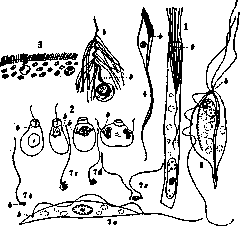
Basal bodies in various cells and in protozoa (b—basal bodies): 1—ciliated cell from the liver of the mollusk Helix; 2—collar cells of sponges; 3—section through the pellicle of the infusorian Opalina ranarum; 4—stage of development of a guinea pig (Cavia) spermatozoon; 5—spermatozoon of the plant Marsilia; 6—flagellate Trichomonas; 7a—Trypanosoma; 7b-e—successive stages of division of the basal body in trypanosomes.
the fact that in the cells of ciliated epithelium, not only do cilia extend from the basal bodies to the cell surface, but so do the so-called root fibrils, which form a bundle inside the cell that undoubtedly performs a supporting function. In plant cells, basal bodies often take on a peculiar form (see figure, 5). In botanical cytology, basal bodies are usually called blepharoplasts (see).
Related articles
Mentioned in
Cite this page
“Basal Bodies.” Soviet Medical Encyclopedia. English translation of Bolshaya Meditsinskaya Entsiklopediya, 1st ed. (Moscow, 1928–1936), ed. N. A. Semashko. https://sovietmedicalencyclopedia.pages.dev/article/basal-bodies/