Algae
Historical document, translated for reference. It reflects medical knowledge of the 1920s–30s and is not medical advice.
Summary
This article from the 1928-1936 Soviet Medical Encyclopedia provides a comprehensive overview of algae, including their classification, structure, reproduction, ecological roles, and various applications in medicine, industry, and food.
Encyclopedia article (1928–1936)
ALGAE (Algae), a common general term for all aquatic plants (including flowering plants), but in science—only certain groups of lower plants, namely those that contain chlorophyll and can therefore feed independently through the assimilation of CO2. In this way, A. sharply differ from other lower plants—bacteria, fungi (see). At present, more than 12,000 species of A. are known. They are divided into several groups (types), differing in a number of basic organizational features and, apparently, completely independent in their origin. These groups, at the same time, are very clearly characterized by their color, depending on the presence or absence of certain additional pigments that mask the basic green color of chlorophyll. 1) Green
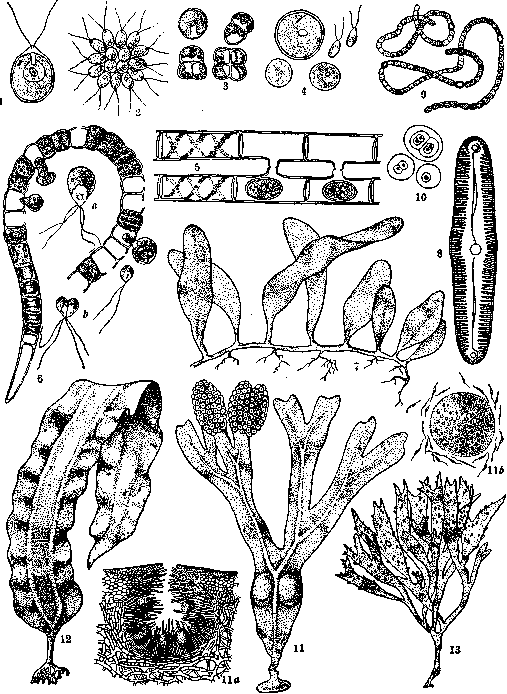
Figs. 1-7, 8-10, 11a, 11b enlarged 100 to 500 times. 1-7-green algae [1-Chlamydomonas; 2-Gonium, colony; 3-Pleurococcus, cell division; 4-Protococcus with zoospores; 5-Spirogyra, conjugation; 6-Ulothrix: a-zoospore, b-gametes and their copulation; 7-Caulerpa ("/")]; 8-diatom alga Pinnularia; 9-blue-green alga Nostoc; 10-blue-green alga Gloeocapsa; 11-brown alga Fucus (Vs); receptacle for egg cells; 11b-fertilization, egg and spermatozoa; 12-brown alga Laminaria japonica (O/); 13-red alga Gigartina mammillosa (*/3).
A. (Chlorophyceae)—color purely green; 2) diatom A. (Diatomeae; see figure 8)—yellow or brown from an additional pigment—diatomine (of unknown composition); 3) brown A. (Phaeophyceae; see figure 11)—brown from an additional pigment—fucoxanthin (C40H56O6); 4) red A. (Rhodophyceae)—additional pigment phycoerythrin (of protein nature); 5) blue-green A. (Cyanophyceae; see figures 9, 10)—additional pigment phycocyanin (of protein nature).—The structure of A. is diverse. In our fresh waters, they are represented mostly by microscopic unicellular forms (see figures 1, 3, 4), or loose cell colonies (see figure 2), or filamentous forms (types; see figure 6). Marine, predominantly brown and red A. often show more complex cellular structure and sometimes reach enormous sizes (100 m or more in length; see figure 12). Finally, among green A. there are forms that, at considerable sizes (several decimeters) and deep division of the body, lack cellular division (acellular plants, e.g., Caulerpa; see figure 7).—Reproduction in A. in many unicellular forms occurs by simple division of the cell into two, but the most typical is reproduction by zoospores, which are formed from cell contents and exit outside through a rupture in the cell wall in the form of naked, flagellated, protoplasmic bodies (see figure 6a). Sometimes spores lack organs of movement and are called aplanospores. Most A. also have a sexual process (except blue-green). It consists either in the fusion of two ordinary vegetative cells (conjugation; see figure 5), or in the copulation of two identical sexual elements (gametes), similar in structure and origin to zoospores (see figure 6b), or finally, in higher forms of algae, fertilization of the egg by a spermatozoon is observed (see figure 11b). Corresponding to their name, most algae live in water. Small forms of them often float freely, entering into the composition of plankton (see), causing the so-called water bloom or forming more noticeable accumulations (e.g., the scum of our ponds). Other A. attach to some substrate; larger ones form entire underwater meadows and forests in shallow (up to 100-150 m) coastal zones of seas. Outside water, A. are not often found, and most such forms are associated with moist habitats. In dry places, A. are found only as an exception. They grow there periodically during rains and become dormant during dry periods. A similar mode of life is led by A., causing the phenomena of red, yellow, sometimes green snow, quite common in mountains and high latitudes. They also vegetate intermittently during brief thaws of snow from the surface. Among A. there are those that settle on animals (on mollusks, sometimes on terrestrial animals, e.g., on the hair of the sloth, Bradypus) and, especially, on plants. They live either epiphytically (only on the surface) or endophytically (penetrate into tissues), and some are even parasites, causing tissue death and receiving organic nutrients from them. In this connection, some of them have even lost their chlorophyll. Examples of typical parasitic A. can be: 1) chlorophyll-lacking Harveyella (from red A.)—in the sea on other red A.; 2) color-retaining Cephaleuros (from green A.)—on the leaves of tropical camellias. Another type of connection with other organisms—symbiosis (see)—is more common among A. The best-known example of this is lichens—the cohabitation of A. with a fungus. Symbiosis with animals, infusoria, hydras, sponges, worms is also observed. In symbiosis, A. apparently receive partly organic substances (specifically nitrogenous) from the other symbiont. This ability to certain organic nutrition is also characteristic of many free-living forms. Most of them retain their chlorophyll and feed mainly through the assimilation of CO2, but some completely switch to organic nutrition and lose their color (some diatom and green A.). This ability and even need of some A. for organic nutrition, differently expressed in different forms, is the basis of their use as indicator organisms in determining the degree of pollution of a given water body for sanitary purposes (see Biological analysis). A. play an important role in the life of a water body, being directly or indirectly a source of food for all its animal population. Some large marine A., mainly from brown and red, have various special applications, especially along the eastern coasts of Asia and western coasts of North America. From them are obtained: 1) iodine; 2) potassium salts; 3) agar-agar and related carrageenan, carrageenin and alginic acid; 4) in many coastal areas (and in Europe) marine A. are widely used for fertilizing fields, and also go for animal feed; 5) as a food for humans A. are used, mainly in East Asia under the name of sea cabbage (mainly Laminaria japonica and others; see figure 12). Their use, besides nutritional value, has the significance of a dietary means that stimulates intestinal peristalsis, which for a population feeding mainly on rice has substantial importance. Due to the high iodine content (up to 1% of dry weight), A. are a remedy against sclerosis. In North America and East Asia they are recommended against goiter, and baths from boiled A.—against rheumatism. In East Asia A. are used as food. From Japan in 1904, A. and products from them were exported for 18 million dollars, not counting considerable local consumption. In our country, from the Far Eastern region, the annual export amounts to several million rubles, and this industry has every reason to develop further. The use of A. in European medicine is very insignificant. Here one can note: 1) Corallina officinalis, used as an anthelmintic; 2) carrageenan, obtained mainly from Chondrus and Gracillaria (see figure 13)—as a mucilaginous substance; 3) Laminaria digitata; dry sticks cut from the petiole of this A. are still used surgically for dilating narrow passages (introduced in dry form and then swell).
L. Kursanov. Algae on corpses can serve, among other identifying features, as an indicator of the duration of the body's stay in water. Usually, a corpse with prolonged stay in water becomes covered with firmly attached silt, consisting mainly of algae, in the form of wet wool (Phycomycetes, according to Haberda). Not only in polluted factory waters abundantly developing A. (Lectomites lacteus, Oscillaria alba, etc.) easily cover the surface of corpses, but also in running water similar A. quickly adhere to the body and grow rapidly. From Hoffman's experiments it is seen that on the corpse of a newborn placed in running spring water, after 7 days a delicate fluff of A. appears in places, after 10 days turning into brush-like clusters the size of a walnut; on the 18th day the corpse is entirely covered with A., which after fertilization on the 28-30th day fall off; on the 8th day after this a new growth appears in the same order as before. Besides the described A., after 10-12 days on the corpse may appear slimy fungi (Lycogalae) in the form of spots the size of a lentil, of cinnabar or blue color. A. on corpses can undoubtedly testify only to the duration of the corpse's stay in water, regardless of the cause of death.
Related articles
Mentioned in
Cite this page
“Algae.” Soviet Medical Encyclopedia. English translation of Bolshaya Meditsinskaya Entsiklopediya, 1st ed. (Moscow, 1928–1936), ed. N. A. Semashko. https://sovietmedicalencyclopedia.pages.dev/article/algae/