Symbiosis
Historical document, translated for reference. It reflects medical knowledge of the 1920s–30s and is not medical advice.
Summary
Symbiosis refers to the mutual cohabitation of two organisms that benefit each other. This article explores various examples of symbiosis in plants, animals, and microorganisms, including lichens, mycorrhizae, and relationships between microorganisms and hosts.
Encyclopedia article (1928–1936)
SYMBIOSIS (from Greek syn-, together and bios, life), a form of mutual cohabitation of two organisms (or organic groups) associated with obtaining mutual benefit. The term S., introduced in 1867 by de Bari, has various interpretations and in the broadest sense is understood as the cohabitation of organisms, regardless of its character and the resulting consequences for both participants. From this point of view, parasitism represents1 nothing other than a form of S. Even if one does not adhere to this extreme viewpoint, it must be admitted that the concept of S. is somewhat vague and in the interpretation of the phenomena observed here a certain arbitrariness is possible. S. can be observed in both plants and animals, and it also occurs in microorganisms. In the latter, phenomena of changes in properties—pathogenicity, virulence, etc.—as a result of S. of two species of microbes have been described (see Para-immunity).L/Phenomena of S. in microorganisms, still relatively little studied, represent one of the most important problems of modern microbiology. The normal flora of humans (oral cavity, intestines), usually considered indifferent, acquires in light of new research (L. G. Peretz) the significance of an important physiological factor; disruption of this S. leads to the predominance of pathogenic microbes and to subsequent disease. Bacillus carriage (see) is also a special case of S. In various cases, S. of pathogenic microbes can lead to an enhancement of their poisonous properties (diphtheria bacillus and streptococci) or, conversely, they mutually inhibit each other's growth and reproduction (antibiosis). As an example of S. of microorganisms with plants, one can point to the S. of bacteria Bact. radicicola on the lateral roots of leguminous plants (see Nitrogen-fixing bacteria). For sago plants, special coral-like organs have been described, arising as a result of the accumulation of the same Bact. radic. and the alga Anabaenae, which gives these formations a green color. On the leaves of the tropical plant Pavetta, nodules are found, formed by accumulations of nitrogen-fixing bacteria.
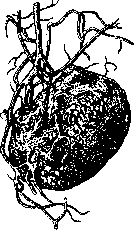
As an example of S. among plants, lichens should first be mentioned, which' since the work of Famintsyn and Baranetsky, and especially after the research of Schwendener (Schwendener), are considered as a complex organism—the S. of a fungus with an alga. Experimentally, both components (especially the fungus) can be separated and cultivated separately. Reproduction of lichens occurs by means of special formations—soredia, which contain both fungal hyphae and algal cells. The meaning of S. in lichens is not entirely clear; besides the usual interpretation of the cohabitation of fungus and alga as mutually beneficial, there are views that consider this phenomenon as parasitism ('exploitation') of one or the other component. The nature of mutual benefit for the symbionts is apparently related to the difference in the methods of nutrition of the green alga and the fungus. It is necessary to note a new property compared to the original forms—their extraordinary hardiness. In 1885, Frank introduced the concept of mycorrhiza—a symbiosis of a fungus with the roots of some higher plants (heather, orchids, oak, etc.). In the absence of mycorrhiza, the plant (heather) remains underdeveloped, lacking a root (fig. 1). A distinction is made between ectotrophic mycorrhiza, when the fungal threads envelop the plant (root) from the outside, and endotrophic mycorrhiza, when the hyphae penetrate into the cells and intercellular spaces of the symbiotic plant. The S. of oak roots with truffles is well known (fig. 2). The significance of mycorrhiza is not entirely clear; apparently it refers to the enhanced absorption of salts from the soil with the help of numerous branches of the fungus; some assume that the S. with the fungus creates the ability to assimilate atmospheric nitrogen and gives plants the possibility to exist on nitrogen-poor soil. A very bright example of S. is represented by the endotrophic mycorrhizas of orchids. Orchid seeds are usually viable only if they are infected with a fungus. This latter causes the formation of new organs—tubers, the underground root of the orchid, 'nesting' etc. A number of data shows that for the flowering of orchids the presence of stem mycorrhiza is necessary. The significance of S. for the flowering plant apparently comes down to the presence of protein substances (part of the hyphae is digested), for the fungus—to the supply of water and salts entering the plant. Figure 1. Heather of the same age. Left—sterile plant (without root), right—'infected' with a symbiotic fungus.
fig. ?. Symbiosis of oak roots with truffle.
Somewhat apart stand the widely known cases of a special S. of animals with plants, in which the former contribute to the cross-pollination of the latter (the moth Proncia in the pollination of yucca and many other examples). Pollination is carried out thanks to the sequential visiting of male and female flowers by animals and the transfer of pollen to the female organs of plants. All these cases should be considered as symbiotic parasitism, since animals usually cause some harm to the plant, eating part of the ovules, castrating part of the flowers, etc. Some cases of indirect S. can be seen in the role that animals play in the dispersal of fruits and seeds; these are provided with special adaptations such as hooks, spines, etc., allowing them to attach to the bodies of plant-eating animals and move with them over long distances. Examples of S. of animals with plants are very numerous; here one should first point to the single-celled green and yellow algae (zoochlorellae and zooxanthellae), found in the body of various representatives of animals. This type of S. has been established for amoebas (Amoeba pelomyxa), radiolarians, sponges, worms, polyps, insects, up to highly organized animals. The significance of S. is related to the possibility for the animal symbiont to synthesize organic substances, and for the plant—to feed on the remains of the animal's food. Green algae isolated from the body (previously considered as animal chlorophyll) are capable of independent existence on a nutrient medium. 'Sponge-algae' are extremely widespread, representing an algae covered with a sponge. Such cases are especially frequent among sponges of the genus Reniera, Spongia, etc. S. /HpV is apparently hereditary, i.e. the eggs of sponges contain //Ш3л\ spores of algae. One can IP^*Щм0?\ also mention the case of S. of the green > ^ШЩщр-^ alga Oedogonium on the surface-I |^й0вЦод I of the body of the dragonfly Aesctma. S. of animals with microorganisms—bacteria and yeast fungi—is extremely widespread. Especially in insects, a whole series of special organs filled with microorganisms and obviously playing a significant role in the physiology of these animals, mainly in digestive processes, have been noted. These include the so-called bacterioid organs of certain worms, symbiotic colonies of microorganisms in the cells-S1S Cмаш?CT°" ках of the intestine of the ant Сатро-поtus, club-shaped organs and vaginal glands of certain beetles, the so-called false yolk of aphids of the genus Aphidae, the abdominal organ of cicadas, etc. Microbes are especially common in the organs of blood-sucking animals (digestive glands of ticks, esophageal glands of leeches, etc.) (fig. 3). Special mention is deserved by the 'fat body' of butterflies, which is a 'symbiotic organ'; in this case, the activity of the symbionts apparently determines the maturation of the sexual elements (Pospelov). Symbiotic accumulations of microorganisms have been described for many mollusks and tunicates (Boyanusov organ). It is very important to note that the widely spread phenomenon of biological luminescence (see Luminescence) in many cases (in insects, cephalopods, tunicates-Pyrosoma) is due to the S. of these animals with luminescent bacteria (Pierantoni). Cases of S. of animals with animals have been described somewhat less frequently. The most well-known are the frequently cited cases of S. of the crab
fig. 4. Anemone Sagartia parasitica on a shell inhabited by a hermit crab.

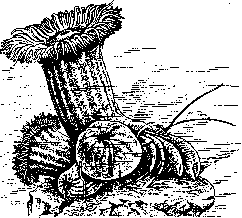
of the hermit crab Eupagurus with the anemone Adamsia (mutual benefit: for the anemone-movement, for the crab, unprotected by a shell-protection of the body by means of the stinging organs of the anemone) (fig. 4); similarly, one can mention the S. of the crab Mellia with the anemone, the female lobster-with the leech Mistrobdella (eating of decaying eggs on the lobster's abdomen) and etc. There is a trend (Buchner, Portier, Famintsyn, Merezhovsky, Kozo-Polyansky and others), significantly expanding the concept of S. and putting forward the idea of s y m b i o g e n e s i s as an important moment in biological evolution. From this point of view, all organisms (except bacteria) represent consociations-biological communities in S; evolution is possible due to the complication of the consociation, the addition of new members to it, just as a new type of lichens arises from the S. of fungi and algae. Using the rich factual material accumulated by biology in the field of S., the authors go very far, for example, asserting that cellular organelles up to the nucleus, chromosomes, chondriosomes, etc. : represent symbiotic microorganisms; similarly, as a result of the S. of microorganisms with plant cells, many organelles of the latter are considered-plastids (chloroplasts), aleurone grains and etc. The authors also include grafts in higher plants, heterotransplantations in animals and etc. These extreme views find some confirmation in the works of a number of authors (Portier, V. N. Luyimenko), who cultivated: first-chondriosomes, second-chlorophyll grains outside the organism and established their ability to survive outside the cell. If one cannot deny some significance of S. as a factor creating new biological individualities (lichens)-still the views of the representatives of the theory of s y m b i o g e n e s i s seem one-sided and hardly reconcile with modern cytological views. They in any case need a series of verification experiments. The very concept of symbiosis, as we have seen, is extremely vague and easily opens the way to anthropomorphic and idealistic interpretations.
Related articles
Mentioned in
Cite this page
“Symbiosis.” Soviet Medical Encyclopedia. English translation of Bolshaya Meditsinskaya Entsiklopediya, 1st ed. (Moscow, 1928–1936), ed. N. A. Semashko. https://sovietmedicalencyclopedia.pages.dev/article/symbiosis/