Nitrogen-Fixing Bacteria
Historical document, translated for reference. It reflects medical knowledge of the 1920s–30s and is not medical advice.
Summary
Nitrogen-fixing bacteria are microorganisms that can utilize atmospheric nitrogen, which is unusable by most microbes. They exist in two main groups: those that form symbiotic relationships with leguminous plants and free-living soil bacteria.
Encyclopedia article (1928–1936)
Nitrogen-Fixing Bacteria, bacteria that can feed on free atmospheric nitrogen, which is completely unsuitable for nutrition by most microbes. Two groups of N. bacteria are known: one, the so-called 'nodule bacteria,' fix nitrogen in symbiosis with leguminous plants, forming special swellings-nodules on their roots; the other group of N. bacteria vegetates freely in the soil and is not directly dependent on the life of higher plants. Among representatives of the second group of N. bacteria, there are aerobic and anaerobic species, very widespread in nature. Nodule bacteria were discovered and studied earlier. The discovery of this group of N. bacteria was preceded by old and very interesting observations from agricultural practice. It was noted that with respect to nitrogen nutrition, all cultivated plants can be divided into two groups, unequal in number of representatives. While the vast majority of plants, including all cereals, need combined nitrogen for their nutrition and, absorbing nitrate salts with their roots, reduce the nitrogen reserve in the soil, other plants, belonging to the legumes, grow excellently on nitrogen-poor soils, not only not depleting them, but on the contrary, improving their quality and enriching them with nitrogen. The discovery of two groups of plants depleting and enriching the soil with nitrogen formed the basis on which modern crop rotation theory developed. Research by Hellriegel and Wilfarth clarified that there is a mutual connection between the presence on the roots of legumes of special wart-like outgrowths, the so-called 'root nodules' (see Figure 1 and 2), and the fixation of free nitrogen by these plants. When sterilized beans are sown in sterilized soil, nodules do not appear at all. In this case, in the absence of combined nitrogen in the soil, legumes develop just as poorly as cereals. But if in a parallel experiment the same, but not sterilized, land is taken, then the legume will develop quite normally with abundant nodule formation. The latter develop especially luxuriantly in soils poor in combined nitrogen, giving the roots of the legume their characteristic appearance. If, however, the legume is provided with nitrogenous food, then nodules either do not appear at all or develop weakly. They must therefore be regarded only as a temporary adaptation which the legume uses to fix atmospheric nitrogen and which is not part of the normal development cycle of this plant when there is sufficient nitrate salt content in the soil. As the legume grows, the nodules become drier, shrivel, and gradually disintegrate, giving up the accumulated N to the plant with the vascular bundles of which they are in direct connection (see Figure 3). In some legumes (pea, clover, vetch), nodules form as small swellings on small root branches and on rootlets (see Figure 1); in others, on the contrary, e.g., in lupine, they cover the main root of the plant with large wart-like outgrowths, sometimes reaching the size of a forest nut (see Figure 3). In young nodules, the bacteria have the appearance of unusually small, non-spore-forming, very motile rods. As the nodule develops, the bacteria increase in size, and among them appear 'bacteroids' (see Figure 3 e and f). The appearance of bacteroids is a sign of the beginning of degeneration under the influence of processing by the acidic juices of the host plant, which is in the period of full development. Remains of disintegrated nodules infect the soil with surviving bacteria, and therefore soils under legume crops are usually rich in nodule bacteria. Bacteria isolated from nodules of various legumes are almost identical in their morphological and cultural characteristics, and therefore they are all united into one common species-Bac. radicicola, distinguishing only individual races. However, physiologically these varieties differ significantly from each other in that each of them causes abundant nodule formation only on the roots of its host plant. Only systematic experiments can accustom nodule bacteria to other legumes and thus obtain 'crossing microbes,' but this mutual exchange of host plants is possible only between closely related species, e.g., between clover and alfalfa, between beans and vetch, etc. The coexistence of legumes with nodule bacteria shows signs of mutual parasitism: first the bacteria parasitize on the plant, using nutrients, and then the plant abundantly returns its losses, taking away from the bacteria the mucilaginous nitrogenous substance used for nutrition. Direct observation convinces us that the soil itself possesses nitrogen-fixing forces, and that along with nodule bacteria, other groups of microbes exist in the soil layer that perform the same nitrogen binding process, independently of legume cultivation. They were discovered in 1893 by Winogradsky, who used a nitrogen-free medium for their isolation, which, along with the necessary mineral nutrients, contained a large amount of sugar, the decomposition of which serves as an energy source for the microbes. Winogradsky succeeded in obtaining in anaerobic conditions a pure culture of N. rods, which he named Clostridium Pasteurianum (see Figure 4). This is a rather large anaerobic species, which in the spore-forming period takes the form of a short spindle and stains in this stage with iodine in blue color. In the mature state, the elongated spore is surrounded by the remains of the bacillus body in the form of a gelatinous triangular sheath. The spore germinates polarly and always from the open side of the sheath. The distribution of Clostridium Pasteurianum in nature is very great. It was possible to isolate it from the most diverse soils of the Old and New Worlds. Clostridium Pasteurianum causes in sugar liquids typical butyric acid fermentation with the formation of butyric and acetic acids, butyl alcohol, H and carbon dioxide; its fixation of nitrogen, according to Winogradsky, occurs by the formation of ammonia from atmospheric nitrogen and hydrogen at the moment of release. The reduced ability to fix nitrogen can be restored to its former size if the microbe is 'passed through the soil' by sowing a weakened culture into sterilized soil, just as the virulence of pathogenic microbes is restored by passing them through the body of a susceptible animal. In 1901, Beijerinck isolated from garden soil an aerobic species-Azotobacter chroococcum in the form of large, slightly elongated cells with a sharply expressed property of fixing atmospheric nitrogen (see Figure 5, 1). At the same time, from wastewater he isolated a variety-Azotobacter agile-of somewhat larger size (see Figure 5, 2). Azotobacter cells are usually provided with a mucous capsule, sometimes exceeding the size of the bacterial body itself. In the division stage, the cells appear as large diplococci. Their protoplasm has a pronounced granularity. Like Clostridium Pasteurianum, Azotobacter fixes nitrogen only in the presence of nitrogen-free organic substances, which it burns completely. The fixation mechanism is probably the same as that of Clostridium Pasteurianum. The nitrogen assimilated by Azotobacter is deposited in its body in the form of protein compounds. Getting into the soil, Azotobacter cells undergo successive processes of decay and nitrification, and their N thus becomes accessible for nutrition of higher plants. Azotobacter is extremely widespread in various soils. Intensive plowing of the land, facilitating access of air to it, as well as the addition of lime salts, favors the development and activity of Azotobacter. Some other species of microorganisms (bacteria, algae, fungi) also have a weakly expressed property of binding atmospheric nitrogen, very widespread in nature.
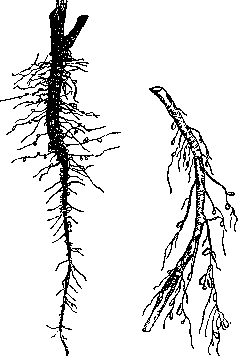
Figure 1. Root of Vicia faba with young nodules.
Figure 2. Root of Trifolium pratense with nodules. this group of N. bacteria was preceded by old and very interesting observations from agricultural practice. It was noted that with respect to nitrogen nutrition, all cultivated plants can be divided into two groups, unequal in number of representatives. While the vast majority of plants, including all cereals, need combined nitrogen for their nutrition and, absorbing nitrate salts with their roots, reduce the nitrogen reserve in the soil, other plants, belonging to the legumes, grow excellently on nitrogen-poor soils, not only not depleting them, but on the contrary, improving their quality and enriching them with nitrogen. The discovery of two groups of plants depleting and enriching the soil with nitrogen formed the basis on which modern crop rotation theory developed. Research by Hellriegel and Wilfarth clarified that there is a mutual connection between the presence on the roots of legumes of special wart-like outgrowths, the so-called 'root nodules' (see Figure 1 and 2), and the fixation of free nitrogen by these plants. When sterilized beans are sown in sterilized soil, nodules do not appear at all. In this case, in the absence of combined nitrogen in the soil, legumes develop just as poorly as cereals. But if in a parallel experiment the same, but not sterilized, land is taken, then the legume will develop quite normally with abundant nodule formation. The latter develop especially luxuriantly in soils poor in combined nitrogen, giving the roots of the legume their characteristic appearance. If, however, the legume is provided with nitrogenous food, then nodules either do not appear at all or develop weakly. They must therefore be regarded only as a temporary adaptation which the legume uses to fix atmospheric nitrogen and which is not part of the normal development cycle of this plant when there is sufficient nitrate salt content in the soil. As the legume grows, the nodules become drier, shrivel, and gradually disintegrate, giving up the accumulated N to the plant with the vascular bundles of which they are in direct connection (see Figure 3).
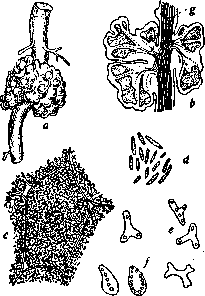
Figure 3. Root nodules of legumes: a-nodules of lupine in natural size; b-longitudinal section of lupine root with nodule; d-vascular bundle of root; c-cell of lupine nodule filled with bacteria; d-nodule bacteria in unchanged form; e, f-bacteroids (enlarged: c-600; d, e, f-approx. 1,500).
In some legumes (pea, clover, vetch), nodules form as small swellings on small root branches and on rootlets (see Figure 1); in others, on the contrary, e.g., in lupine, they cover the main root of the plant with large wart-like outgrowths, sometimes reaching the size of a forest nut (see Figure 3). In young nodules, the bacteria have the appearance of unusually small, non-spore-forming, very motile rods. As the nodule develops, the bacteria increase in size, and among them appear 'bacteroids' (see Figure 3 e and f). The appearance of bacteroids is a sign of the beginning of degeneration under the influence of processing by the acidic juices of the host plant, which is in the period of full development. Remains of disintegrated nodules infect the soil with surviving bacteria, and therefore soils under legume crops are usually rich in nodule bacteria. Bacteria isolated from nodules of various legumes are almost identical in their morphological and cultural characteristics, and therefore they are all united into one common species-Bac. radicicola, distinguishing only individual races. However, physiologically these varieties differ significantly from each other in that each of them causes abundant nodule formation only on the roots of its host plant. Only systematic experiments can accustom nodule bacteria to other legumes and thus obtain 'crossing microbes,' but this mutual exchange of host plants is possible only between closely related species, e.g., between clover and alfalfa, between beans and vetch, etc. The coexistence of legumes with nodule bacteria shows signs of mutual parasitism: first the bacteria parasitize on the plant, using nutrients, and then the plant abundantly returns its losses, taking away from the bacteria the mucilaginous nitrogenous substance used for nutrition. Direct observation convinces us that the soil itself possesses nitrogen-fixing forces, and that along with nodule bacteria, other groups of microbes exist in the soil layer that perform the same nitrogen binding process, independently of legume cultivation. They were discovered in 1893 by Winogradsky, who used a nitrogen-free medium for their isolation, which, along with the necessary mineral nutrients, contained a large amount of sugar, the decomposition of which serves as an energy source for the microbes. Winogradsky succeeded in obtaining in anaerobic conditions a pure culture of N. rods, which he named Clostridium Pasteurianum (see Figure 4). This is a rather large anaerobic species, which in the spore-forming period takes the form of a short spindle and stains in this stage with iodine in blue color. In the mature state, the elongated spore is surrounded by the remains of the bacillus body in the form of a gelatinous triangular sheath. The spore germinates polarly and always from the open side of the sheath. The distribution of Clostridium Pasteurianum in nature is very great. It was possible to isolate it from the most diverse soils of the Old and New Worlds. Clostridium Pasteurianum causes in sugar liquids typical butyric acid fermentation with the formation of butyric and acetic acids, butyl alcohol, H and carbon dioxide; its fixation of nitrogen, according to Winogradsky, occurs by the formation of ammonia from atmospheric nitrogen and hydrogen at the moment of release. The reduced ability to fix nitrogen can be restored to its former size if the microbe is 'passed through the soil' by sowing a weakened culture into sterilized soil, just as the virulence of pathogenic microbes is restored by passing them through the body of a susceptible animal. In 1901, Beijerinck isolated from garden soil an aerobic species-Azotobacter chroococcum in the form of large, slightly elongated cells with a sharply expressed property of fixing atmospheric nitrogen (see Figure 5, 1). At the same time, from wastewater he isolated a variety-Azotobacter agile-of somewhat larger size (see Figure 5, 2). Azotobacter cells are usually provided with a mucous capsule, sometimes exceeding the size of the bacterial body itself. In the division stage, the cells appear as large diplococci. Their protoplasm has a pronounced granularity. Like Clostridium Pasteurianum, Azotobacter fixes nitrogen only in the presence of nitrogen-free organic substances, which it burns completely. The fixation mechanism is probably the same as that of Clostridium Pasteurianum. The nitrogen assimilated by Azotobacter is deposited in its body in the form of protein compounds. Getting into the soil, Azotobacter cells undergo successive processes of decay and nitrification, and their N thus becomes accessible for nutrition of higher plants. Azotobacter is extremely widespread in various soils. Intensive plowing of the land, facilitating access of air to it, as well as the addition of lime salts, favors the development and activity of Azotobacter. Some other species of microorganisms (bacteria, algae, fungi) also have a weakly expressed property of binding atmospheric nitrogen, very widespread in nature.
Related articles
Mentioned in
Cite this page
“Nitrogen-Fixing Bacteria.” Soviet Medical Encyclopedia. English translation of Bolshaya Meditsinskaya Entsiklopediya, 1st ed. (Moscow, 1928–1936), ed. N. A. Semashko. https://sovietmedicalencyclopedia.pages.dev/article/nitrogen-fixing-bacteria/