Anuclear Organisms
Historical document, translated for reference. It reflects medical knowledge of the 1920s–30s and is not medical advice.
Summary
This article discusses the historical and biological concept of "anuclear organisms"—creatures lacking a morphologically defined nucleus. It covers the evolution of the term, the debate surrounding the nuclear structure of bacteria, spirochetes, and blue-green algae, and the scientific methods used to investigate their cellular composition in the early 20th century.
Encyclopedia article (1928–1936)
ANUCLEAR ORGANISMS, creatures in which, at no stage of their development, has it yet been possible to discover morphologically defined nuclei. At the present time, bacteria, spirochetes, and blue-green algae (Chlamydozoa) are classified as anuclear organisms. In the historical course of the development of morphological microbiology, the list of anuclear organisms has changed quite significantly. Shortly after the appearance of the cell theory (1838–39), the presence of a nucleus was also established in Protozoa (see). The first finding of this kind was the nucleus of gregarines (Siebold, 1838), which, in connection with this, were recognized as "unicellular" organisms (Kolliker, 1848). The gradual recognition of the universal significance of the cell theory led to the idea of the universality of cellular-nuclear structure among protozoa as well. However, their systematic study showed that there are also protozoa in which a nucleus cannot be detected. All such forms were united into the group of Monera (Haeckel, 1868). As cytological technique improved, the circle of Monera gradually narrowed, and at the present time, the concept of anuclear organisms in relation to Protozoa has been completely discarded: it is applied exclusively to blue-green algae, spirochetes, and bacteria. The very idea of the existence of anuclear organisms so contradicts the biological concept of the universal significance of the nuclear apparatus for all living beings that the unceasing attempts of morphologists to find a nucleus in the so-called anuclear organisms become completely understandable. The results obtained in this process and the theories that have arisen differ greatly from one another, which depends on the very definition of the concept of a nucleus. In addition to stainability with so-called nuclear stains, modern cytology includes in the concept of a nucleus certain morphological features, such as, for example, the existence of a nuclear membrane and a specific internal structure. But the decisive factor here is the participation of the nucleus in the processes of division and, in particular, the formation of chromosomes. Not a single one of the anuclear organisms satisfies these requirements. Isolated descriptions of this kind (Schussnig, 1920) still require verification. The impossibility in the overwhelming number of cases of proving the presence of a morphologically impeccable nucleus in anuclear organisms has led, for example, to the fact that some authors acknowledge that bacteria consist of only protoplasm but are definitely devoid of a nucleus (Migula, 1896; Fischer, 1903); others believe that the entire body of bacteria consists entirely of nuclear substance and has no cellular protoplasm at all (Butschli, Ruzicka, 1903–1917, Merezhkovsky, 1910); others attribute to bacteria
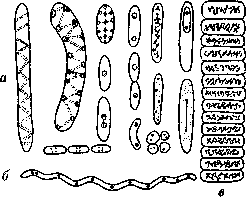
Various forms of stainable inclusions in bacteria (a), spirochetes (b), and blue-green algae (c), described as nuclei.
protoplasm and a nucleus, but admit that the latter exists in them not in the form of a morphologically defined formation analogous to the cell nucleus of so-called multicellular organisms, but only in the form of a more or less close mixture of chromatin with protoplasm (which explains the diffuse stainability of these microorganisms with so-called basic nuclear stains). But under certain conditions, for example, during spore formation, nuclear substance can appear in the same organisms in the form of chromatin granules scattered in the protoplasm (Guilliermond, 1910; Schwellengebel, 1912; Gotschlich, 1927). Such a diffuse state of chromatin, which in its entirety forms a kind of equivalent of a cell nucleus, is equated by the latter authors to the so-called chromidial state in Protozoa, in which stages of development without a nucleus, but with a diffuse arrangement of chromatin, were also previously described (Hertwig, 1903). However, in relation to the latter, this view is currently decisively rejected. Similar equivalents of a nucleus in the form of granules, networks, spirals, and similar formations that stain with nuclear stains have also been described in spirochetes (Dobell, 1913) and in blue-green algae (Baumgartel, 1923). However, in these organisms, the determination of nuclear substance has so far relied only on the sign of its stainability with basic dyes and, in part, on the reaction of its dissolution by enzymes. These proofs do not have absolute significance, since, besides known nuclear substance, i.e., chromatin, various inclusions in the protoplasm that have no relation to the nucleus can also be stained with basic dyes. Experiments with digestion by pepsin and trypsin do not resolve the question, since they are not specific but group-specific in nature. The question entered a new phase from the moment of the development of the nuclear reaction (Feulgen and Rossenbeck, 1924), proposed for the microtechnical determination of nucleoproteins and apparently having specific significance. This reaction was brilliantly justified on the nuclei of all multicellular organisms and very many Protozoa; however, initial attempts to apply it to bacteria and spirochetes gave a negative result, which seemed to serve as additional confirmation of their anuclear nature. However, the latest observations point to the possibility of a positive nuclear reaction in bacteria as well (Muratova, 1928). This allows one to think that systematic studies of both the essence of the nuclear reaction and the limits of its applicability will help to finally resolve the question of anuclear organisms.
Related articles
Cite this page
“Anuclear Organisms.” Soviet Medical Encyclopedia. English translation of Bolshaya Meditsinskaya Entsiklopediya, 1st ed. (Moscow, 1928–1936), ed. N. A. Semashko. https://sovietmedicalencyclopedia.pages.dev/article/acellular-organisms/