Fats
Historical document, translated for reference. It reflects medical knowledge of the 1920s–30s and is not medical advice.
Summary
Fats are substances formed in plant or animal organisms, consisting mainly of glycerides, which are complex esters of glycerol with saturated and unsaturated fatty acids of high molecular weight. Along with proteins and carbohydrates, fats constitute the third main group of substances in animal and plant organisms.
Encyclopedia article (1928–1936)
FATS, substances formed in plant or animal organisms and consisting mainly of glycerides, i.e., complex esters of glycerol with saturated and unsaturated fatty acids of high molecular weight. Fats, along with proteins and carbohydrates, constitute the third main group of substances that make up the animal and plant organism. In animals, fats are found in greater or lesser quantities apparently in all tissues and cells. In plants, they play a less important role, but they are found here as well, both in lower representatives—in bacteria, yeast fungi, algae, fungi, and mosses—and in higher plants—in underground parts (roots, bulbs, and tubers), in tree trunks and branches, and especially in seeds. In plants, fats play almost exclusively the role of a reserve food substance. They are formed in ripening seeds from carbohydrates, and during seed germination the reverse process occurs—the amount of fats decreases, and accordingly the content of carbohydrates—starch, sugars, etc.—increases. For the animal organism, the main significance of fats is determined by their large reserve of potential chemical energy. Containing significantly more carbon and hydrogen and less oxygen in their molecule than proteins and carbohydrates, fats have approximately twice the heat of combustion: 1 gram of fat yields 9.3 calories compared to 4.1 calories given by proteins and carbohydrates. However, besides this energy value, fats in the body perform a number of other functions, in particular purely mechanical ones: they form a soft, elastic padding in all places subject to mechanical impact—on the soles of the feet, on the buttocks, on the palms, etc. They give roundness to the forms of the body, fill cavities, surround internal organs with a sac, holding them in a certain position and protecting them from external injuries. The fat filling the orbit forms a kind of articular surface for the eyeball. Being a poor conductor of heat, fat deposited in subcutaneous adipose tissue protects the body from excessive heat loss and softens the effect of sharp changes in external temperature. The fat content in various tissues and organs is subject to extremely strong fluctuations, so it is not possible to give any average figures. It is determined primarily by nutritional conditions and lifestyle. The composition of fats in different parts of the body of the same animal differs; thus, fats of the superficial layers of subcutaneous tissue are richer in oleic acid and have a lower melting point than fats of internal cavities. From the point of view of their participation in the overall economy of the organism, a distinction must be made between fats that are part of the protoplasm of cells themselves and fats deposited only as a reserve nutritional material. Fats that are part of the protoplasm as some integral part participate in the exchange of the cell, affecting the penetration of substances from the surrounding environment into it; they are much more difficult to extract from tissues than freely deposited reserve fats. Apparently, in terms of composition, they also show greater individual differences than reserve fats. The main places of deposition of the latter are subcutaneous adipose tissue, adipose tissue of the abdominal cavity (omentum), and intermuscular tissue.
V. Engelhardt. In human nutrition, Fats play a very important role; they are, along with proteins, carbohydrates, vitamins, and salts, necessary for the proper metabolism in the body. The human body daily loses part of its fat reserves, and these losses up to a certain limit must be replenished by dietary Fats. Although it has been established that Fats in the body can also be formed from proteins and carbohydrates, however, the essence of these processes is still not sufficiently studied, and at present it cannot be definitely said to what extent and under what conditions Fats formed from proteins and carbohydrates can replace dietary Fats. Practical observations of the nutrition of large masses of people indicate that for maintaining strength and health, the presence of a sufficient amount of Fats in food is undoubtedly necessary. The deficiency of Fats in the food ration during the military blockade in Germany and during our civil war had a detrimental effect on the health of the population, causing exhaustion, general weakness, hydremic condition of tissues, and reducing resistance to infectious diseases and generally harmful influences. The amount of Fats in the hungry wartime ration averaged no more than 10-22 g, whereas the normal daily food ration for a person engaged in moderate work should contain: according to Rubner-52 g, according to Voit-56 g, according to Gautier-54 g, according to Moleschott-84 g, according to Tigerstedt-93 g, according to Ranke-100 g, according to Etouffer-100 g. During heavy work, the amount of Fats should be increased: according to Rubner-up to 70 g, according to Voit-up to 100 g, according to Tigerstedt-up to 106 g, and according to Etouffer-up to 160 g. Only as an exception can be mentioned that some people, and sometimes entire nations, can apparently be satisfied with a very small amount of Fats in their food; for example, the daily ration of Japanese people (according to Slovtsov) contains no more than 5-10 g of fat. The presence of Fats in food limits the breakdown of proteins associated with metabolism in the body and reduces the loss of Fats in the body. Fats entering the body from food, as well as those formed in it from other nutrients, have the property of being deposited in various tissues and organs of the body. During starvation and severe diseases, these fat reserves are used in the first place and thereby protect other, more important tissues and organs of the body from destruction. According to Voit's observations, the consumption of Fats during starvation almost triples the breakdown of protein substances; as Fats disappear in the body, protein losses increase. The value of fat as a nutrient lies in its good digestibility. According to the research of Rubner and many other authors, the digestibility of animal and vegetable Fats can be considered equal on average to 95-97%. In the process of digesting Fats, the melting point of fats is of great importance. Fats that are liquid and melt at body temperature are digested very well; Fats with a melting point above 43°C are digested significantly worse. For example, the digestibility of olive oil is 97.7%, of pork fat (melting point 32-40°C)-97.5%, of goose fat (melting point 25°C)-97.5%, of beef and mutton tallow (melting point 44-51°C)-91.0%, of pure tristearin (average melting point 60°C)-from 0% to 15%. The admixture of low-melting fats to fats with a high melting point increases the digestibility of the latter. Glycerides of unsaturated acids are digested better than glycerides of saturated acids. Fats possess enormous potential energy and when burned in the body release on average 2.3 times more calories than an equal weight of carbohydrates and proteins. Therefore, in cases where it is necessary to increase the caloric value of food without greatly increasing its volume, Fats are indispensable. This is very important for the rational nutrition of certain categories of patients, for example, tuberculosis patients, who due to lack of appetite cannot eat much food, yet require enhanced nutrition. The same can be said about the worker's ration with very high caloric value, which becomes excessively bulky if high caloric value is achieved not by adding fats but by carbohydrates, especially bread and potatoes. The nutritional value of Fats is also great because they significantly improve the taste of food, and most people when improving their budget strive to increase the amount of Fats in their daily ration. Therefore, statistical data show that among well-to-do population groups the food ration always contains more Fats than among less affluent ones. Excessive content of Fats in food leads to undesirable excessive obesity of the body, and too fatty food can cause persistent digestive disorders. Slovtsov points out that prolonged feeding on fatty food after the first beneficial effect on the deposition of fat reserves in the body and increase in weight begins to noticeably disrupt digestion, especially pancreatic, causing a catarrhal condition of the stomach and intestines, and according to some authors also disrupts calcium metabolism. Not all Fats entering human food have the same biological value for the body. The most valuable among them are those rich in lipoids (especially lecithin) and vitamins A and D. These should primarily include the following Fats of animal origin: butter (cow's) fat, egg yolk fat, perirenal fat, liver fat, fish fat. Incomplete Fats include purified beef, mutton, pork tallow, margarines, and all vegetable oils. In view of the important role of lecithin and vitamins for growing as well as for disease-exhausted bodies, it is desirable in the diet of children and sick adults that full-value Fats of animal origin predominate. It is interesting to note that vegetable oils and purified animal fats, which do not contain vitamin D, under the influence of ultraviolet rays acquire antirachitic properties, i.e., the properties of vitamin D. Cow's butter, milk, wheat germ, etc. are strongly activated by ultraviolet rays. These facts indicate some dependence of the formation of antirachitic vitamin D on ultraviolet rays. According to the latest observations, vitamin D is nothing other than ultraviolet ray-activated ergosterol (a cholesterol-like compound contained in fats).
N. Ignatov. By origin, fats are divided into animal and vegetable; they differ from each other both in chemical composition and in consistency. By consistency at room temperature, the following are distinguished: 1. Liquid fats, or fatty oils; the liquid fats of some marine animals are called blubbers. 2. Semiliquid fats, such as chaulmoogra oil, or hydnocarpus oil, coconut oil, palm oil, butter, lard, poultry fat, etc. 3. Solid fats—cocoa butter, the fat of the internal organs of sheep and cattle, Japanese wax, etc. Fats are distinguished as drying, semidrying, and nondrying. The more glycerides of unsaturated acids a fat contains, and mainly the higher the unsaturation of these acids, the faster the fat dries, turning into a solid lacquer film. Of the fats used in medicine, the drying ones include linseed and hemp oils; the semidrying ones include cod-liver oil, or fish oil, sunflower oil, sesame oil, and croton oil; the nondrying ones include almond oil, olive oil and provence oil, peach oil, apricot oil, bay oil, hydnocarpus oil, castor oil, cocoa butter, lard and tallow, and Japanese wax. All natural fats are mixtures of glycerides. Unsaturated esters of glycerol—mono- and diglycerides—are not found in fresh fats, but in aged fats the presence of mono- and diglycerides can be considered established. Most natural fats are mixtures of simple (unmixed) triglycerides. Of the mixed glycerides that have been isolated, we can mention: oleo-palmito-butterin (butter), oleo-distearin (cocoa butter), palmito-distearin and stearo-dipalmitin (lard), capryl-laurin-myristin (coconut oil), dioleo-palmitin and dioleo-stearin (goose fat). Animal fats contain mainly triglycerides of stearic, palmitic, and oleic acids; vegetable fats contain a large amount of triglycerides of oleic acid and also more or less significant amounts of glycerides of other unsaturated acids. The more a fat contains glycerides of stearic and palmitic acids, the firmer its consistency. Most animal fats are solid or semisolid; vegetable fats, on the contrary, are predominantly liquid; in southern plants (cacao, coconut palm, hydnocarpus, etc.), solid and semisolid fats are found. For the same plant, the firmer the fat, the more southern the plant is cultivated. Fats in southern animals are also harder than in northern ones. The relative amounts of glycerides of oleic, palmitic, and stearic acids vary within rather wide limits depending on the location of the fat in the animal's body and to a lesser extent on age, breed, and feeding. Glycerides of volatile acids (acetic, caproic, capronic, and butyric) are found in any significant amounts only in certain fats, such as in the fats of animal milk, in croton, coconut, and palm kernel oils. Glycerides of saturated hydroxy acids are almost never found in fats; castor oil contains a large amount of glycerides of ricinoleic acid (unsaturated hydroxy acid) CH3.(CH2)5.CH(OH).CH2.CH::CH.(CH2)7.COOH. Fats also contain acids of cyclic structure (hydnocarpic acid C17H31.COOH). Free fatty acids in fresh fats are found in negligible amounts, but even when heated to 100°, more or less significant amounts of acidic decomposition products of fats appear.
Fats are nonvolatile and decompose when heated; the decomposition temperature varies for different fats and is determined as the flash point, i.e., the temperature at which the volatile decomposition products of the fat ignite upon contact with a burning object and then go out. The flash point for fats ranges from 200° to 300°. The ignition temperature of fats, i.e., the temperature at which the amount of volatile decomposition products of the fat is sufficient to maintain a constant flame, is above 300°. All fats contain a small amount of sterols; some animal fats contain fairly large amounts of lecithin. The elementary composition for various fats varies slightly: carbon—from 76% to 79%; hydrogen—from 11% to 13%; oxygen—from 10% to 12%. All artificially obtained fats are colorless, odorless, and tasteless; therefore, it is assumed that the taste, smell, and color of natural fats are due to minor impurities of non-fat substances. The color of lard, butter, egg yolk fat, and almost all animal and vegetable fats is caused either by the solid red-yellow unsaturated hydrocarbon carotene (C40H56), or by chlorophyll (green shades of vegetable fats), or by yellow xanthophyll (C40H56O2). A strong saffron-yellow color of fat is observed in old, emaciated, and sick animals. Depending on origin and composition, fats differ not only in consistency but also in other physical properties. 1. By specific gravity, which for fats is generally below unity. 2. By the melting and solidification points, with the first always being higher than the second. The melting point of mixtures of glycerides does not correspond to the calculated average and is always lower than the latter; characteristic of fats is the double melting point; thus, tristearin melts at 51°, but if heating is continued, cloudiness appears at 60°, and final clarification occurs at 71.6°. 3. All fats are easily soluble in ether, benzene, petroleum ether, chloroform; difficult to dissolve in cold alcohol and insoluble in water. Castor oil is one exception—it dissolves in all proportions in alcohol, mixes with one or two volumes of petroleum ether or gasoline, but is precipitated upon the addition of larger amounts of these. Fats are optically inactive or rotate the plane of polarization only slightly; exceptionally strong rotation is possessed by hydnocarpus oil—from +49° to +59°; less active are dextrorotatory: castor oil and croton oil, and even less so—sesame oil. The refractive index of fats is higher the more unsaturated acids it contains and the higher their unsaturation; for most vegetable oils, the refractive index n/d 20° ranges between 1.44 and 1.48; for liquid animal fats—from 1.46 to 1.49, and for solid animal fats n/d 40°—from 1.45 to 1.47.
All fats exhibit reactions characteristic of esters, especially the saponification reaction. The unsaturated acids of fat glycerides have the ability to add halogens, are easily oxidized and polymerized. During storage, fats, depending on their nature and composition, undergo various changes, usually acquiring acidic properties, a characteristic unpleasant rancid and often sharp odor, and a sharp, pungent, and for vegetable oils and some animal fats also a bitter taste. The smell and taste of rancid fats depend on the decomposition products of glycerol and volatile fatty acids that have an aldehyde or ketone character. Often the unpleasant smell or taste of fats is due to the presence of foul-smelling and disgusting-tasting decomposition products of oil residues, buttermilk, or other similar substances. Among the reactions that occur, the oxidation, polymerization, and addition reactions have practical significance. Nondrying oils, containing a significant amount of glycerides of oleic acid series, are prone to rancidity and salting under the influence of atmospheric oxygen and light, but are difficult to oxidize and polymerize. Drying oils—linseed and hemp, containing a significant amount of glycerides of unsaturated acids with two and three double bonds—during storage, and rather upon heating, polymerize with the probable formation of cyclic groupings of the following type (according to the scheme of truxilic acids): R-CH-CH-R', R-CH-CH-R R-CH-CH-R
R-CH-CH-R With prolonged heating to 320° and higher without access to air, linseed oil, by polymerizing, thickens and turns into a rubbery, sticky mass ('bird glue'). With access to air, Fats containing a significant amount of glycerides of high unsaturated acids quickly oxidize, become rancid, and, drying, form a lacquer film-linoxin (a substance of an anhydride nature). The main cause of change in pure Fats is oxygen from the air and light, with temperature having less significance; changes in impure Fats, containing enzymes or substances capable of supporting the life activity of microbes (e.g., Finnish or butter, Fats with maggots, etc.), are complicated by the influence of enzymes and the life activity of microorganisms. Changes in Fats under the influence of the life activity of microorganisms, which promotes the saponification of fats, consist mainly in the accumulation of free fatty acids. Organic substances, such as oil cakes, containing lipase, serve not only as a nutrient medium for microbes but can themselves enzymatically break down Fats. Often an increase in free acids in Fats is not accompanied by its rancidity, and Fats with a fairly high acid number retain a pleasant taste. On the other hand, some oils, e.g., coconut oil, in a fresh state contain a large amount of free acids without showing a rancid taste.-All Fats cause a special sensation on the skin-'greasiness,' which is connected with the viscosity of Fats. Due to the viscosity of Fats, they form a film between moving surfaces and reduce friction, which causes the greasy sensation. As a lubricant for machines, Fats have everywhere been replaced by mineral oils, and only castor oil, possessing the ability to change its coefficient of viscosity little under the influence of temperature, is used for lubricating airplane motors. Of vegetable fatty oils, for preparing subcutaneous injections, the finest ointments, as well as for oil emulsions, the most suitable are non-drying oils; of these, almond oil should be placed first, and as a substitute for it-apricot or peach kernel oil. In second place is olive-provincial oil (Oleum provinciale), followed by semi-drying oils: sesame oil (Oleum Sesami) and then sunflower oil (Oleum Helian-thi). Since fresh cold-pressed oils contain fewer free acids and other fat decomposition products compared to hot-pressed oils or those that have been stored, for medical purposes, especially for subcutaneous injections and oil emulsions (Emulsio oleosa), it is advisable to use as fresh as possible oils pressed without heating. For the examination of Fats for the purpose of detecting falsifications and sanitary evaluation, a sample is taken. Solid or semi-solid Fats (rendered beef or pork lard) are taken from barrels in several places with a special probe or auger, immersing the latter deeply into the Fat. The Fat is placed in a jar with a good stopper; before examination, it is melted at the lowest possible temperature and freed from water, determining the amount of the latter by volume, namely by allowing the melted Fat to settle in a graduated cylinder, calibrated to 1/m cm3. Liquid at room temperature Fats are shaken before sampling, and if there are maggots and turbid substances, before examination the Fat is settled and filtered, and the sediment is examined separately if necessary. All samples of the Fat being examined should be stored in a cool and dark place. In the examination of Fats, besides determining their physical and chemical constants, the organoleptic examination, i.e., by means of the senses, is of great importance for determining contamination, rancidity, and generally the freshness of the Fat; this includes determining the color, odor, taste, and describing the external appearance (transparency, consistency, turbidity, sediment). To characterize Fats, determine their origin, test for freshness, purity, etc., recourse is had to determining a number of physical and chemical quantities: specific gravity, refractive index, various so-called 'numbers'-iodine, acid, etc. (see below); for the same purpose, a number of qualitative tests are also used. A final judgment on the purity or falsification of fats cannot be based on the magnitude of any one number, but only on the combination of several constants, since the composition and properties of natural Fats are subject to significant fluctuations. Based on the comparison of all constants, it is possible with some approximation to determine not only the nature of impurities but also their quantity. Methods for determining the physical and chemical properties of Fats. Physical properties. Specific gravity of Fats is determined by Westphal balances, a pycnometer, or by measuring the volume of 70-90% alcohol displaced by a weighed piece of solid Fat. The correction for temperature to bring it to 15° averages about 0.0007 per 1°.-Melting point. The melting point of Fats is taken as the lowest temperature at which it turns into a transparent homogeneous liquid ('final' melting point); but the temperature at which the Fat partially becomes liquid is also noted-the beginning of melting.-Solidification temperature. Since many Fats do not have a definite solidification temperature, it is customary to determine the more constant solidification temperature of the acids of the Fats, so-called the Fat's titer. The acids are obtained by saponifying the Fat with caustic alkali; the solution of the resulting soap is decomposed with hydrochloric acid; by settling in heat, complete separation of fatty acids from the aqueous liquid is achieved; the fatty acids separated from water are dried with calcined Na2SO4, filtered, placed in a test tube, into which a thermometer is inserted on a stopper, immersing it in the fatty acids; the test tube is also fixed on a stopper in a cylindrical glass jar with water so that the test tube does not reach the bottom of the jar; the jar is immersed in a vessel with cold water, maintaining the required temperature with snow or ice; the fatty acids in the test tube are stirred with the thermometer until turbidity appears, and then the thermometer is fixed immovably and the temperature is watched. With the beginning of crystallization of the acids, the temperature drop slows down and finally stops for a few moments, and then the temperature rises slightly, stops again for a short time, and begins to fall again; the highest temperature shown by the thermometer during the crystallization (solidification) of the fatty acids is noted as the solidification point, or the titer of the fat.-Refractive index is determined by an Abbe refractometer (figure 1) or a Zeiss butter refractometer. Chemical research.Qualitative reactions. 1. Elaidin test: 2 cm3 of oil is mixed with 1 cm3 of water and 1 cm3 of fuming nitric acid. The test serves to distinguish drying oils from non-drying oils and is based on the ability of oleic acid to turn under the influence of nitrous acid into a solid stereoisomer-elaidic acid. The more oleic acid in the fat, the faster the hardening and the harder the elaidin clot.-2. Bellier reaction on seed oil. To a mixture of 5 cm3 of fat with 5 cm3 of saturated

Fig.
To a solution of resorcinol in benzene, add 5 cm3 of nitric acid with a specific gravity of 1.38-1.40; if seed oils are present, a violet coloring of the mixture appears within 4 seconds, soon turning red and brown.-3. As indications of rancidity, the following reactions can serve: a) for the presence of aldehydes and ketones (meta-phenylenediamine, Schiff's reagent, fuchsin-sulfuric acid, etc.); b) for the presence of peroxides (10 cm3 of F. are mixed with 10 cm3 of an aqueous solution of NH2OH and with 5 drops of a 5% alcoholic solution of guaiacol—blue coloring); and c) coloring with a 1‰ solution of phloroglucin in ether (F VII).-4. Halphen's reaction. When heated for 15 min. in a water bath, a mixture of 5 cm3 of fat with 5 cm3 of amyl alcohol and 5 cm3 of a saturated solution of sulfur in carbon disulfide gives a red coloring if the fat contains cottonseed oil (01. Gossypii).-5. Baudouin's reaction. When shaking 0.1-0.5 g of sugar dissolved in hydrochloric acid with a specific gravity of 1.18 with double the volume of F., a red coloring of the aqueous layer already occurs with even a small admixture of sesame oil (01. Sesami) in the F.-6. Reaction for the presence of resin. The F. is extracted with acetic anhydride, 1 drop of sulfuric acid with a specific gravity of 1.6 is added; the presence of resin in the F. is considered established if the mixture colors violet, which soon turns brown. Many resins can be extracted from the F. with 70% alcohol.-7. Reaction for completeness of saponification. 1-2 g of F. are saponified with 5-10 cm3 of a 20% alcoholic solution of caustic potash when heated on a water bath for 5-10 min.; after diluting the saponified liquid with water 5-6 times, turbidity or separation of fat droplets should not appear, which would indicate the presence in the F. of unsaponifiable mineral oils, paraffin, ceresin, vaseline.-8. Reaction for the presence of oils from cruciferous plants. 5 g of F. are saponified with 20 cm3 of a 5% solution of caustic potash in 90% alcohol; the soap is dissolved in a small amount of water and mixed with 2 cm3 of an aqueous 20% solution of silver nitrate; the mixture is decomposed with dilute nitric acid and heated so that the fatty acids rise to the surface. In the presence of sulfur-containing oil from cruciferous plants, a thin black layer is observed at the boundary of the fat and water layers, which does not disappear either upon stirring or upon prolonged heating.
Quantitative chemical indicators. 1. The acid number shows how many milligrams of caustic potash are necessary to neutralize the free fatty acids contained in 1 g of fat. Dissolve 5 or 10 g of F. in 30-40 cm3 of a mixture of ether and alcohol (3 + 1), add 5-10 drops of an alcoholic solution of phenolphthalein and titrate with n/10 solution of caustic potash until a pink, non-disappearing coloring appears within 5 min.; from the number of cm3 of alkali used in this titration, subtract the number of cm3 of this alkali that will be required to neutralize the free acids contained in the taken mixture of alcohol with ether (without F.). Since 1 cm3 of the n/10 solution taken for titration contains 5.611 mg of caustic potash, the number of cm3 of alkali obtained after subtraction is multiplied by 5.611 and the resulting number of mg of caustic potash is divided by the number of grams of the F. sample; the quotient will be the value of the acid number. -2. The saponification number, or Kotschorfer number, shows how many mg of caustic potash are required to bind or neutralize all, both free and combined with glycerin, fatty acids in 1 g of fat. According to VII, 1-2 g of F. are weighed accurately into a flask with a capacity of 150-200 cm3, exactly 25 cm3 of n/10 alcoholic solution of caustic potash are added and the flask is closed with a stopper into the opening of which a glass tube 75-100 cm long is inserted; the flask with the mixture is heated on a water bath for 15 min.; at the end of saponification, the contents of the flask should represent a homogeneous, completely transparent liquid, not containing droplets of F. Then the excess of caustic potash in the saponified mixture is titrated with n/2 hydrochloric acid (indicator phenolphthalein). The same determination is performed a second time without F. (blank experiment, or control). From the difference between the number of cm3 of n/2 alkali used in experiments 1 and 2, the saponification number is calculated. 1 cm3 of the n/2 solution of alkali taken in these experiments contains 28.05 mg of caustic potash.
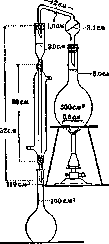
3. The Reichert-Meissl number is the number of cm3 of n/10 solution of caustic alkali required to neutralize the volatile, water-soluble acids isolated from 5 g of F. Into a round-bottomed glass flask of 300 cm3 capacity, exactly 5 g of melted and filtered F., 20 g (or 16 cm3) of glycerin are weighed and 2 cm3 of a solution of caustic soda (1+1) are added; the mixture is heated on a small flame to boiling with constant shaking; after 5-12 min. of heating, almost all the water evaporates and saponification ends, the mass of soap becoming transparent and collecting at the bottom of the flask. To the soap cooled to 80-90°, 90 cm3 of freshly boiled hot water (about 90°) are added; if not all the soap dissolves, the mixture is heated on a water bath until complete dissolution and 50 cm3 of diluted (25 cm3 in 1 l) sulfuric acid are added; then 0.6-0.7 g of coarsely crushed pumice (to avoid bumping during boiling) is poured into the flask and the flask is connected with a vertically placed condenser (see in Fig. 2 the required dimensions and arrangement of the apparatus). Within 18-21 min., 110 cm3 of distillate are distilled into a measuring flask, the temperature of the distilling liquid not exceeding 23°. The flask with the distillate is placed for 10 min. in water at 15°, and then, after plugging the flask with a stopper, the distillate is shaken and exactly 100 cm3 are filtered into a measuring flask; this filtrate is titrated with n/10 alkali (indicator phenolphthalein) until a non-disappearing pink coloring appears within 2 min. To the volume of caustic alkali used for titration, 1/10 of it is added, since only 100 g were taken from the 110 cm3 of distillate for titration; the found sum is the Reichert-Meissl number. Since this determination is not absolutely, but only relatively accurate, for obtaining quite comparable results it is necessary to strictly adhere to the prescribed methodology of determination and the arrangement of all parts of the distillation. The Reichert-Meissl number for most F. is below 1; when the F. becomes rancid, this number increases. The Reichert-Meissl number reaches its greatest value in the following fats: dolphin fat—22-47; butter—22-33; coconut oil—7.5; palm kernel oil—5.0; croton oil—13.0; rabbit fat—5.6.
4. The Polenske number shows how many cm3 of n/10 alkali are required to neutralize the volatile, water-insoluble fatty acids obtained from 5 g of fat during the determination of the Reichert-Meissl number. The determination of the Polenske number represents a continuation of the determination of the Reichert-Meissl number. The flask with the condenser in 110 cm3 at the end of the distillation for the Reichert-Meissl number is removed and replaced under the condenser with a 25 cm3 measuring cylinder for collecting all that flows from the condenser after the distillation is stopped; what is collected in the cylinder is poured onto the same filter through which the distillate was filtered for the determination of the Reichert-Meissl number; then the condenser, cylinder and flask used as receiver are rinsed three times with 15 cm3 of water each; the wash waters are each time poured onto the same filter; after the washing is completed, the funnel with the filter and the fatty acids on it is transferred to a dry flask and the receivers, condenser and filter are washed three times with 15 cm3 portions of 90% alcohol, free from free acids. The collected alcoholic solution of volatile, water-insoluble liquid acids is titrated (with phenolphthalein) with n/10 alkali. The number of cm3 of n/10 alkali required for this titration represents the Polenske number.-When making this, only relatively accurate determination, it is necessary to strictly adhere to the described instructions for determining the Reichert-Meissl and Polenske numbers. Polenske number: for pure butter .... not more than 1.5 for that with an admixture of 10% coconut,
» » 5.5 » pure coconut oil........& 9.0 5. Iodine number of f. [Hübl's number (blabla)] shows how many g of iodine are added to 100 g of f. The determination of the iodine number is based on the ability of i unsaturated fatty acids to add 2 halogen atoms at the double bond site, but it is undoubtedly that substitution processes by halogens in saturated groups also take place here. The iodine number, indicating the amount of unsaturated fatty acids in f., allows one to judge the purity and naturalness of f., as well as the possibility of f. drying, rancidity, etc. The Ph. VII prescribes determining the iodine number according to Hübl, who proposed reacting with a mixture of alcohol solutions of iodine (25 g + 500 cm3) and mercuric chloride (30 g + 500 cm3); the solutions are stored separately and mixed no earlier than 2 days before applying the mixture, since in the first 2 days the iodine titer changes very strongly. Iodine reacts with mercuric chloride according to the equation: HgCl2+2J2=HgJ2+2JCl; the resulting iodine chloride is the vigorous active principle of Hübl's mixture. The presence of substitution processes during this reaction alongside the addition process and the probable reaction of not only iodine, but also chlorine, make it impossible to obtain strictly theoretical results, create the conventionality of the iodine number, and force strict adherence to the methodology in order to obtain constant and comparable data. In addition to the iodine mixture, when determining the iodine number, the following reagents are also necessary: 1) n/10 hyposulfite solution; 2) chloroform; 3) 10 percent potassium iodide solution; 4) 0.5% starch paste, well boiled and filtered. To determine the iodine number, melted and filtered f. is weighed (accurately): solid—0.8–1 g, liquid non-drying—0.3–0.4 g, drying—0.15–0.18 g (linseed oil, fish oil). Portions of f. are dropped into a glass-stoppered flask with a capacity of 300–500 cm3, dissolved in 15 cm3 of chloroform, and, having added exactly 30 cm3 of the iodine mixture, left to stand in diffused light for two hours, and in the case of drying oils and fish oil—for 24 hours, since drying f. contain unsaturated acids with 2–3 double bonds, and in the second and third bonds, halogen addition proceeds more difficultly than in the first. If it is noticed that the mixture of the fat solution with the iodine mixture becomes cloudy, then chloroform is added until clear. If the mixture discolors, the determination is repeated with a smaller portion of f. The excess of iodine remaining by the end must be at least 1/3 (better about 1/2) of the taken amount. At the end of the standing, 15 cm3 of a 10% potassium iodide solution and 100 cm3 of water are added; if a red precipitate of mercuric iodide separates out, then more potassium iodide solution is added until the precipitate dissolves. Then the excess iodine is titrated with a n/10 sodium thiosulfate solution (indicator—starch paste) with vigorous shaking. The initial content of titratable iodine in the 30 cm3 of iodine mixture taken for standing is determined by the same titration before or after determining the excess J in the mixture with fat that had stood. In the case of drying oils, as well as fish oil, the titer of the iodine mixture is determined 2 times: at the beginning and at the end of standing with f., and the average of these titrations is taken as the titer of the iodine mixture. Subtracting from that amount of iodine which was contained in 30 cm3 of the iodine mixture, that quanti-
Composition of fats used in medicine Specific gravity Fats at 15° Fish (cod) liver oil at other temperatures Melting point (in degrees Celsius) fat fatty acids fat Linseed oil . . Hemp oil Castor » Croton » 0.922/0.935 0.922/0.938 0.925/0.935 0.959/0.973 At 99° to water I at 15° 0.909 j i
!
» . . . . Cottonseed
:
!
|
:
12.1/13.6 Polenske number Acid number of fresh fat Fat composition (acids included in the fat glycerides) 220/245 23/32.7 0.6/5.4 0.8/8.4 1.2/9.5 Composition is inconstant and diverse. There is always palmitin and stearin up to 4%, oleic and other series CHn-2O2, zoomaric, jecoric, therapy, and other acids Linseed, linolenic, arachidic, stearic, palmitic acids Linseed, linolenic, isolinolenic, palmitic, stearic acids 3.0/3.1 i Ricinoleic, oleic, stearic acids Up to 1.5 Means amount of free acids 0.2/1.0 242/268
' 6.5/8.5 204/232 193/199 193/200 191/200 192/196 191/203 188/195.4 188.0/193.1 188.6/188.2 174.5/203.0 187.0/197.0 188.0/194.0 189.0/197.0 191.0/198.0 148.0/174.0 219.0/222.0 3.0 0.3/2.0 0.3/0.9 0.2/0.5 0.3 0/2.0 Means amount of free acids 0.4/4 Stearic, palmitic, myristic, lauric, valeric, butyric, acetic, formic, oleic, tiglic, crotonolic (active principle) acids Glycerides: butyrin (6.5%), caproin (3.8%), caprinin, laurin (15%), myristin (11.5%), palmitin (15.7%), stearin (8.4%), olein (31%), linolen (5%), decenoyl and hexadecenoyl glycerides Myristic, lauric, oleic, caprylic, capric, caproic, palmitic and stearic acids. Palmitic, gynocardic acids. The oil exhibits exceptionally large rotation +46/+59 Stearic (6–7%), palmitic (17–21%), oleic (67–87%) acids Oleic (50%), stearic, palmitic acids 1.0/5.0 i Oleic, stearic, palmitic acids 1.4/1.8 0.2/0.8 0.2/1.2
1.4/3.5 | I May contain: means amount of free acids, 16.0/24.0 7.5/20.0 Stearic, palmitic, arachidic, linseed acids. j Almost solely oleic acid Predominantly oleic acid Predominantly oleic, then palmitic, arachidic, and linseed acids Oleic, stearic, palmitic, linseed acids Oleic, linseed, palmitic, arachidic acids Oleic, linseed, linolenic, isolinolenic, palmitic, stearic acids Olein (26.5%), linseed (46.5%), palmitic and stearic acids (22–30%). The last two acids are removed during purification by winterization Myristic, oleic, linseed acids and from 4% to 12% essential oil Palmitic, japanic, free palmitic and some volatile acids ty of iodine which remained in 30 cm3 of the iodine mixture after standing with f., the amount of iodine bound by the fat sample is found. Converting the bound amount of iodine in milligrams per 100 mg of f. sample, the iodine number of the fat is obtained. Results closer to theoretical data and much faster are obtained when determining the iodine number with bromo-iodine and purely bromine mixtures; in the latter case, the bromination results are converted to iodine. With all bromometric and bromo-iodometric mixtures, one should keep in mind the high activity of bromine, especially in the light, and the possibility of the formation of bromo-substituted products. Of these mixtures, officially adopted are: 1) Hanus's reagent (Hanus), used in Switzerland in the study of foodstuffs, and 2) Winkler's reagent, indicated in the latest, VI edition of the German Pharmacopoeia. Hanus's reagent contains 20 g of iodine bromide in 1 l (13 g of iodine is drenched with 50 cm3 of acetic acid, 8 g of bromine is added, and the mixture is brought to 1 l with glacial acetic acid). Hanus's reagent is indefinitely stable. Standing with this reagent is reduced to 15 min.; for drying oils and fish oil, two hours are required. The magnitude of the numbers depends on the excess of reagent, as in Hübl's method, but the data are more constant. Winkler's reagent represents exact solutions of potassium bromide and potassium bromate, which are stored separately and do not change their titer. With this method of determination, one has to reckon with the sensitivity of the reaction to light. Standing lasts at most 2 hours. This method, modified so that the back titration of the excess bromine is carried out iodometrically (with potassium iodide), gives values close to theoretical and is not inferior in this respect to Hanus's method.—Hehner's number indicates the amount of insoluble fatty acids contained in 100 parts of f. To determine it, f. is saponified with an alcoholic alkali solution, the alcohol is evaporated on a water bath, the soap is decomposed by acid, the liberated fatty acids are collected and thoroughly washed on a filter, dried, and weighed. This determination has no great practical significance. (Determination of f. in tissues—see Histological technique.) N. Kornilov.
Related articles
Mentioned in
Cite this page
“Fats.” Soviet Medical Encyclopedia. English translation of Bolshaya Meditsinskaya Entsiklopediya, 1st ed. (Moscow, 1928–1936), ed. N. A. Semashko. https://sovietmedicalencyclopedia.pages.dev/article/fats/