Canal Rays
Historical document, translated for reference. It reflects medical knowledge of the 1920s–30s and is not medical advice.
Summary
Canal rays are positively charged particles discovered by Goldstein in cathode ray tubes, consisting of atoms or molecules from the gas inside the tube. These rays were studied for their properties and used to determine particle velocities and masses, leading to the discovery of isotopes.
Encyclopedia article (1928–1936)
Canal rays, rays discovered by Goldstein in specially designed cathode tubes. If one prepares an evacuated tube with anode A and cathode K (fig. 1), made from a perforated metal plate, then when an electric current from a high-voltage battery or induction coil is closed, cathode rays KS travel from the cathode toward the anode, causing characteristic fluorescence on the glass walls near A. In the space KP, rays T pass through the holes in the cathode, called canal rays, having a characteristic appearance and differing significantly in external appearance from cathode rays. These rays possess the spectrum of the gas in which the discharge occurs. The investigation of the properties of canal rays and the study of their behavior in magnetic and electric fields belong to Wilhelm Wien and J.J. Thomson. This study showed that canal rays consist of particles that almost always have a positive charge and represent atoms or molecules of gases inside the tube.
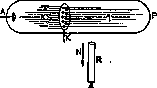
The characteristic method for studying the velocity of canal rays was developed by Stark, based on the optical Doppler principle. According to Stark's method, observation of canal rays is performed as follows. The spectrum of canal rays is observed either in the direction of arrow M in fig. 2 using spectroscope L or in the direction of arrow N using spectroscope R. When observing in the direction of arrow M, particles flying toward the spectroscope are observed; when observing in direction N, particles flying past the spectroscope in a direction perpendicular to the line of sight are observed. In these observations, different data are obtained in the spectroscopes placed at M and N. Let the gas in the tube give a spectral line a (fig. 2). Particles flying toward the spectroscope give a shift of the spectral line a toward the violet part of the spectrum (line b). The study of the position of spectral lines when observing canal rays in M and N allows determination of the velocity of canal rays, which can also be determined by Wien's method from the deflection of canal rays in magnetic and electric fields. The results obtained by Stark's method fully agree with what Wien's method gives.
For determining the mass of canal ray particles, J.J. Thomson developed the remarkable parabola method. Its essence consists in that canal rays are subjected to the action of electric and magnetic fields arranged so that the particles receive deflection in mutually perpendicular directions. In this case, as theory and experience show, a very thin beam of canal rays spreads out, and on a photographic plate placed perpendicular to the original beam, traces are obtained in the form of a series of parabolic segments. Each parabola corresponds to particles having the same mass but different velocities. Thus, the composition of the residual gas in a discharge tube can be subjected to chemical analysis using canal rays. This method, significantly improved by Thomson's pupil Aston, currently allows determination of the true masses of atoms with accuracy up to one ten-thousandth. According to Aston, one can determine the atomic weight of each type of atom present in a gas mixture, and thus Aston managed to prove that ordinary chlorine, in which the atomic weight relative to hydrogen is 35.45, consists of a mixture of atoms having individually atomic weights 35 and 37. Canal rays thus allow establishment of the existence of isotopes (see). Canal rays owe their origin to the fact that positive ions formed during discharge in a gas, under the action of an electric field, are directed toward the cathode and, passing through its holes, form canal rays. Close to canal rays are the alpha rays of radium, which create thermal effects in radium. Finally, positive rays analogous to canal rays, according to research by Størmer and Vegard, should play an enormous role in the formation of auroras. The characteristic spectra of auroras correspond to the formation of canal rays in the higher layers of the atmosphere.
Related articles
Mentioned in
Cite this page
“Canal Rays.” Soviet Medical Encyclopedia. English translation of Bolshaya Meditsinskaya Entsiklopediya, 1st ed. (Moscow, 1928–1936), ed. N. A. Semashko. https://sovietmedicalencyclopedia.pages.dev/article/canal-rays/