Alphascop
Historical document, translated for reference. It reflects medical knowledge of the 1920s–30s and is not medical advice.
Summary
The Alphascop is an instrument designed for detecting radioactivity in minerals. It operates on the principle that zinc sulfide (ZnS) fluoresces when struck by alpha rays, allowing measurement of radioactivity based on the intensity of the flashes observed.
Encyclopedia article (1928–1936)
ALPHASCOP (of Merezhitsky), proposed for detecting radioactivity in minerals; it is based on the property of zinc sulfide (ZnS) to luminesce when alpha rays strike it, and consists of two cylinders, A and B, that fit into each other.
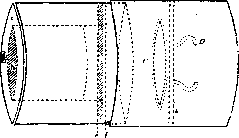
Alphascop of Merezhitsky. (see illustration); cylinder B has clips L and a cup C, in which the mineral to be examined is placed. Cylinder A contains a glass plate e, coated with ZnS, protected from daylight by a removable screen f and a removable cover g, under which there is a magnifier h. When the mineral or sand to be examined is placed in cylinder B, the latter is fitted onto cylinder A, moved forward to the screen, after which the screen is removed and the cover g is removed; one looks through the magnifier to see if any flashes from the ZnS are visible: the more flashes observed, the more radioactive the mineral.
Related articles
Mentioned in
Cite this page
“Alphascop.” Soviet Medical Encyclopedia. English translation of Bolshaya Meditsinskaya Entsiklopediya, 1st ed. (Moscow, 1928–1936), ed. N. A. Semashko. https://sovietmedicalencyclopedia.pages.dev/article/alphascop/