Cottrell-Moeller Method
Historical document, translated for reference. It reflects medical knowledge of the 1920s–30s and is not medical advice.
Summary
The Cottrell-Moeller method is a technique for cleaning gases from dust and fog using electrostatic precipitation. It involves passing gases through special apparatus where they undergo ionization and exposure to strong electric fields.
Encyclopedia article (1928–1936)
COTTRELL-MÖELLER METHOD (F. G. Cottrell, E. Möeller) for cleaning gases from dust and fog (in English literature often called the Lodge-Cottrell method) consists in passing the gas to be cleaned through special apparatus (electrostatic precipitators), where it undergoes simultaneous ionization and exposure to a strong electric field. Essential parts of the C.-M. electrostatic precipitators are two systems of electrodes, one of which must have a significantly smaller surface than the other (for example, a system of wires suspended between metal plates). The electrodes are connected to a high-voltage current source. For gas ionization in the C.-M. method, the so-called "corona" discharge is used, which on the outside is characterized by the appearance of a violet glow at the electrodes with the smaller surface (wire) and a characteristic hissing sound, and from a physical standpoint - intense gas ionization. The gas to be cleaned is passed between the electrodes, with the dust particles settling on the electrodes with the larger surface (plates), while the gas exits the apparatus purified. According to their functions, one system of electrodes is called the "ionizing" and the other the "precipitating". - The physical phenomena that make up the C.-M. process are quite complex. Basically, the phenomenon consists of the fact that particles, finding themselves in an ionized gas, adsorb gas ions and acquire a charge of the same sign as the ionizing electrodes; while in an electric field, they begin to move toward the precipitating electrodes and are removed from the gas flow. The beginning of experiments on electrostatic precipitation of gases is dated to 1824, when mathematician Hohlfeld (M. Hohlfeld) in Leipzig made an interesting observation: a vessel filled with tobacco smoke suddenly becomes transparent if an electrode connected to the pole of an electrostatic machine is introduced into it. In 1883, this phenomenon was more thoroughly investigated by Lodge (O. Lodge), who precipitated smoke from tobacco, camphor, turpentine, MgO, NH4Cl, (NH4)2SO3, P2O5, burning paper, lead, and zinc. However, the successful practical application of this method became possible only after the work of Cottrell, begun in 1905-06 in America, and Möeller, begun in 1907 in Germany. At present, three types of electrostatic precipitators have become widespread: 1. Tubular type, the device of which is shown in Fig. 1 (firm Lurgi, Germany). The precipitating electrodes are in the form of tubes, along the axes of which are stretched ionizing electrodes in the form of wires. The most common dimensions: length - 3-4 m, diameter 25-30 cm, wire diameter 1-2 mm. The precipitating and ionizing electrodes are insulated from each other by means of special insulators. Normally there are two groups of tubes (2 and 3). The contaminated gas enters the upper chamber (1), passes successively through the two groups of tubes (2 and 3), and exits purified through the exhaust shaft (4). The dust settled on the walls of the tubes either falls off by itself and enters the field bunkers (5) or is removed by tapping the tube walls manually or with special rappers. It should be noted, however, that with certain types of dust, the removal of already settled particles from the tube walls may present considerable difficulties. This type of electrostatic precipitator is mainly used for cleaning blast furnace gases. It is characterized by very complete gas purification (up to 99.9%). 2. Plate, or plate apparatus (Fig. 2). The precipitating electrodes are in the form of planes, made in the form of solid plates (2), between which are placed ionizing electrodes in the form of a system of parallel wires (3). The electrodes are enclosed in a chamber, which occupies a relatively small area compared to the tubular apparatus. The contaminated gas enters through opening 1 and exits purified through 4. The precipitated impurity exits through opening 5. Plate apparatus are especially suitable in cases where it is desirable to avoid cooling the gas. The degree of purification is lower than in tubular apparatus. Plate apparatus have found particular application in the separation of liquid particles (acid fumes, etc.). 3. Grid filter is very similar to the plate apparatus. The precipitating electrodes are given the form of flat or slightly wavy grids. The gas to be cleaned is caused to move either parallel to the planes of the electrodes (as in the plate apparatus) or perpendicular to them. As a source of high voltage current for industrial electrostatic precipitators, at present exclusively high-voltage transformers are used. As experience shows, when using direct current for electrostatic precipitation, a much greater degree of gas purification is obtained and the danger of complete breakdown of the gas in the electrostatic precipitator (transition of the corona discharge to a spark or arc) is reduced, which disrupts the electrostatic precipitation process. Therefore, a current rectifier must be introduced into the electrostatic precipitator circuit. At present, for this purpose, almost exclusively rotating mechanical rectifiers are used, which have proven to be the most convenient and cheapest for operation in a factory environment (Fig. 3). Fig. 3 shows the basic circuit diagram for connecting an electrostatic precipitator. T-transformer, R-rectifier, E-electrostatic precipitator. To eliminate the danger to operating personnel associated with the use of high voltage, the body of the electrostatic precipitator (and the precipitating electrodes) are grounded. Advantages and disadvantages of the C.-M. method. The main advantage of the C.-M. method is the possibility of very complete purification of gas from any dust-like impurity, which cannot be said about all other known methods of gas purification. Furthermore, electrostatic precipitators have very little resistance to gas movement and thus allow a significant reduction in the power of exhaust fans of ventilation systems. Among the known disadvantages should be mentioned the comparative complexity of the apparatus, requiring systematic care and supervision (though very little), as well as rather high initial costs. In operation, electrostatic precipitators in most cases prove to be cheaper than other installations. The scope of application of the C.-M. method is extremely extensive. In industry, the use of electrostatic precipitators is extremely important from a sanitary point of view. In a number of industries with waste gases, many tons of various substances are carried away in a finely dispersed state, which, if not retained, contaminate the atmosphere and disrupt the proper operation of the ventilation system, pollute the surroundings, etc. From an economic point of view, the use of electrostatic precipitators makes it possible to utilize a very significant amount of products that, if not retained, are uselessly lost. For these purposes, the C.-M. method is currently successfully applied in the following industries: in the chemical industry in the production of acids (cleaning gases from roasting furnaces, separation of arsenic and selenium in the contact process, cleaning of concentration gases); in the production of soda, potash, zinc white, artificial fertilizers, dry milk, paints, for fractional separation of resins and oils, in the cellulose industry, in metallurgy-for retaining valuable metallic dust and metal oxides; in the cement, gypsum, and lime industries for cleaning flue gases; in the textile industry; in briquetting of coal, etc. Thanks to the very complete gas purification with electrostatic precipitators, it is also possible in many cases to implement a recirculation ventilation system, which leads to savings on heating of industrial premises. The question of electrically cleaning blast furnace and generator gases has acquired great independent importance, to which very high purity requirements are made. The C.-M. method can also be used for gas sterilization. As experiments have shown, air that has passed through an electrostatic precipitator turns out to be completely freed from fungi and bacteria. In recent years, the C.-M. method has begun to be successfully applied in occupational hygiene practice for the purpose of measuring air dustiness. A miniature electrostatic precipitator, suitably adapted (e.g., a design proposed by the State Scientific Institute of Labor Protection), due to its very perfect, practically 100% dust collection, proves to be very suitable for this purpose. In laboratory practice, the C.-M. method in many cases proves convenient for studying the properties of aerosols.
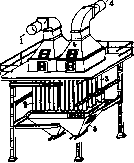
Figure 1. 1-2 mm. The precipitating and ionizing electrodes are insulated from each other by means of special insulators. Normally there are two groups of tubes (2 and 3). The contaminated gas enters the upper chamber (1), passes successively through the two groups of tubes (2 and 3) and exits purified through the exhaust shaft (4). The dust settled on the walls of the tubes either falls off by itself and enters the field bunkers (5) or is removed by tapping the tube walls manually or with special rappers. It should be noted, however, that with certain types of dust, the removal of already settled particles from the tube walls may present considerable difficulties. This type of electrostatic precipitator is mainly used for cleaning blast furnace gases. It is characterized by very complete gas purification (up to 99.9%). 2. Plate, or plate apparatus (Fig. 2). The precipitating electrodes are in the form of planes, made in the form of solid plates (2), between which are placed ionizing electrodes in the form of a system of parallel wires (3). The electrodes are enclosed in a chamber, which occupies a relatively small area compared to the tubular apparatus. The contaminated gas enters through opening 1 and exits purified through 4. The precipitated impurity exits through opening 5. Plate apparatus are especially suitable in cases where it is desirable to avoid cooling the gas. The degree of purification is lower than in tubular apparatus. Plate apparatus have found particular application in the separation of liquid particles (acid fumes, etc.). 3. Grid filter is very similar to the plate apparatus. The precipitating electrodes are given the form of flat or slightly wavy grids. The gas to be cleaned is caused to move either parallel to the planes of the electrodes (as in the plate apparatus) or perpendicular to them. As a source of high voltage current for industrial electrostatic precipitators, at present exclusively high-voltage transformers are used. As experience shows, when using direct current for electrostatic precipitation, a much greater degree of gas purification is obtained and the danger of complete breakdown of the gas in the electrostatic precipitator (transition of the corona discharge to a spark or arc) is reduced, which disrupts the electrostatic precipitation process. Therefore, a current rectifier must be introduced into the electrostatic precipitator circuit. At present, for this purpose, almost exclusively rotating mechanical rectifiers are used, which have proven to be the most convenient and cheapest for operation in a factory environment (Fig. 3).
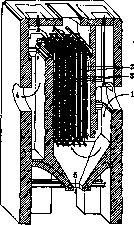
Figure 2.
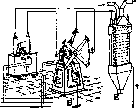
Figure 3.
shing degree of gas purification and reduces the danger of complete breakdown of the gas in the electrostatic precipitator (transition of the corona discharge to a spark or arc), which disrupts the electrostatic precipitation process. Therefore, a current rectifier must be introduced into the electrostatic precipitator circuit. At present, for this purpose, almost exclusively rotating mechanical rectifiers are used, which have proven to be the most convenient and cheapest for operation in a factory environment (Fig. 3). On Fig. 3 is shown the basic circuit diagram for connecting an electrostatic precipitator. T-transformer, R-rectifier, E-electrostatic precipitator. To eliminate the danger to operating personnel associated with the use of high voltage, the body of the electrostatic precipitator (and the precipitating electrodes) are grounded. Advantages and disadvantages of the C.-M. method. The main advantage of the C.-M. method is the possibility of very complete purification of gas from any dust-like impurity, which cannot be said about all other known methods of gas purification. Furthermore, electrostatic precipitators have very little resistance to gas movement and thus allow a significant reduction in the power of exhaust fans of ventilation systems. Among the known disadvantages should be mentioned the comparative complexity of the apparatus, requiring systematic care and supervision (though very little), as well as rather high initial costs. In operation, electrostatic precipitators in most cases prove to be cheaper than other installations. The scope of application of the C.-M. method is extremely extensive. In industry, the use of electrostatic precipitators is extremely important from a sanitary point of view. In a number of industries with waste gases, many tons of various substances are carried away in a finely dispersed state, which, if not retained, contaminate the atmosphere and disrupt the proper operation of the ventilation system, pollute the surroundings, etc. From an economic point of view, the use of electrostatic precipitators makes it possible to utilize a very significant amount of products that, if not retained, are uselessly lost. For these purposes, the C.-M. method is currently successfully applied in the following industries: in the chemical industry in the production of acids (cleaning gases from roasting furnaces, separation of arsenic and selenium in the contact process, cleaning of concentration gases); in the production of soda, potash, zinc white, artificial fertilizers, dry milk, paints, for fractional separation of resins and oils, in the cellulose industry, in metallurgy-for retaining valuable metallic dust and metal oxides; in the cement, gypsum, and lime industries for cleaning flue gases; in the textile industry; in briquetting of coal, etc. Thanks to the very complete gas purification with electrostatic precipitators, it is also possible in many cases to implement a recirculation ventilation system, which leads to savings on heating of industrial premises. The question of electrically cleaning blast furnace and generator gases has acquired great independent importance, to which very high purity requirements are made. The C.-M. method can also be used for gas sterilization. As experiments have shown, air that has passed through an electrostatic precipitator turns out to be completely freed from fungi and bacteria. In recent years, the C.-M. method has begun to be successfully applied in occupational hygiene practice for the purpose of measuring air dustiness. A miniature electrostatic precipitator, suitably adapted (e.g., a design proposed by the State Scientific Institute of Labor Protection), due to its very perfect, practically 100% dust collection, proves to be very suitable for this purpose. In laboratory practice, the C.-M. method in many cases proves convenient for studying the properties of aerosols.
Related articles
Cite this page
“Cottrell-Moeller Method.” Soviet Medical Encyclopedia. English translation of Bolshaya Meditsinskaya Entsiklopediya, 1st ed. (Moscow, 1928–1936), ed. N. A. Semashko. https://sovietmedicalencyclopedia.pages.dev/article/cottrell-moeller-method/