Ionization of Gases
Historical document, translated for reference. It reflects medical knowledge of the 1920s–30s and is not medical advice.
Summary
This article explains the physical process of gas ionization, where neutral molecules become charged ions through external agents like X-rays or flames, rendering the gas electrically conductive. It details the mechanisms of ion recombination, impact ionization, and saturation current, while also discussing practical applications such as industrial gas cleaning and medical treatments like static showers and ionized air therapy.
Encyclopedia article (1928–1936)
IONIZATION OF GASES, the appearance in a gas under the influence of various external agents (X-rays, radium rays, flame, etc.) of charged particles—molecules and groups of molecules called ions (more precisely, gas ions, to distinguish them from electrolytic ions of solutions). Gases are generally insulators. Objects charged with electricity placed in a gas retain their charge for a long time. However, one only needs to illuminate the gas with X-rays or simply place a flame near a charged body, and the charge begins to decrease more or less rapidly; the gas becomes a conductor of electricity. All these phenomena of electrical conductivity of gases, which at first glance appear very complex, received a simple interpretation once it was clarified that the electrical conductivity of gases, like the electrical conductivity of solutions of salts and other electrolytes, is caused by the appearance in the gas of carriers of electricity—ions. The mechanism of ionization of gases reduces to the following. Neutral molecules and atoms contain an equal amount of positive electricity in the form of central nuclei and negative electricity in the form of electrons surrounding these nuclei (see Atom). Under the influence of one cause or another, an electron can be torn away, and then the remaining molecule acquires a positive charge; the torn-away electron, in turn, does not remain free but is quickly captured by a neutral molecule, imparting a negative charge to it. Thus, a pair of oppositely charged ions appears. Usually, however, the process is not limited to this. 1. Each formed molecular ion attracts a certain number of neutral molecules to itself, forming an entire ionic complex. 2. Ions of opposite signs, colliding with each other, neutralize each other, as a result of which the original neutral
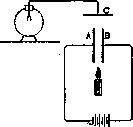
molecules are obtained again (so-called recombination of ions). Thus, under stationary conditions, the quantity of ions in an ionized gas is determined by the dynamic equilibrium between the number of ions delivered by the ionizer and the number of ions disappearing due to recombination. The following simple experiment can serve as an illustration of the fact that the electrical conductivity of a gas is caused by the appearance of charged carriers of electricity in it. A small flame burns between two metal plates (Fig. 1); above these plates is a small metal disc O, charged and connected to an electroscope. Under the action of the flame, a large number of ions are formed in the air, which are carried upward by the stream of heated air and
quickly discharge the disc. The leaves of the electroscope fall. However, if one excites a sufficiently intense electric field between plates A and B, by charging one with + and the other with - electricity, the discharge of the disc instantly ceases. The reason is that the + charged plate attracts all - charged ions from the passing stream of air, and the - charged plate attracts all + charged ions. If, using a similarly constructed device, we measure the ionization current in the gas between the plates depending on the potential difference between these plates, we will obtain the following result. Initially, at small potential differences, the current strength increases in direct proportion to the potential difference (Ohm's law); with an increase in the potential difference, the increase in current strength becomes slower, and finally, a certain constant current strength is established, which does not depend on further increases in potential. This is the so-called saturation current, the establishment of which is explained by the fact that the ionizer creates exactly as many ions per unit of time as the charged plates "suck out." This phenomenon is of enormous importance for the theory of measurements of X-rays and rays of radioactive substances, as the saturation current is a measure of the intensity of the ionizer. At very strong electric fields, the current strength begins to increase again, and quite rapidly (Fig. 2). This is explained by the fact that the primarily formed ions, under the action of a very intense electric field, acquire such a high velocity that they, in turn, are able to destroy molecules during collisions, creating new ions; the latter are again accelerated by the electric field and also create new ions, etc. In this way, an avalanche of ions is formed, which causes a sudden strong increase in the electrical conductivity of the gas, which, with a further increase in the electric field, may be followed by an electrical breakdown of the gas; the discharge then takes the form of a spark. The described phenomenon is called impact ionization. The simplest method of obtaining impact ionization consists of charging a point, for example, by connecting it to the pole of an electrostatic machine. The electric field around the point is extremely uneven, and directly at the point itself, it changes so rapidly that the electric force, proportional to the potential gradient, turns out to be very significant. As a result of this, the few ions always present in the air receive such acceleration that they can excite impact ionization. At the same time, ions of the opposite sign are immediately absorbed by the point, which is thus always surrounded only by ions having a charge of the same sign as it. These latter are repelled from the point and, dragging air molecules with them due to internal friction, form the ionic wind used in electromedicine in the form of a so-called static shower.
Among the properties of ions, one should mention their ability to condense vapors on themselves, as well as their sharply expressed ability for adsorption. Air devoid of dust and ions can be significantly supersaturated with vapors. If such air is ionized, condensation of vapors occurs immediately; each ion serves as a center around which a droplet condenses. Such condensation of vapors on ions plays a prominent role in the physics of the atmosphere, where a large number of ions are created primarily by the ultraviolet radiation of the sun. The adsorption of ions has recently been widely used in industry and sanitary engineering for the electrical cleaning of gases. If a point connected to the pole of an electrostatic machine is introduced into a vessel filled with smoke, the smoke immediately settles. This is explained by the fact that the ions, which arise in abundance at the point as a result of impact ionization, are adsorbed by the solid particles of smoke; at the same time, the particles that have received opposite charges in this way stick together, forming such significant clumps that they settle downward under the action of gravity. Practically, however, modern cleaning devices are given the shape of a cylindrical capacitor; the gas to be cleaned enters a pipe, along the axis of which a thin wire is stretched. A very intense electric field of constant direction is created between the pipe and the wire, under the influence of which impact ionization and subsequent charging of suspended particles occur. Cleaning in this case is caused not so much by the formation of clumps and their falling downward as by the deposition of charged particles on the walls, to which these particles are attracted. The sanitary-hygienic significance of such devices is completely obvious. Their role is especially great in industries of a chemical nature. The quantity of foreign, in most cases extremely harmful, ingredients with which large industries saturate the air can be seen from the following example: one of the largest electrical cleaning devices in the world is installed in Spain at a plant dealing with lead processing. The cleaning of gases at this plant yields 12,000 kg of solid sediment daily, which consists 90% of lead. Ionization of gases is also used at the present time in medicine. For example, ionized air is used in the treatment of tuberculosis, and the results described by various authors are of considerable interest.
Related articles
Mentioned in
Cite this page
“Ionization of Gases.” Soviet Medical Encyclopedia. English translation of Bolshaya Meditsinskaya Entsiklopediya, 1st ed. (Moscow, 1928–1936), ed. N. A. Semashko. https://sovietmedicalencyclopedia.pages.dev/article/gas-ionization/