Ionic Theory of Excitation
Historical document, translated for reference. It reflects medical knowledge of the 1920s–30s and is not medical advice.
Summary
This article outlines the ionic theory of excitation, which posits that tissue excitation occurs due to changes in ion concentration. It details the historical development of the theory, its application to sensory processes and muscle contraction, and the mathematical laws governing the effects of electrical currents on nerves and muscles.
Encyclopedia article (1928–1936)
IONIC THEORY OF EXCITATION, a theory based on the concept that tissue excitation can occur only if the concentration of ions in the tissue changes. The foundations of the theory of nerve and muscle excitation and the first experiments related to their boundary stimulation belonged to Walther Nernst and Jacques Loeb. The generalization of these concepts to vision, hearing, taste, smell, muscle contraction, the propagation of excitation along a nerve, electrotonus, processes in centers, and finally to the fundamental laws of excitation (the Weber-Fechner law) was carried out by Lazarev, who introduced the very term Ionic Theory of Excitation. The concept that tissue excitation can occur only if the concentration of ions in the tissue changes is connected to an even more general concept that physical-chemical reactions in a liquid medium lead to changes in the quantity of ions in the medium, and a change in the ionization of the medium must lead to the occurrence of reactions in the medium. Proceeding from the most general assumptions, namely that ions can act not only in an excitatory but also in an inhibitory manner and that their concentration in tissues and organs is small, one can derive a general law of excitation that relates the concentrations of excitatory and inhibitory ions in the form of a specific mathematical formula. The resulting formula for one type of excitatory ion shows that excitation is obtained when the ion concentrations exceed a certain limit. Suppose there is a nerve or muscle to which electrodes E1 and E2 of an irritating current are applied (Fig. 1). The only change that an electric field can cause in tissues is the transport of ions. If there is a semipermeable partition S between the electrodes, then ions that cannot pass through the partition accumulate near it when current passes. The concentration of these ions, depicted in the figure by dots, changes near the partition, and the change in concentration serves as the beginning of phenomena associated with excitation and changes in the state of aggregation in the protein medium. In the space between the partition S and the electrode E2, the ions and the salts forming them diffuse according to Fick's law. The salt accumulating near S diffuses toward E1 in the direction of the arrow. The amount of salt supplied by the current and the salt removed due to diffusion depends on the frequency of oscillations of the alternating current, and with low-frequency currents (up to 1,000 periods per second), the amount of salt supplied by the current at a certain moment is equal to the amount of salt removed by diffusion. In this case, the problem of determining the salt concentration can be brought to a conclusion, and two laws of the action of current on nerves and muscles are obtained. These laws show that with a constant current, currents for which the energy delivered during the time of action is the same act equally. Alternating currents must deliver the same amount of energy during one period (Nernst's law in Lazarev's formulation). If the currents are very frequent (from 50,000 to 350,000 periods per second), then Nernst's laws are replaced, as Lazarev showed, by the following law: with the same action of the current, the quantity of electricity delivered by the current to the partition S during one period of alternating current or during the time of action of a constant current is the same. The laws indicated above can be derived under the assumption that there is only one sort of ion. It is possible, however, to assume that there is a whole series of ions; in this case, one can find the same laws and discover the role of the cathode and anode in excitation. If a constant current is applied to nerves, then due to the greater mobility of the excitatory ions—potassium ions—they will accumulate in the cathode region in a greater quantity than calcium ions, which act in an inhibitory manner. The change in the ratio between the quantity of calcium ions and potassium ions manifests itself in the cathode region in that the application of a weak additional electric current can cause the appearance of excitation in this area, while in a non-polarized area, a more significant current is required for excitation. Thus, an increase in sensitivity is obtained at the cathode, and a decrease in sensitivity is obtained at the anode due to the greater outflow of potassium ions. These laws, derived theoretically, were previously established empirically by Pflüger. With an increase in the strength of the constant current, the increased excitability leads to the excitation of nerves, which occurs upon closing at the cathode, and upon opening the current, conversely, at the anode. The laws of polar excitation were also discovered empirically earlier. Ionic theory of muscle contraction. Questions related to boundary excitability of muscles lead to the study of phenomena of muscle contraction. From the point of view of the Ionic Theory of Excitation, the process of muscle fiber contraction must be caused

Figure 2.
by a change in the quantity of ions arising in the region of individual contractile muscle elements under the influence of a reaction occurring in the muscle when excitation is applied via nerves. One can imagine a muscle fiber as a system consisting of 2 liquids (Fig. 2), of which one is present in a minimal quantity b, b, b and forms the walls of the cells in which the other liquid a, a, a is enclosed, possessing the property of liquid crystals, in which the molecules, depicted in the figure schematically by short lines, are located at the boundary of the surface (short lines in a) and which are, thanks to this, an anisotropic substance capable, upon the occurrence of a reaction in the liquid layer, of changing its shape due to changes in surface tension at their boundary. Changes during contraction will consist in the fact that individual muscle elements take on a shorter shape, the correctly arranged molecules in the boundary layer will diverge to a greater distance from each other (Fig. 3), and from this results a decrease in double refraction, which before contraction was sharply noticeable in the elements of the anisotropic substance. This decrease depends on the separation of the correctly oriented molecules. If one applies to a contracting muscle a force that would prevent its contraction, then the change in capillary forces at the boundaries of elements a will manifest itself in a change in the tension with which the muscle will act on external objects. At any given moment, the muscle will possess a different tension, and one can calculate the course of muscle tension over time. It is assumed that under the influence of excitation conducted along the nerve, lactacidogen begins to decompose and forms lactic acid, which in turn decomposes and yields carbonic acid. At the same time, along with the destruction of lactic acid (by its conversion into carbonic acid), there is also a new formation of lactacidogen. Based on such a representation, one can calculate the concentration of all substances and show that both lactic acid and carbonic acid can be the cause of the change in surface tension and contraction of muscle elements. In Fig. 4, a theoretical curve is given, with which the experimental curve obtained by recording isometric muscle contraction on a myograph fully coincides. If the contraction is isotonic in nature, i.e., the muscle shortens and lifts a certain load, then the contraction curve must change its shape and take on, as theory and experience show, the appearance depicted in the figure by the dashed curve. Ionic Theory of transmission of excitation along a nerve. The process that has arisen in the nerve at a specific point of application of excitation propagates in the form of an excitation wave along the nerve and creates the transfer of excitation. The transfer occurs due to special ionic processes leading to phenomena analogous to those that occur during the combustion of an explosive substance; from the point of view of chemical kinetics, the burning of a trail of gunpowder or the burning of a fuse is identical to the process of propagation of excitation along nerves. The degree of heating of both the fuse and the trail of gunpowder, just like the degree of nerve excitation and the number of accumulated ions at the site of excitation, does not affect the speed of the chemical process occurring in the system, which destroys all substances capable of reaction, and thus, the reaction that has arisen at one point of the nerve propagates along it, destroying all substances sensitive to excitation; after the passage of excitation, the nerve remains completely unexcitable for a short time. This law, derived theoretically from the phenomenon of the constancy of the speed of excitation and the invariability of the nature of chemical processes arising in the nerve, was discovered earlier empirically for the nerve and bears the name of the "all-or-nothing" law (see). This law, as indicated, is derived theoretically from the Ionic Theory of Excitation. Ionic Theory of peripheral vision. According to the concept of the Ionic Theory of Excitation, under the influence of incident light, the decomposition of a light-sensitive substance, the so-called visual purple, occurs. This decomposition causes in the sensitive substances located in the rods a reaction that produces ions, which create irritation of the nerve fiber endings. Along with this first process, there exists a reverse process of restoration of visual purple, occurring under the influence of pigment epithelium cells: this second process proceeds with different intensity in the dark and in the light. Based on the indicated representation, one can provide a general equation for the kinetics of the decomposition of visual purple, and by solving these equations, one can obtain
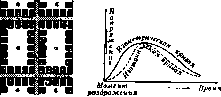
Figure 3.
Figure 4. for different cases of the action of light, the concentration of ions near the endings of the optic nerve. If, under other equal conditions, the concentration of ions reaches a certain value A, then excitation occurs, and this excitation will cause one and the same sensation, provided that everything else in the organism remains in an unchanged state. One can imagine the matter in such a way that one and the same process of purple decomposition is caused on one hand by light, and on the other by a mechanical, thermal, or some other process. Finally, one can imagine that ions are supplied directly by an electric

current, and if their quantity near the nerve ending is one and the same in all considered cases, then the sensation of light that results will be identical. Everything said can be represented in the form of a simple diagram (Figure 5). Using the Ionic Theory of Excitation, it was first of all shown that, in agreement with previously conducted experiments, identical sensations are obtained when the amount of absorbed light energy for different cases is one and the same. If red, blue, and green rays are absorbed by the purple in an equal amount, the sensations obtained thereby will be identical, since the amount of decomposed purple remains one and the same. For short-term illuminations, a simple linear relationship is obtained between the time of action and the amount of energy supplied during this time. The study of light acting periodically on the retina shows that at a certain ratio of light brightness, its color, and the state of adapta-
Molecule
light per second po- r )
I i \ a continuous sensation is obtained. This continuous sensa-"-"-
"decompo- sition is obtained by- Fig 5-
to the fact that fluctuations in ion concentration, which are significant at rare frequencies of alternating light and darkness, become small at frequent alternations. From this, Talbot's law is also theoretically derived. Illumination of the eye with bright light or, conversely, keeping the eye in darkness for some time after prolonged illumination causes a change in the sensitivity of the eye, called adaptation. The phenomenon of adaptation depends, from the point of view of the Ionic Theory of Excitation, on the decomposition of visual purple, and if visual purple disappears from the retina, the retina becomes less sensitive, because a greater amount of light is required to obtain the amount of ions necessary for minimal excitation. Conversely, after a prolonged stay in darkness, the sensitivity of the retina is restored due to the restoration of purple, and the retina can be excited by light of lower intensity. Ionic theory of the activity of nerve centers. Theoretically, the study of adaptation shows that sensitivity E must be expressed by an exponential curve. Experimental work has fully confirmed the theoretical formula. The study of adaptation over a long period of time (12 hours and 24 hours) shows regular periodic changes in the course of adaptation, which, it can be thought, depend on processes occurring in the centers. Good agreement between theory and experiment for the adaptation curve proves, as the theory reveals, that in phenomena of adaptation associated with fatigue and rest of the visual apparatus, the process of fatigue must occur only at the periphery. The centers must remain unaffected by this process. In the theoretical conclusions, there is no assumption about changes in the centers, and the experiments satisfy the theory very well. The paradoxical result of the non-fatigability of the centers was confirmed directly by stimulating the retina with an electric current, and it was shown that both the fatigued retina and the rested retina have the same sensitivity. The use of electrical stimulation, as well as a more precise analysis of the phenomena occurring during light stimulation, allow for separating central sensitivity, which depends on the stimulation of cortical cells located in the occipital lobes, from peripheral sensitivity, with which the restoration of sensitive substances, mainly visual purple, is associated. The study of central sensitivity shows, first of all, that this sensitivity changes during the day in a regular manner, giving a maximum around two o'clock in the afternoon and a minimum in the hours after midnight. Similar changes have been noted in a number of people, so this phenomenon can be considered regular. In one of the subjects studied, a change in sensitivity was observed in jumps, and these jumps, in all probability, also depend on sudden changes in the sensitivity of the centers. The causes of these jumps have not yet been clarified. The study of the maximum sensitivity of the centers leads to the conclusion that it depends on age. At an early age, sensitivity is low, and at birth, as extrapolation shows, we can consider the sensitivity of the centers to be equal to zero; then the sensitivity grows, reaching a maximum at 20 years of age, and then it slowly falls towards old age. Deviations of individual observations from the mean value reach small magnitudes, so the age of a person found from the sensitivity of the visual centers differs by 2-3 years from the actual age. Observations were carried out with Russians, Germans, Jews, Poles, and Frenchmen and showed in all cases coincidence with the law indicated above. Action of various substances on the visual apparatus. Using the Ionic Theory of Excitation, one can study the influence of various poisons on the eye. It could be shown, for example, that amyl nitrite must remove irritating substances from the eye due to vasodilation at a greater rate than they are removed normally. Therefore, it was possible to derive a theoretical law of the action of amyl nitrite on the eye. This law turned out to be exactly reproduced in the experiment. The study of the influence of alcohol on the eye showed that all observed subjects can be divided into 2 categories. In one category, alcohol, taken even in small quantities, immediately lowers the sensitivity of the centers, while peripheral sensitivity, on the contrary, increases in them as the amount of alcohol increases. In the second group of people, as the dose of alcohol increases, sensitivity first grows (up to 50 cm3 of alcohol), and then begins to fall. As for peripheral sensitivity in this latter category, it changes in the same direction as the central sensitivity changes. In exactly the same way, one can study the influence of bromine ions on the centers and the periphery, and it can be shown that both central and peripheral sensitivity decrease in this case. These experiments lay the foundation for theoretical physicochemical pharmacology. Ionic Theory of Excitation of other sense organs. In addition to the theory of peripheral vision, the Ionic Theory of Excitation has been developed, albeit less detailed, for hearing, color vision, taste, smell, and processes of the central nervous system. The difference lies only in the fact that the number of different types of nerve fibers that must be stimulated to obtain a certain sensation is equal to one fiber for peripheral vision and hearing, to three for color vision, and to four for taste; to obtain all shades of olfactory sensations, an even greater number of stimulated nerve fibers is necessary. The processes occurring in the centers are periodic in nature, resembling periodic chemical reactions, and the laws of excitation of the centers coincide with the laws of electrical effects in periodic chemical reactions. In all these cases, the periodicity of excitation is associated with the periodicity of the appearance of ions, which can be verified by studying electrical phenomena on the periphery of the body. The Ionic Theory of Excitation currently allows for approaching the questions of the excitation of individual organs, as well as explaining a number of processes occurring during the growth of tumors. Finally, the Ionic Theory of Excitation allows for generalizing Fechner's law and showing that, by considering ion concentration as an external stimulus, one can find a definite dependence between their threshold increase and the limit of sensation. The generalized Fechner's law contains all the laws of excitation ever proposed.
Related articles
Mentioned in
Cite this page
“Ionic Theory of Excitation.” Soviet Medical Encyclopedia. English translation of Bolshaya Meditsinskaya Entsiklopediya, 1st ed. (Moscow, 1928–1936), ed. N. A. Semashko. https://sovietmedicalencyclopedia.pages.dev/article/ionic-theory-of-excitation/