Weber-Fechner Law
Historical document, translated for reference. It reflects medical knowledge of the 1920s–30s and is not medical advice.
Summary
This article explains the Weber-Fechner law, which relates the intensity of a stimulus to the magnitude of the resulting sensation. It details the historical development of the law from Weber's initial observations on weight perception to Fechner's mathematical formulations and subsequent refinements by Helmholtz and Lazarev.
Encyclopedia article (1928–1936)
WEBER-FECHNER LAW connects the just-noticeable increase in a stimulus with the initial magnitude of the stimulus. Research conducted by Weber showed that for the sensation of pressure, the following law can be established: a just-noticeable increase in the sensation of the weight of a load is obtained by us when the weight of the load P and the increase of this weight ΔP, which must be added so that the load seems to us just slightly heavier, are in the following simple ratio: ΔP/P = k, where k is a constant. This law was further extended by Fechner to a whole series of other sensations (to sensations of light, sound); Fechner showed that in all these cases, between the magnitude of the stimulus J (intensity of sound, intensity of light) and the increase of this stimulus ΔJ, there exists a ratio which was discovered by Weber (ΔJ/J = k). Fechner made a further assumption, which is quite plausible, namely, that a just-noticeable increase in stimulation ΔJ occurs when a just-noticeable increase in sensation ΔE reaches one and the same definite magnitude, independent of the preceding sensation. Consequently, if we call the just-noticeable increase in sensation ΔE, then from the previous it is clear that the just-noticeable increase in sensation ΔE, remaining constant, must be connected by proportionality with the magnitude ΔJ/J, which also remains constant during a just-noticeable sensation, and, therefore, it can be assumed that expressed in certain units for the threshold of stimulation ΔE = k(ΔJ/J) (1). In such a form, the law does not represent any hypothesis: it represents only a differently expressed ratio, observed for the first time in an experiment, and gives a definition to the magnitude ΔE. Fechner assumes further that sensation can grow continuously and that a definite impression is obtained when these increases reach a definite magnitude ΔE = k; therefore, he believes that the ratio expressed by equation (1) is true not only at the moment of obtaining a minimal sensation, but remains true even up to the limit when ΔJ and ΔE are infinitely small. Thus, he finds dE = k(dJ/J) (2). In this assumption lies a hypothesis about the possibility of continuous growth of sensation, and if this is admitted, then, by taking the integral of expression (2), we obtain the ratio which represents the famous Weber-Fechner law: E = k log(J/J0); J0 is a constant. Regarding this law, a huge literature has arisen, and at the present time, apparently, the majority of scientists, together with Helmholtz, are inclined to believe that Fechner's assumption about the possibility of summing ΔE is an arbitrary assumption and that one can speak only about finite differences of sensations—one cannot speak at all about infinitely small sensations. In any case, in its initial form (1), the law remains an empirical fact and is subject to experimental verification. More thorough study of the phenomena showed that the Weber-Fechner law cannot be exactly represented by formula (1), which was initially adopted by Fechner and which is graphically expressed by a straight line passing through the origin of coordinates—line OA, as can be seen in the figure (the scale for the abscissae and ordinates is different). If one accepts Fechner's law in this simple form, then a disagreement with experience is obtained. Indeed, at low brightnesses, a just-noticeable increase in stimulation can be made arbitrarily small, and according to formula (1), the initial stimulation must also be arbitrarily small, which in reality is not the case.
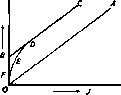
Fechner changed the initial formula and gave it the form represented by the following expression: K = ΔE = k(ΔJ / (J+a)) (2a).
In this case, the straight line BC, depicted in the figure, is obtained. At the threshold of stimulation, when J=0, one does not have in this case ΔJ=0, as in the previous formula (1), but one finds the threshold ΔJ equal to ΔJ=Ka. In the figure, ΔJ, corresponding to zero initial stimulation (J=0), is represented by the segment ΔJ BO. However, in this case as well, agreement of theory with experience is not obtained, because, at low brightnesses, for ΔJ and J one obtains a complex dependence (as König showed for vision), expressed by the curve FEDC, which, as Helmholtz discovered, can be obtained theoretically in the form of a complex expression, in the form of an infinite series, if one assumes that the sensation created by individual elements on the surface of the retina is summed and if one assumes that the intrinsic light of the retina a, which represents a light sensation in the absence of external light, is distributed over the fundus of the retina in spots. The curve FEDC, found by König, fit perfectly into the approximate formula of Helmholtz, representing a hyperbola. Further experiments by Lazarev confirmed all of Helmholtz's assumptions. It was discovered that within the limits of the yellow spot there is a summation of sensations of individual elements and that the intrinsic light of the retina is indeed distributed in spots. For the periphery of the retina, the law obtained is even more complex than Helmholtz's law, because one has to take into account the phenomena of stimulation not only of cones, but also of rods (Lazarev). Finally, the initial formulation of Fechner's law can be replaced by a formulation in which one can connect the number of stimulated nerve fibers N and the increase of this number ΔN, necessary for obtaining a just-noticeable sensation. The formula has the following form: ΔN/N = k = Const (3). In this case, one can obtain not only the initial form of Fechner's law (1), if one assumes that nerves act according to the "all-or-nothing" law, but also derive the complex formulas proposed by Helmholtz. Finally, one can apply Fechner's law in this form not only to visual and auditory sensations, when determining the intensity of light and sound, but also extend it to spatial relationships, by applying this law to the measurements of lines, areas, etc. In this last form (3), Fechner's law is a general principle which governs the phenomena of stimulation, and from it one can derive the laws of Loeb, the law of Nernst, and all the laws of the ionic theory of excitation. Thus, the simple-in-form Fechner's law, which does not give a clear definition of what should be called a stimulus, receives at the present time a more rigorous form, and with this precise formulation, Fechner's law is a general law governing both threshold and supra-threshold stimulations. Fechner's law has been repeatedly applied in fields of science far removed from the field in which it was first applied by him. Measurements by Pfeffer showed that the movement of bacteria sensitive to external influences follows this law, as Mechnikov noted. Furthermore, Fechner's law was applied to questions of economics (Edgeworth, Lazarev). Finally, the connection of the Weber-Fechner law with the "all-or-nothing" law forces one to recognize that the phenomena of excitation of not only nerves, muscles, and sense organs follow this law, but also that all organs of excretion and glands of internal secretion must also follow Fechner's law in form (3), while at the same time obeying the "all-or-nothing" law.
Related articles
Mentioned in
Cite this page
“Weber-Fechner Law.” Soviet Medical Encyclopedia. English translation of Bolshaya Meditsinskaya Entsiklopediya, 1st ed. (Moscow, 1928–1936), ed. N. A. Semashko. https://sovietmedicalencyclopedia.pages.dev/article/weber-fechner-law/