Taste
Historical document, translated for reference. It reflects medical knowledge of the 1920s–30s and is not medical advice.
Summary
This article from the 1930s details the physiology of taste, identifying four primary sensations—bitter, sweet, salty, and sour—and their corresponding receptors on the tongue. It discusses the ionic theory of taste excitation, the synthesis of complex tastes, and the interaction between taste and smell.
Encyclopedia article (1928–1936)
TASTE. Taste phenomena are connected, mainly, with the surface of the tongue; precise investigations show that taste sensations depend on the irritation of nerve endings in the vallate papillae and in the fungiform papillae of the tongue. The lateral part of the soft palate, its posterior surface, the posterior wall of the pharynx, and the surface of the epiglottis also provide taste sensations. The areas that perceive taste are innervated by the nerves: nn. lingualis and glosso-pharyngeus. Precise investigation of the localization of taste sensations shows that the surfaces in which different tastes are perceived do not coincide exactly with one another. Thus, there are parts where only the sensation of bitter, only sweet, only salty, or only sour taste is observed. This circumstance shows that there exist four primary taste sensations—bitter, sweet, salty, and sour—from the combination of which all those taste sensations that are obtained from the external world are composed. The same fact can be established more precisely if individual fungiform papillae of the tongue are irritated with microscopic electrodes. Such irritation shows that there are papillae which, upon electrical irritation, give a sensation of only bitter taste, others—only sour, third—only sweet, and fourth—only salty taste. Finally, studies of pathological phenomena also lead to the conclusion that there are four primary sensations. Thus, it should be expected that the irritation of the 4 types of papillae with varying intensity should give the sensation of all the diverse tastes that exist in the external world. To imagine how this can occur, one must assume, as is done in the ionic theory of excitation, that in the 4 types of tongue papillae there are embedded special sensitive substances in which, upon the action of taste substances, a chemical reaction occurs with the release of ions. One of these substances reacts under the influence of all those substances that have a sour taste. It is natural to assume that such a substance must react under the influence of hydrogen ions, which are characteristic of every acid; from this, one can conclude that when hydrogen ions are present in the same quantity in the medium, the sensation of the degree of sour taste in all these cases will be the same. This circumstance is confirmed by precise experiments and thus serves as a confirmation of the above-mentioned assumption. Not only all acids, in which there are free hydrogen ions, but also all those substances in which hydrogen ions are encountered, give the sensation of a sour taste (e.g., acid salts, etc.). The second substance decomposes under the influence of substances having a sweet taste sensation, e.g., under the influence of sugar, and such decomposition can be produced by a whole range of different substances that belong to different classes of organic and inorganic chemistry. It is known that various types of sugar appear sweet, and then some lead salts also appear sweet. Thus, it can hardly be asserted that exclusively the similarity of chemical structure can lead to sensations of the same taste. The absence of similarity in the structure of substances does not serve as a basis for the sensations they provide not being identical. The third substance reacts, mainly, to bitter substances belonging to the group of alkaloids. Finally, the fourth group includes substances that give a salty taste and react with table salt and a whole range of other salts. To make it clear how one can imagine that substances of diverse classes can give sensations of different tastes, one can take a simple example from chemistry. Let us imagine that we have 4 substances enclosed in 4 apparatuses that possess the following properties. Let there be substance A in the first apparatus, substance B in the second apparatus, C in the third, and D in the fourth. If one takes specific reagents that can distinguish these individual substances from one another, one can notice that there are substances that act only on A, only on B, only on C, or D; then there are substances that act on substances A and B, A and C, B and C, etc. A number of other substances cause reaction phenomena in three substances sensitive to taste at once, e.g., A, B, and C; A, B, and D, etc. Finally, there are cases when all sensitive substances A, B, C, D are reacting with the applied taste substance, and, thus, a model of those processes that are in the taste apparatus is obtained. The action of some taste substance can, thus, either be limited to the action on one of the above-mentioned substances sensitive to taste, or this action can extend to 2, to 3, to 4, and accordingly, either simple tastes, which correspond to only one type of papillae, or combined ones, in which 2, 3, or 4 types of sensitive papillae are irritated, are obtained. Consequently, there is a certain analogy here with the phenomena of color vision, where, according to Helmholtz, there exist three types of nerves irritated predominantly by red, green, or violet rays. The difference between taste and vision lies in the fact that, instead of three elementary primary substances, here there are four; consequently, if in the case of vision the task of geometric interpretation of visual sensations reduces to finding certain points in a three-dimensional space, where each point is characterized by three coordinates corresponding to the sensations of red, green, and violet color, then for taste sensations one is dealing with a four-dimensional space in which one has to construct corresponding points characterizing the sensations. Substances that give almost pure, non-combined sensations include diluted acids, which give a sour taste, quinine solutions, which give a bitter taste, table salt solutions, which give a salty taste, and sugar solutions, which give a sensation of sweet. The action of one of the primary stimuli on the tongue causes the decomposition of the corresponding sensitive substances; after these substances have decomposed, the tongue becomes less sensitive to these sensations, and the restoration of sensitivity after strong fatigue is expressed for each of the corresponding simple stimuli by the following formula: E = E0(1-e-at). E is the sensitivity at moment t; E0 and a are constants, e is the base of Naperian logarithms. The above-mentioned equation is completely identical to the equations that are obtained during the restoration of the sensitivity of the auditory apparatus or the visual apparatus after the impact of strong sound and light stimuli. Thus, from the external, kinetic side, the processes of restoration of taste sensitivity, the phenomenon of taste adaptation, completely correspond to the processes of fatigue of vision or hearing. If, for example, one fatigues the papillae that perceive sweet taste by the action of sugar, then the sensitivity regarding bitter, sour, or salty taste does not change in the tongue, and, therefore, it must be considered that the taste substance caused a change only in one type of papillae, i.e., it is a simple stimulus. If one uses some sweet substances, e.g., saccharin, it can be shown that, along with the decomposition of sensitive substances giving the sensation of sweet taste, decomposition also occurs in substances perceiving bitter taste; therefore, upon the action of saccharin, a special aftertaste is obtained, which is characteristic of this substance. An interesting circumstance is that the ability of a substance to act in an exciting manner on the corresponding papillae is connected with its ionization; this confirms the general view on the connection between taste processes and the emergence of ions, which must irritate the endings of the taste nerves. The study of taste processes and their analysis lead to the inverse problem, to the problem of the synthesis of taste sensations, which reduces to the following. Let us assume that there are 4 primary stimuli, each acting only on one type of the above-mentioned papillae and giving, therefore, simple non-combined sensations. If one mixes together a certain amount of solutions of sugar, quinine, table salt, and any diluted acid, one can select the concentration of these substances such that the degree of decomposition of sensitive substances in the various papillae of the tongue will correspond to the irritation that is caused by some natural or artificially prepared substance possessing a complex taste. Thus, one can find a series of concentrations of primary stimuli that together will give sensations identical to the complex taste caused by a certain chemical substance or complex of substances. Similar experiments were conducted in Moscow, at the Institute of Biological Physics, where a number of such combinations of primary stimuli were selected that were quite similar in their taste to the taste given by complex substances. As substances giving a certain complex taste in the tongue, tea, coffee, fruit juices, and a whole range of other solutions were taken. Here it must be noted that, as is always the case with taste phenomena, taste sensations are combined with olfactory sensations, and if one wants the experiments of taste synthesis to be sufficiently accurate, it is necessary to eliminate olfactory sensations by plugging the nose.
Finally, one of the curious phenomena is the following: it is possible, by combining 4 types of primary stimuli, to obtain a substance which, in terms of taste, would be indifferent and would produce the taste of distilled water. This corresponds to obtaining white color in vision. Such an experiment was also repeatedly performed at the Institute of Biological Physics; its results fully confirmed the theoretical concepts. Until now, we have been talking exclusively about such a category of taste sensations where there were no side effects of taste substances. To such effects, one must attribute the sensations of tart and astringent taste, which cause irritation not only of the taste nerves of the tongue but also of a whole series of other nerves; the same applies to the sensation of burning, etc., which is caused by a number of substances. All these phenomena do not directly relate to taste and should be considered as combinations of taste sensations and irritation of other nerves of the tongue. In addition to the quantitative theory of taste mentioned above (Lazarev), which appeared earlier than the others, it should be noted that there are also other theoretical concepts about taste processes; first of all, one should point out the interesting views of Renkvist, who considers the taste obtained from hydrogen peroxide as a special chemical process. If one assumes that the free energy of a chemical reaction can be considered as a stimulus, one can arrive at a number of quantitative conclusions consistent with experience. The results of these views of Renkvist, however, largely coincide with the results derived from the ionic theory of excitation. Particularly important and new in Renkvist's research is the role of adsorption indicated by him, which, undoubtedly, can be of enormous importance in taste processes. Therefore, according to Renkvist's theory, the speed of adsorption of a taste substance in the substances of sensitive cells takes on a special role. There are studies that indeed reveal a parallelism in adsorption phenomena and in taste. To verify his views, Renkvist derived a formula allowing one to determine the time during which a taste sensation continues. As experimental studies show, sufficiently good results are obtained, consistent with the theoretical ones. Based on his experiments, Renkvist gives a number of practical rules allowing one to determine taste. If both ions into which a salt dissociates have a high and similar transport speed, the salts have a bitter taste. If the transport speed of the cation is less than that of the anion, then a salty taste is obtained. If the transport speed of the cation is greater than that of the anion, then a sour taste is felt. Thus, in Renkvist's concepts,, first, adsorption and, second, the formation of potential differences during the action of electrolytes and the speed of ion transport are of importance.
P. Lazarev.
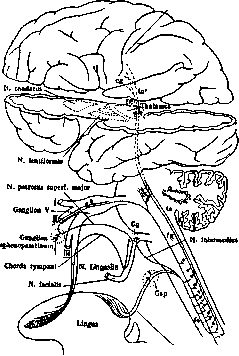
Taste conduction pathways. The conductors of taste sensations are the glossopharyngeal nerve and the chorda tympani, which initially runs in the lingual nerve of the trigeminal nerve, and then passes into the intermediate nerve of Wrisberg. The glossopharyngeal nerve originates, mainly, in the cells of the nodose ganglion and the jugular ganglion, located near the jugular foramen. The peripheral processes of these cells end in the mucous membrane of the posterior third of the tongue and the soft palate; this area is very rich in specific taste organs—circumvallate papillae; on the lateral surface of the tongue are located the foliate papillae, due to which these areas possess the greatest taste sensitivity. The central processes of these cells are directed to the medulla oblongata and enter it with several rootlets through the retro-olivary fissure. In the medulla oblongata, they are directed backward and, without reaching the floor of the fourth ventricle, in the internal parts of the restiform body begin to descend downward, forming the so-called solitary fasciculus, which is lost in the cervical segments of the spinal cord. The second conductor of taste sensations—the chorda tympani—is formed by the peripheral processes of the cells of the geniculate ganglion of the facial nerve, located in the Fallopian canal; through the petrotympanic (Glaserian) fissure, the chorda tympani exits the canal, is directed at an acute angle downward and forward, enters the lingual nerve of the trigeminal nerve, and together with it ends in the anterior two-thirds and partly in the lateral surfaces of the tongue; the anterior part of the tongue is very poor in taste organs. The chorda tympani is formed by centripetal fibers carrying taste sensations to the centers. The central processes of the cells of the geniculate ganglion form the intermediate nerve of Wrisberg, which enters the brainstem together with the facial and acoustic nerves in the cerebellopontine angle, turns downward, and enters the composition of the solitary fasciculus. Thus, the solitary fasciculus is the conductor of all taste sensations. It can be said, in general, that the question of the course of taste fibers remains controversial; there are several views, and in favor of each there is clinical evidence; there is especially much disagreement regarding the second conductor of taste sensations. The most common opinions are as follows: the taste fibers of the chorda tympani go from the geniculate ganglion to the brain not through the nerve of Wrisberg, but 1) through the second branch of the trigeminal nerve, into which they pass through the superficial petrosal nerve and the sphenopalatine ganglion, 2) these fibers go into the third branch of the trigeminal nerve, 3) the fibers of the chorda tympani upon exiting the geniculate ganglion go into the glossopharyngeal nerve, which innervates the entire surface of the tongue, 4) the fibers from the posterior third of the tongue pass from the ninth nerve into the trigeminal nerve. Taste fibers passing in the solitary fasciculus gradually end in the nucleus surrounding it—the terminal nucleus; from the cells of this nucleus originates the second sensory neuron for taste sensations. Upon exiting the nucleus, the fibers decussate and are placed in the reticular substance, behind and medial to the medial lemniscus, then merge with it and go together to the optic thalamus; part of the fibers remains on its own side and goes into the homonymous medial lemniscus. Some authors admit, besides this pathway, a second pathway going in the posterior part of the reticular formation of its own and the opposite side. In the optic thalamus, all these fibers end in its ventral and medial nuclei. From the optic thalamus begins the third, or central, neuron carrying taste sensations; it is not yet exactly known where it passes; there is a hypothesis about its passage through the posterior third of the posterior limb of the internal capsule in the so-called sensory crossroads of Charcot. Also controversial remains the place of termination of the taste fibers; according to some data—in the operculum, where the sensory fibers of the fifth and tenth nerves end; according to other data—in the hippocampal gyrus and Ammon's horn, in the vicinity of the olfactory center. As for the center of taste representations, it must lie somewhere in the vicinity of the center of taste perception. Clinical data rather confirm the first hypothesis about the localization of the taste center. Examination of taste. Various kinds of taste sensations are perceived unequally in different parts of the tongue: bitter—in the posterior third, sweet—at the tip, postcentral gyrus.
Glossopharyngeal nerve
Taste conduction pathways: eg—cortical taste center; fg—central ascending taste pathway in the medial lemniscus; dl—subcortical taste pathway; is—solitary fasciculus; Gg—geniculate ganglion; Gsp—superior jugular and petrosal ganglion of the glossopharyngeal nerve; ia—central ascending fibers of the trigeminal nerve in the medial lemniscus; la1—subcortical connection of the thalamus with the posterior central gyrus; I—ophthalmic nerve; II—maxillary nerve; III—mandibular nerve (according to Bekhterev). Sour—along the lateral surfaces; salty—in the posterior third and along the lateral surfaces. The examination is performed as follows: the patient is asked to stick out their tongue, and with the help of a pipette, a drop of one or another solution is placed on one or another part of the tongue; the patient must determine to which category of taste sensations the given solution belongs; the patient and the doctor agree that the patient will communicate with the doctor using signs or by pointing with a finger to slips of paper with the names of the aforementioned substances, but not speak, so as not to make a swallowing movement and thereby cause the drop to spread over the tongue and in the oral cavity; before testing with each new taste substance, the mouth must be rinsed thoroughly. Instead of solutions, taste can be tested with a galvanic current: a sensation of salty is obtained at the cathode and sour at the anode. Taste disorders can be of a subjective and objective nature. The former include various kinds of taste paresthesias arising without corresponding stimuli, parageusia, as well as perversion of taste, when patients eat various substances that cause disgust in healthy people. Objective taste disorders are observed either in the form of increased taste irritability—taste hyperesthesia (hypergeusia), or a decrease, or complete absence of taste sensations—taste hypesthesia or anesthesia (hypogeusia or ageusia). Disturbance of taste sensations is observed in various diseases of one of the sections of the taste conduction pathway, starting from the tongue to the taste centers: in various diseases of the tongue, in polyneuritis involving cranial nerves (often in diphtheritic ones); in various processes (hemorrhages, softening, neoplasms, etc.) in the brainstem, in the internal capsule, and in the cortex. It is often encountered in tabes, especially on the anterior third of the tongue.
E.
Kononova.
Related articles
Cite this page
“Taste.” Soviet Medical Encyclopedia. English translation of Bolshaya Meditsinskaya Entsiklopediya, 1st ed. (Moscow, 1928–1936), ed. N. A. Semashko. https://sovietmedicalencyclopedia.pages.dev/article/taste/