Oxygen
Historical document, translated for reference. It reflects medical knowledge of the 1920s–30s and is not medical advice.
Summary
An overview of oxygen as a chemical element, its discovery, physical and chemical properties, and its vital role in biological respiration and industrial applications. The article details its occurrence in nature, methods of laboratory and technical production, and its physiological effects on the human body.
Encyclopedia article (1928–1936)
OXYGEN, the lightest element of group VI of the Mendeleev periodic system, symbol O, atomic number 8. Oxygen is a gas without color, odor, or taste. It has no isotopes. Atomic weight—16.000, molecular weight—32.000. The specific gravity of oxygen relative to air is 1.10535; at 0° and 760 mm pressure, 1 liter of oxygen weighs 1.4292. In 100 volumes of water at 15°, 3.4 volumes of oxygen dissolve. The discovery of oxygen is attributed to Priestley, who obtained it by the decomposition of mercuric oxide upon heating (1774), and Scheele, who isolated (1771) oxygen from a whole series of substances: from saltpeter, manganese dioxide, etc., but published his works only in 1777. There are indications that oxygen was known earlier, starting from the 8th century. The elementary nature of oxygen was established at the end of the 18th century by Lavoisier. Of all the elements, oxygen is the most abundant on the globe; oxygen accounts for almost 50% of all investigated terrestrial matter. In pure air, oxygen is 20.94% by volume (consequently, the total supply of oxygen in the air is about 13 !5 1014 tons); in water, oxygen accounts for 88.81%; in the substances constituting the earth's crust, oxygen averages 47%; in plants about 40%, in animals up to 20%, not counting the water contained in them. In laboratories, oxygen is usually obtained by heating potassium chlorate (KClO3), which ultimately decomposes according to the equation: KClO3 = KCl + 3O; but since the intermediate product in this reaction is the potassium salt of perchloric acid (KClO4) (according to the equation: 2KClO3 = KClO4 + KCl + O2), which requires a higher temperature for decomposition, manganese dioxide (1/4 by weight) is added to KClO3 to accelerate this decomposition and to lower the temperature, acting as a catalyst. In industry, oxygen is obtained from liquid air through the preliminary evaporation of nitrogen from it (boiling point -195.7°). Liquid oxygen obtained in this way contains about 96% pure oxygen. Such oxygen is usually pumped into steel cylinders under a pressure of 100–150 atmospheres and sold in this form. Oxygen from cylinders is impure: it usually contains water vapor, CO2, and sometimes chlorine; it is purified from these impurities by passing it through an alkali solution, through water, and further drying. Liquid oxygen was first obtained by Wroblewski. The boiling point of liquid oxygen is -182.9°; critical temperature -118°, critical pressure 50 atmospheres. Liquid oxygen is pale blue in color, strongly magnetic, specific gravity 0.6. In liquid hydrogen, oxygen solidifies into an icy mass of pale blue color. Oxygen is usually only divalent and forms an ion with two negative charges O''. Oxygen combines directly with all elements except noble gases, halogens, silver, gold, and platinum. Of the common metals, potassium, sodium, barium, and calcium oxidize directly and rapidly at ordinary temperatures; magnesium, aluminum, and zinc oxidize slowly; iron and tin oxidize (burn) upon preliminary incandescence; lead, copper, and (more difficultly) mercury combine with oxygen only at high temperatures. The reaction of metals combining with oxygen is accelerated in the presence of moisture; for example, wet iron oxidizes (rusts) even at ordinary temperatures. The energy for combining with oxygen in non-metals falls in the following order: P, H, B, Si, C, S, N, and halogens. A mixture of 2 volumes of hydrogen and 1 volume of oxygen explodes upon ignition, which is why it is called detonating gas. Compounds of elements with oxygen are called oxides. Oxides are formed according to the following typical formulas: R2O, R2O2, R2O3, R2O4, R2O5, R2O6, R2O7, and R2O8 (R denotes one atom of the element). Some elements combine with oxygen in different weight ratios, and then the oxides are distinguished by calling them suboxide, protoxide, oxide, peroxide, etc. Oxygen can also react with complex substances, forming various oxidation products. The vast majority of oxidation reactions proceed with the release of thermal energy, in some cases with a flame (combustion); the fastest oxidation processes are accompanied by explosions. In slow oxidation, the process occurs without incandescence. But if during slow oxidation the released heat is not dissipated, it can accumulate so much over time that the process will accelerate by itself, i.e., turn into combustion, and then spontaneous combustion will occur. Such a process can be observed, for example, in smoldering oily rags lying in a pile, in ricks and stacks of insufficiently dried hay, or in the coal bunkers of ships. Slow oxidation reactions include smoldering and rusting; the oxidative processes of the organism also belong here. Oxygen is an element necessary for the life of plants and animals. In the latter, oxygen enters the blood through the lungs during the process of respiration and, combining with hemoglobin, is delivered by the bloodstream to the cells of the body, where it is used for the oxidation of their constituent parts. This oxidation is the main source for the development of kinetic energy necessary for the vital activity of the organism (see Gas exchange, Respiration, Metabolism). The loss of oxygen in nature, occurring due to numerous oxidation processes, is replenished by plants, which absorb carbon dioxide and, with the participation of chlorophyll and solar energy, decompose it and release free oxygen. In the analysis of gas mixtures, oxygen is absorbed either by phosphorus or by an alkaline solution of pyrogallol. In the analysis of oxygen-containing organic compounds, oxygen is determined by the difference between the weight of the substance and the sum of the weights of the other elements included in it. Oxygen is used in the combustion of gases to obtain high temperatures (autogenous welding). Oxygen is used to obtain various oxides and for the oxidation of complex substances. Prolonged inhalation of pure oxygen leads to inflammation of the mucous membranes of the respiratory tract and other pathological changes in the body. Oxygen possesses antiseptic properties, which is why substances that easily release it are used as antiseptics (hydrogen peroxide H2O2, potassium permanganate KMnO4, chromic acid CrO3, osmic acid OsO4, etc.). An allotropic modification of oxygen (O2) is ozone (O3) (see Air), which, like oxygen, possesses oxidative properties, but with the difference that ozone, as a substance with a large supply of internal energy (formed endothermically), easily decomposes and is a stronger oxidizing agent than oxygen; when inhaled, it strongly irritates the mucous membranes, causes coughing, and produces a hypnotic-narcotic effect. Ozone is used for the sterilization of water and air, for deodorization, and in industry for bleaching.
A. Reformatsky. Oxygen in therapy. Oxygen has been used as a therapeutic agent since the time of its discovery. Since 1840, it has been applied on scientific grounds. At the present time, it can be considered proven that pure oxygen, inhaled or introduced into the body by other routes, compensates during oxygen starvation for the oxygen consumed in insufficient quantities from the air; moreover, the penetration into the alveoli of even a small amount of pure oxygen raises its fallen alveolar tension, by virtue of which it is actively bound by hemoglobin and simultaneously captured by the plasma. Increased consumption of oxygen enhances the activity of vital processes, neutralizes organic poisons, and promotes their more rapid elimination. Henderson, Haggard, and Coburn proved that adding up to 10% CO2 to oxygen extraordinarily increases the stimulation of the respiratory center and promotes the elimination of gaseous poisons from the body. The indications for the artificial introduction of oxygen into the body are as follows: 1. Mechanical asphyxia due to strangulation, drowning, narrowing, blockage, or compression of the respiratory tract. 2. Oxygen starvation, expressed by severe shortness of breath, suffocation, and cyanosis: a) due to profound disorder of cardiac activity, especially when accompanied by pulmonary edema; upon the introduction of oxygen, a sharp improvement and cessation of suffocation often occur, whereby prolonged maintenance of life is thus possible; b) due to the exclusion of a large respiratory surface in advanced emphysema, compression of the lungs, lobar and diffuse focal pneumonia of various origins, including tuberculosis. 3. Oxygen starvation in severe forms of anemia due to a) large blood losses, b) profound disorder of blood formation. 4. Acute oxygen starvation due to a decrease in atmospheric pressure in the high layers of the atmosphere (with a fall in the partial pressure of oxygen below 150 mm Hg)—mountain sickness, aviators' sickness. The introduction of oxygen often yields brilliant results. 5. Severe forms of external poisoning, especially by blood poisons (such as carbon monoxide, carbon disulfide, potassium chlorate, nitrites, pyrogallol), suffocating gases, alcohol, chloroform, and other narcotic poisons. The introduction of oxygen often gives brilliant results. 6. Various forms of self-poisoning, e.g., in kidney diseases, diabetes mellitus (Gubergrits). 7. Severe forms of general infectious intoxications, especially those based on putrefactive processes, in particular in gangrene of the lungs. 8. In addition, the use of oxygen is indicated for the external treatment of local purulent-putrefactive processes and profound disorders of circulation and tissue nutrition with a tendency toward necrosis, such as gas gangrene, gangrenous bedsores, diabetic gangrene, spontaneous gangrene, burns, frostbite, and long-standing suppurating wounds with sluggish granulations. Oxygen is also used for pneumothorax. 9. Oxygen is introduced into the peritoneal cavity and into the perirenal tissue for the purpose of obtaining light contrasts during X-ray examination of the abdominal organs and kidneys. Methods of oxygen treatment used: Inhalation of oxygen represents the most widespread, but by no means perfect, method of introducing oxygen into the body, even when using increased pressure. For inhalation, the following are usually used: 1. The so-called oxygen pillow—a rubber bag pre-filled (at a pharmacy) with oxygen, equipped with a rubber tube with a tap and a mouthpiece, which is pressed by its edges to the circumference of the mouth opening or held near it. 2. A metal cylinder with a device for manometer-regulated gas flow into a rubber reservoir (bag). 3. The Roth-Dräger apparatus, usually serving for mixed chloroform-oxygen anesthesia. 4. A French portable apparatus (in a small case), equipped with a manometer and a hermetic mask by Nicloux and Legendre (see Artificial Respiration). 5. Dräger's Pulmotor. Patients suffering severely from the sensation of air hunger experience great relief if they receive oxygen for at least 5 minutes every 10–15–30 minutes. 6. Special chambers with the desired oxygen content and proper ventilation, where patients are placed for a longer time. In asphyxia with cessation of respiratory movements and loss of consciousness, oxygen is introduced into the respiratory tract simultaneously with artificial respiration during the inhalation phase; in cases of obstruction of the upper respiratory tract, oxygen is introduced after a preliminary tracheotomy or else subcutaneously or intravenously (see below). Insufflation of oxygen is used mainly in purulent-putrefactive and ulcerative processes in cavities and in hollow and tubular organs. It is more expedient to open the pleural cavity, peritoneum, or joints in two places so
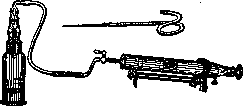
Figure 1.
that one opening serves for the best drainage of the infected discharge, and the other for the introduction of oxygen through a thin catheter. Insufflation of oxygen into the bladder, uterus, and large intestines is performed through natural openings, also with the help of a thin catheter. Oxygen should enter under low pressure at a rate of 50 cm3 per minute, but for a long period of time; the tube with a tap for conducting oxygen from the reservoir is connected to the catheter. It is more convenient to use the small Lian and Navarre apparatus, which makes it possible to measure the quantity and pressure of oxygen (see below). Immersion in hermetically fitted rubber bags, glass vessels (see Cupping glasses), or wooden boxes with oxygen is used for local external action on individual affected areas, for example, limbs. The result of the action of oxygen in this form is manifested by a sharp reduction in pain, cleansing of the wound surface, improvement and even restoration of blood circulation and the viability of the affected tissues. The external application of oxygen-releasing solutions, especially potassium permanganate (KMnO4), in the form of swabbing, compresses, local and even general baths, has a very favorable effect, especially pronounced when using strong, saturated (1:16) solutions in various inflammatory, purulent, necrotic, and putrefactive processes (in cases of noma, severe burns, bedsores, etc.). Introduction of oxygen through the digestive canal: in the form of ozonized water or in tablets containing H2O2, for putrefactive decomposition in the stomach and putrefactive intestinal dyspepsias, and to suppress fermentative and putrefactive processes in the large intestines, as indicated, by insufflation through the rectum (A. Schmidt). Subcutaneous introduction of oxygen in urgent cases, in asphyxia of mechanical origin, as well as in oxygen starvation based on respiratory and circulatory disorders, and also in intoxications, proves to be the most effective and easily performed method, although it has not yet
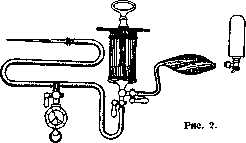
found wide application. Most simply, oxygen is introduced from a rubber bag through a rubber tube equipped with a needle of a fairly large caliber, as for saline infusions. But it is more expedient to use the Agasse-Lafont and Dury apparatus (Fig. 1; oxygen is obtained in a glass vessel from various chemical products) or the Lian apparatus, which is constructed as follows: a small cylinder with an outlet tube and tap, containing oxygen, is attached to a rubber bulb with a rubber tube, which is connected to the side port of a glass syringe (having a nozzle with 2 ports and taps); a rubber tube is placed on the main port of the syringe, the outer end of which is connected by means of a glass T-shaped tube to a small manometer and a rubber tube with a needle for subcutaneous or intravenous introduction of oxygen (Fig. 2). Oxygen is introduced, like physiological saline, into the fatty tissue of the thigh or abdomen, preferably into the space between the fatty layer and the aponeurosis. The introduced oxygen forms a visible swelling in the corresponding area, which upon palpation gives the usual sensation of subcutaneous emphysema. Individual bubbles of oxygen appear under the epidermis. At one time, oxygen is introduced
in an amount of about 500 cm3, but in severe asphyxia, it is possible to introduce several liters without the slightest harm. In chronic oxygen starvation based on anemia, treatment is carried out in series of 20 injections 3 times a week in a dose of about 75–100 cm3. Intravenous introduction of oxygen, proposed by Gärtner as an extreme measure in severe heart failure, is also used in urgent cases during the cessation of respiratory movements and especially dangerous poisonings. With slow introduction under low pressure (10–100 cm3 in 1 min., and in total 200–300 cm3), oxygen is entirely bound by the blood (Stürtz); gas emboli do not form. Injections are made using a sterilized Lian apparatus. To avoid infection, the introduced oxygen is washed by passing it through a two-necked bottle with distilled water and a disinfectant solution. A special place in the therapeutic use of oxygen is occupied by oxygen baths (see).
Related articles
Cite this page
“Oxygen.” Soviet Medical Encyclopedia. English translation of Bolshaya Meditsinskaya Entsiklopediya, 1st ed. (Moscow, 1928–1936), ed. N. A. Semashko. https://sovietmedicalencyclopedia.pages.dev/article/oxygen/