Hydromechanics
Historical document, translated for reference. It reflects medical knowledge of the 1920s–30s and is not medical advice.
Summary
An overview of hydromechanics from the 1930s Soviet medical encyclopedia, covering hydrostatics, fluid equilibrium, Archimedes' principle, and their applications in biological and laboratory centrifugation.
Encyclopedia article (1928–1936)
HYDROMECHANICS, a branch of mechanics concerned with the study of the equilibrium and motion of liquids. The first problem is considered in hydrostatics, the second in hydrodynamics. Hydrostatics is the doctrine of the equilibrium of liquids, which must be conceived as substances whose individual particles, or molecules, are easily movable and at the same time are bound by mutual attractive forces to such an extent that they are held near each other and do not fly apart into the surrounding space like gas molecules. In contrast to a solid body, which tends to preserve not only its volume but also its shape, liquids preserve only their volume, taking the shape of the vessel into which the liquid is poured. If a liquid is in equilibrium in a resting vessel, the surface separating the liquid from the air appears as a horizontal surface, depending on the mobility of the particles. Indeed, if one imagines that an inclined surface has formed in the vessel (as seen in Fig. 1), the force of gravity g acting vertically on a molecule M can be resolved into two components: one directed along the normal n to the surface of the liquid and tending to compress the liquid (this force is counteracted by the resistance of the liquid itself, which is a substance of low compressibility), and another acting tangentially to the liquid surface and causing particle M to slide along the free surface, the liquid assuming a state of equilibrium only if this component is zero. If a liquid is in a space where it is acted upon only by the forces of mutual attraction of the particles, in this case the free surface of the liquid will form a sphere (see Figure 2), since all attraction will be directed inward toward the center of the sphere, and on the surface of the sphere there

Fig. 1,

Figure 2. fe ~"~ Figure 3. will be no tangential force component. If instead of a single liquid one imagines a series of liquids of different density arranged between concentric spherical surfaces, a figure of equilibrium will also be obtained. If a liquid poured into a vessel begins to rotate about the axis of the vessel in the earth's gravitational field, additional forces acting on its surface are produced, as seen in Fig. 3, depending on the centrifugal force (force f). In this case, a surface differing from a flat one is obtained, which, as calculations show, appears as a paraboloid of revolution. If some solid body is placed into a liquid, the liquid exerts an effect on this solid body that can be easily visualized in the following manner: suppose that at a certain moment in a resting liquid (see Figure 4) a certain volume adbc is bounded, having the shape of the solid body to be immersed in the liquid. Since the liquid is at rest and its individual particles do not move within the
liquid, one can imagine that the given volume has solidified. This will not change the equilibrium of the liquid. A force of gravity G will act vertically downward on this volume, equal to the weight of the liquid contained within the volume of the given body, and since it is assumed that the liquid does not change density upon solidification, it is clear that the existence of fluid equilibrium proves that there is pressure from the liquid on all parts of the surface of the immersed body, balancing the force G which tends to make the body abcd move downward. Consequently, the pressure on the surface of the body abcd must equal the weight of the liquid in the volume of the body and must be directed upward, being applied to the center of gravity of the immersed body (force P). If the solid body having the density of the liquid is replaced by any solid body having the exact same geometric shape and placed in the same location in the liquid, the conditions of pressure from the liquid on the body will not change, and therefore two forces will act on the solid body: one force acts in the downward direction and is applied to the center of gravity of the immersed body, and in the case of a non-homogeneous body the point to which the resultant is applied may not coincide with the center of gravity of the displaced volume of liquid; the other force is directed upward and equals the weight of the displaced volume of liquid; this force is applied to the center of gravity of the immersed body if this body is homogeneous. Depending on which of these forces is greater, we have either sinking to the bottom in the case where the weight of the body is greater than the weight of sh sh $sh ME( Figure 4. of the displaced liquid, or indifferent equilibrium is observed if these two forces are equal; finally, the body may float upward if its weight is less than the weight of the displaced liquid. This constitutes Archimedes' principle, which is the basis for all specific gravity or density measurements of bodies. This principle is of enormous significance for the swimming of animals in an aquatic environment. Archimedes' law has extensive application in laboratory practice. Let there be a certain volume containing a mass M, and let the mass of the liquid of equal volume have a magnitude m, where m is either greater than, equal to, or less than M. If under normal conditions the liquid is acted upon by gravity, then the difference between the forces acting downward and upward equals the difference between the masses M and m multiplied by the acceleration of gravity g: (M - m)g. If the difference in mass is insignificant, the force of gravity acting under normal conditions can produce a resultant so small that the particles of the liquid and the body suspended in it can remain in relative equilibrium within the liquid, and the thermal motions performed by the liquid molecules will be sufficient to prevent heavier particles from settling to the bottom and lighter ones from floating to the surface. If one imagines that it is possible by some means to increase the force acting on the liquid and the suspended particles, these particles can be forced to fall to the bottom, and upon this principle rests the use of centrifuge machines, which produce a significant force exceeding the magnitude of gravity, causing heavier particles to settle and lighter ones to float. This is the principle behind obtaining cream from milk, as well as the centrifugation of physiological fluids: blood to obtain serum, and urine to obtain sediments from it. If some surface is placed in a liquid (see Figure 4), the pressure on the surface from below and above will be the same if the liquid is at rest. Since one can imagine the liquid as a solidified column above this surface, the pressure of the liquid on this surface equals the liquid column which has a base equal to area MM and a height h extending to the liquid surface. If a liquid is poured into two communicating vessels M and N (see Figure 5), the liquid level lies on the same horizontal plane AB in ob
vessels, and this does not depend on the width of the vessel, provided the vessel is not too narrow and capillary forces do not come into play (see capillarity). If we pour some other liquids of different density on both sides above the surface of one liquid (for example, mercury), then for equilibrium it is necessary that the weight of the vertical column per square centimeter on the left and right be the same or that h/l = hd, where h and l are heights, and h and d are the densities of the liquids. This makes it possible to determine the densities of liquids. If we place piston A above the liquid in a wide vessel (see Figure 6) and place a certain load P on it, we can hold it with another load Q applied to the small piston B. Since the quotient obtained by dividing the load by the surface area for both sides must be equal, the load Q will be many times smaller than the load P. Thus, by means of a small pressure acting on a small surface, an enormous pressure can be created on a surface of considerable size. The application of hydraulic presses is based on this, wherein water is pumped directly by hand with a small pump into a narrow tube, and the pressure is transmitted to a large surface which is thousands of times larger than the surface of the pumping piston. Then the pressure on this large surface increases thousands of times, and significant pressures can thus be obtained. Hydrodynamics is the study of the motion of liquids. If we have a liquid in which the pressure in different places becomes different, the liquid cannot remain at rest and begins to move in the direction where the pressure is lower; thus, for example, if we take vessel A, into which a side tube is inserted, closed at end a with a stopper and having a series of manometers m (as seen in Fig. 7), then in the resting state, in the absence of outflow, the liquid poured into the vessel will be at the same height both in the vessel itself and in the manometers. If we open orifice a of the tube (see Figure 8), the liquid will begin to flow out in the form of a jet, and the pressure of the outflowing jet becomes equal to the external pressure, and, thus, the pressure changes along the tube from the maximum pressure available in the vessel to a pressure equal to zero at the orifice. Thus, it is seen that in a horizontal tube, in which the pressure changes from the surface of the vessel to the outlet orifice, the liquid moves from places where the pressure is greater to places where the pressure is smaller. If we reduce the orifice from which the liquid flows out, then in this case the pressure near the outlet orifice will not be equal to zero; it will increase, and the course of the pressure change will be expressed by the dashed line shown in Fig. 8. With a decrease in the orifice, the amount of
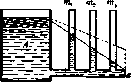
Figure 8.
outflowing liquid will decrease. Thus, it is seen that with a decrease in the amount of outflowing liquid and, consequently, with a decrease in the velocity of the outflowing liquid, the drop in pressure per unit length of the tube, or, as it is called, the pressure gradient, will decrease. If there is a discharge tube not of a single diameter, but this tube is composed of a series of separate parts having different widths, the following pressure distribution will be obtained. In the space of the first narrow tube a inserted into the vessel, there is a rapid drop in pressure. When the liquid passes from the narrow tube a into the wide one b, the velocity of movement of the liquid decreases, and, consequently, the liquid is under a smaller difference in pressures observed along the unit length of this wide tube. The change in pressure is thus associated with a decrease in the velocity of fluid flow. The pressure distribution can be expressed graphically (as shown in Fig. 9). Finally, when
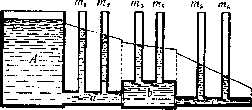
Figure 9.
the liquid enters the narrow tube again, due to the fact that the amount of liquid flowing through the cross-section of the tube per unit time must remain constant, an acceleration of movements and an increase in the pressure difference per unit length of the tube occur once again. A similar scheme has great biological significance, making it possible to understand the phenomena that occur in the circulatory system. Indeed, pressure is maximal in the heart, which is a pump that delivers blood to all parts of the body during its contraction. This pressure drops rapidly along the large arteries right down to the capillaries. The bed of the circulatory system gradually expands, and the velocity of movement drops, which is why the pressure drop, rapid at first, becomes slower and slower. Passing further into the capillaries, which in total have a much greater width than the arterial trunks emerging from the heart, the blood begins to move extremely slowly, and the change in pressures along the capillaries is extremely small. This circumstance has great physiological meaning, since, on the one hand, in the region of the capillaries, the blood delivering nutrients and oxygen would not have time to produce the corresponding exchange with rapid movement, and, on the other hand, sharp large pressure gradients would have an adverse effect on the vessel walls; consequently, in such an arrangement and structure of the vessels there is an adaptation to certain physiological conditions established by nature. Passing further into the veins, the blood begins to move faster, and correspondingly the pressure drop becomes greater. The phenomena change little if, instead of continuous pressure, the pressure is made periodic by causing pulsations. Periodic pressures will change movement only in the sense that the movement will become sharply jerk-like. Such periodicity and jerkiness of movements is reduced to a significant extent if elastic tubes are attached to the pumping heart-pump, which upon pressure increase will expand and thus store liquid. When the pressure in the heart begins to drop, the elastic tubes contract due to elasticity and drive the blood further. There is here, as it were, a special arterial system of pumps. The heart plays a major role in the correct, uniform movement of blood, and the study of this process is one of the most difficult and interesting tasks of hydrodynamics. The principles of blood hydrodynamics are studied by a whole series of instruments with the help of which the movement of blood in animals is investigated. The simplest method consists in making the blood flow through a vessel filled with oil, wherein the volume of this vessel is known, and noting the time (t) during which the oil is replaced by blood. Knowing the volume of oil, one can also find the volume of blood delivered in a certain time by the heart. These are the so-called Ludwig's kymographs, which are used in the study of blood circulation. Furthermore, in the study of blood circulation, manometers are also used, which are tubes filled with mercury, wherein the blood in its flow exerts pressure on the liquids contained in the manometers. A plate held by a spring can be placed in the blood stream passing through a certain tube, and the deflection of the plate, due to the pressure of the moving mass upon it, indicates the velocity of blood flow. For details, see Circulation. P. Lazarev.
Related articles
Cite this page
“Hydromechanics.” Soviet Medical Encyclopedia. English translation of Bolshaya Meditsinskaya Entsiklopediya, 1st ed. (Moscow, 1928–1936), ed. N. A. Semashko. https://sovietmedicalencyclopedia.pages.dev/article/hydromechanics/