Westphal Balance
Historical document, translated for reference. It reflects medical knowledge of the 1920s–30s and is not medical advice.
Summary
The Westphal balance is a laboratory instrument used to determine the specific gravity of liquids based on Archimedes' principle. It utilizes a float and a system of riders on a graduated beam to measure the buoyancy of a liquid, providing a convenient method for density determination in general laboratory practice.
Encyclopedia article (1928–1936)
Westphal balance, serves for the determination of the specific gravity of liquids. They are based on Archimedes' principle, according to which a body, when immersed in a liquid, loses as much weight as the weight of the liquid it displaces. The beam of the Westphal balance (see Figure 1) carries a counterweight at one end, and a float is suspended from the end of the other arm by a thin platinum wire; the float usually represents a small thermometer, which simultaneously indicates the temperature of the liquid being tested. This arm of the beam, between the main axis and the point of suspension of the float, is divided by small notches into 10 equal parts. The balance is equipped with a set of so-called riders, weights in the form of a bent piece of wire. Their weights are in the ratio of 1 : 1/10 : 1/100 : 1/1000, with the weight of the heaviest one being exactly equal to the loss in weight of the float when the latter is immersed in pure water. The float suspended from the balance is balanced in the air by a counterweight; when the float is immersed in a liquid, it

loses weight, and to restore equilibrium, one must place a certain number of riders on the beam of the balance. Since the volume of the float is constant, the loss


in weight is directly proportional to the specific gravity of the liquid in which it is immersed. When it is immersed in water (specific gravity = 1), equilibrium is restored if the rider "1" is placed on the hook of the float suspension. The same rider, placed, for example, on the 6th notch of the beam, will correspond to a specific gravity of 0.6; the next size of rider, 10 times lighter, will determine the second decimal place, and so on. As an example
Figure 2. Position of the riders on the beam at a specific gravity of 0.8535. The figures indicate the relative weight of the riders.
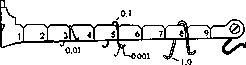
Figure 2 shows the position of the riders at a liquid specific gravity of 0.8535; Figure 3 shows the arrangement at a specific gravity of 1.7353. The figures indicate the relative weight of the riders. When determining specific gravity, the riders are placed starting with the largest, successively moving to the lighter ones and stopping each time at the notch where the given rider does not yet cause the beam to tip past the point of equilibrium. Moving the fourth, lightest rider by one division of the beam causes a just-perceptible change in weight and allows the specific gravity to be determined with an accuracy of 0.0001. The Westphal balance represents an improved modification of the Mohr balance (they are often called Mohr-Westphal balances). In some other modifications, instead of placing riders on the beam, ordinary gram weights are placed on a special pan attached between the float and the beam. The Westphal balance, although inferior in terms of accuracy to the pycnometric method of determining specific gravity, is quite sufficient for ordinary laboratory needs and is very convenient due to its universal applicability for liquids of any density. They are unsuitable for determining the specific gravity of very thick and viscous liquids.
Figure 3. Position of the riders at a specific gravity of 1.7353.
V. Engelhardt.
Related articles
Cite this page
“Westphal Balance.” Soviet Medical Encyclopedia. English translation of Bolshaya Meditsinskaya Entsiklopediya, 1st ed. (Moscow, 1928–1936), ed. N. A. Semashko. https://sovietmedicalencyclopedia.pages.dev/article/westphal-balance/